
Researchers discovered hundreds of fossilized footprints, which were exposed by sediment erosion, during a survey of an ancient lake in Saudi Arabia's Nefud Desert.In among the 376 ancient shapes discovered around Alathar lake, experts identified animal footprints, including prints belonging to horses, camels and elephants — notable because elephants appeared to have gone extinct in the Levant about 400,000 years ago. But more surprisingly, researchers said they discovered seven hominin footprints, which, if confirmed, could be evidence of the earliest dated evidence of the human species in the Arabian Peninsula. "We immediately realized the potential of these findings," Mathew Stewart, one of the study's lead authors from the Max Planck Institute for Chemical Ecology, said in a statement."Footprints are a unique form of fossil evidence in that they provide snapshots in time, typically representing a few hours or days, a resolution we tend not [to] get from other records," he added. Researchers believe that the footprints date to the last interglacial period — a time which saw humid conditions that facilitated human and animal movement across a region which was otherwise comprised of deserts. 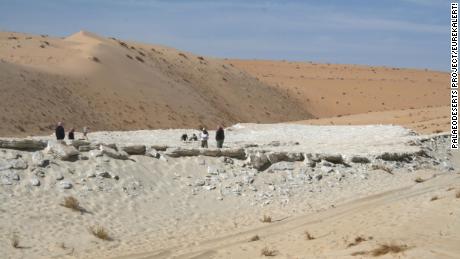 Fossil and archeological records show that these conditions aided human migration from Africa to the Levant, researchers said. "It is only after the last interglacial [period] with the return of cooler conditions that we haRead More – Source
120,000-year-old footprints found in Saudi Arabia — and they might be human

1 min read


Latest from Middle East

BEIRUT, June 12 (Parliament Politics Magazine) – Hezbollah maintains complete confidence that Iran will insist on

GENEVA, June 12 (Parliament Politics Magazine) – A U.S.-Iran peace memorandum to end the ongoing conflict

TEHRAN, June 11 (Parliament Politics Magazine) – Iran’s top joint military command, the Khatam al-Anbiya Central

TYRE, June 11 (Parliament Politics Magazine) – Residents of the historic Christian quarter in the southern

NEW DELHI, June 11 (Parliament Politics Magazine) – India has officially urged the United States to