UK (Parliament Politics Magazine) – A rare waterspout was spotted off the coast of Cyprus following the passage of Storm Byron, which caused heavy rainfall and wind damage across the island. Multiple sources, including Cyprus News Agency and Reuters, reported the storm’s impact, meteorological conditions, and official responses.
Storm Byron’s Passage and Cyprus Weather Disruption
As reported by Anna Georgiou of Cyprus News Agency, Storm Byron swept through Cyprus late on Sunday, bringing heavy rain, strong winds, and localized flooding. The storm caused disruptions in daily life, including power outages and traffic delays. The Cyprus Meteorological Service confirmed that Byron originated as a Mediterranean cyclone, which intensified as it approached the region.
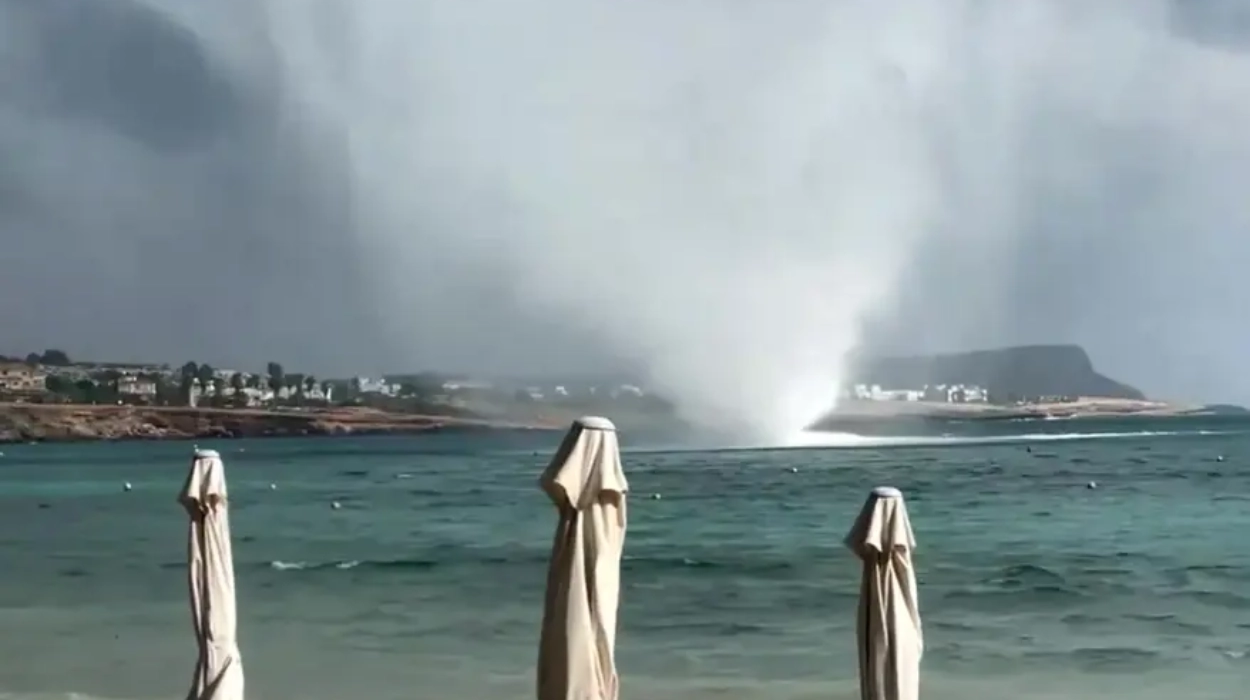
The waterspout a tornado-like column of rotating air and water was observed shortly after the storm’s peak, approximately 5 kilometres off the southern coast near Limassol. As noted by Chris Michaelides from Reuters, the sighting of this waterspout drew significant attention from locals and weather enthusiasts, as these phenomena are relatively uncommon in this area of the Mediterranean.
Details on the Waterspout Incident
According to Maria Ioannou of The Guardian, the waterspout was visible for roughly 10 minutes before dissipating. Coastal residents shared imagery and videos via social media, which were verified by meteorologists. The Cyprus Civil Defence reported that no injuries or damages were linked directly to the waterspout, but officials urged caution for boats and swimmers in affected marine zones.
The Cyprus Department of Meteorology issued a statement via their official Twitter account, highlighted by journalist Andreas Papadopoulos of Cyprus Mail:
“This waterspout formed due to the unstable atmospheric conditions created by Storm Byron’s moist air interacting with cooler sea surface temperatures.”
Storm Byron’s Impact Across Cyprus
Storm Byron resulted in severe weather conditions in various parts of Cyprus. The Ministry of Interior, as reported by Elena Savva in the Cyprus Mail, confirmed that emergency services responded promptly to incidents including fallen trees, flooded streets, and temporary power failures.
Local authorities in Limassol and Paphos declared a state of caution, advising residents to avoid unnecessary travel. Schools in affected districts were temporarily closed due to safety concerns, and the public transport system operated at reduced capacity.
Official Reactions and Emergency Measures
In a press briefing cited by Giorgos Petrides of Al Jazeera English, Environment Minister Costas Kadis explained the gravity of the storm’s impact:
“Our teams are actively working to restore normalcy. While damage have been contained so far, the unusual formation of a waterspout highlights the need for continued vigilance.”
The Cyprus Meteorological Service provided continuous updates to the public, monitoring the dissipation of Storm Byron. Authorities also called on residents to stay informed via official channels and prepare for any further weather developments.
Regional Context and Meteorological Insights
Storm Byron is part of a pattern of increasingly frequent and severe weather events in the Mediterranean region, discussed extensively by weather experts in a report by BBC Weather. The unusual atmospheric instability bringing together warm and moist air over cooler waters partly explains the formation of rare phenomena like the waterspout off Cyprus.
Climate scientist Dr. Haris Demetriou, interviewed by The Times correspondent Helen Grant, stressed: “While waterspouts in the Mediterranean are not unheard of, their increased occurrence could be linked to changing climatic patterns, signalling a need for enhanced observation.”
Cyprus Weather in Focus Post-Storm Byron
Storm Byron’s effects, combined with the rare waterspout event, underscore the growing unpredictable nature of weather in Cyprus and the broader Mediterranean. Authorities remain alert as they continue recovery and monitoring activities.