


The Glorious Revolution, also known as the Revolution of 1688, was the deposition of James II and VII in November 1688. He was replaced by his daughter Mary II and her Dutch husband, William III of Orange (William III and II), a nephew of James who had an interest in the throne irrespective of his marriage to his cousin Mary.
The two ruled as joint monarchs of England, Scotland, and Ireland until Mary’s death in 1694, when William became ruler in his own right. Jacobitism, the political movement that aimed to restore the exiled James or his descendants of the House of Stuart to the throne, persisted into the late 18th century. William’s invasion was the last successful invasion of England.
What was the Glorious Revolution?
The Glorious Revolution refers to the events of 1688–89 that saw King James II of England deposed and succeeded by one of his daughters and her husband. James’s overt Roman Catholicism, his suspension of the legal rights of Dissenters, and the birth of a Catholic heir to the throne raised discontent among many, particularly non-Catholics.
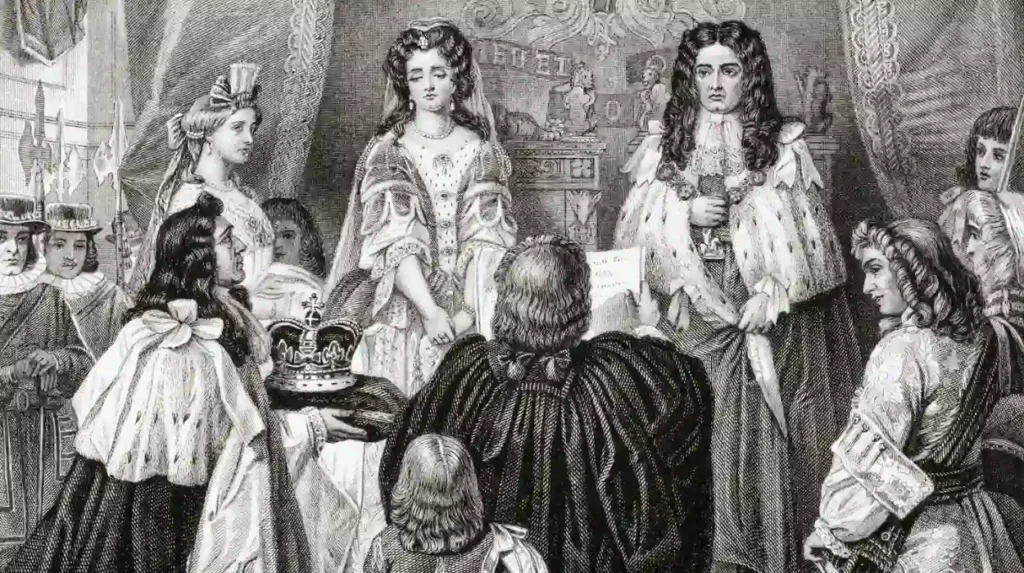
Opposition leaders invited William of Orange, a Protestant who was married to James’s daughter Mary (also Protestant), to, in effect, invade England. James’s support dwindled, and he fled to France. William and Mary were then crowned joint rulers.
Historical Overview
Tension between the king and parliament ran deep throughout the seventeenth century. In the 1640s, the dispute turned into civil war. The loser, Charles I, was beheaded in 1649; his sons, Charles and James, fled to France; and the victorious Oliver Cromwell ruled England in the 1650s.
Cromwell’s death in 1659 created a political vacuum, so Parliament invited Charles I’s sons back from exile, and the English monarchy was restored with the coronation of Charles II in 1660.
Tensions after the Restoration
The Restoration, however, did not settle the fundamental questions of power between king and Parliament. Indeed, exile had exposed Charles I’s sons to the strong monarchical methods of Louis XIV. Charles and James returned to Britain with expectations of an absolute monarchy justified by the Divine Right of Kings, so tensions continued during the reigns of Charles II (1660-1685) and his brother James II (1685-88).
Table 1 lists many of the tensions and the positions favored by each side. The compromise struck during the Restoration was that Charles II would control his succession, that he would control his judiciary, and that he would have the power to collect traditional taxes. In exchange, Charles II would remain Protestant, and the imposition of additional taxes would require Parliament’s approval.
James II
Parliament, however, was also unable to gain the upper hand. From 1679 to 1681, Protestant nobles had Parliament pass acts excluding Charles II’s Catholic brother James from succession to the throne. The political turmoil of the Exclusion Crisis created the Whig faction favoring exclusion and the Tory counter-faction opposing exclusion.
Even with a majority in Commons, however, the Whigs could not force a reworking of the constitution in their favor because Charles responded by dissolving three Parliaments without giving his consent to the acts.
As a consequence of the stalemate, Charles did not summon Parliament over the final years of his life, and James did succeed to the throne in 1685. Unlike the pragmatic Charles, James II boldly pushed for all of his goals. On the religious front, the Catholic James upset his Anglican allies by threatening the preeminence of the Anglican Church (Jones 1978, 238).
He also declared that his son and heir would be raised Catholic. On the military front, James expanded the standing army and promoted Catholic officers. On the financial front, he attempted to subvert Parliament by packing it with his loyalists. With a packed Parliament, “the king and his ministers could have achieved practical and permanent independence by obtaining a larger revenue” (Jones 1978, p. 243). By 1688, Tories, worried about the Church of England, and Whigs, worried about the independence of Parliament, agreed that they needed to unite against James II.
William of Orange
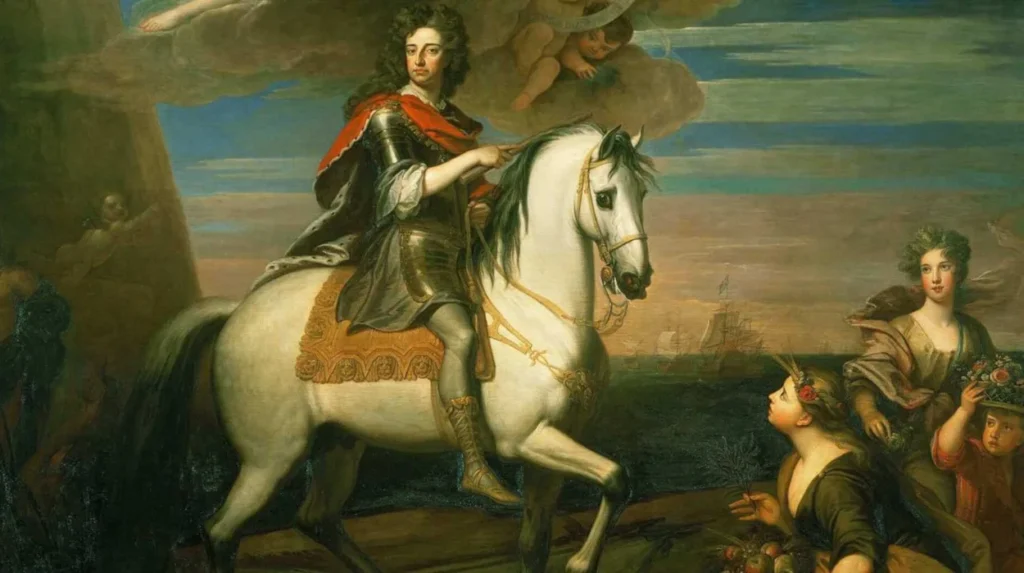
The solution became Mary Stuart and her husband, William of Orange. English factions invited Mary and William to seize the throne because the couple was Protestant and Mary was the daughter of James II. The situation, however, had additional drama because William was also the military commander of the Dutch Republic, and, in 1688, the Dutch were in a difficult military position.
Holland was facing war with France (the Nine Years War, 1688-97), and the possibility was growing that James II would bring England into the war on the side of France. James was nearing open war with his son-in-law William.
For William and Holland, accepting the invitation and invading England was a bold gamble, but the success could turn England from a threat to an ally. William landed in England with a Dutch army on November 5, 1688 (Israel 1991). Defections in James II’s army followed before battle was joined, and William allowed James to flee to France.
Parliament took the flight of James II as abdication, and the co-reign of William III and Mary II officially replaced him on February 13, 1689. Although Mary had the claim to the throne as James II’s daughter, William demanded to be made king, and Mary wanted William to have that power. Authority was simplified when Mary’s death in 1694 left William the sole monarch.
Importance of Glorious Revolution
The Glorious Revolution (1688–89) permanently established Parliament as the ruling power of England and, later, the United Kingdom, representing a shift from an absolute monarchy to a constitutional monarchy. When William III and Mary II were crowned, they swore to govern according to the laws of Parliament, not the laws of the monarchy.
A Bill of Rights promulgated later that year, based on a Declaration of Rights accepted by William and Mary when they were crowned, prohibited Catholics or those married to Catholics from claiming the throne.
Legacy of the Glorious Revolution
Many historians believe the Glorious Revolution was one of the most important events leading to Britain’s transformation from an absolute monarchy to a constitutional monarchy. After this event, the monarchy in England would never hold absolute power again.
With the Bill of Rights, the regent’s power was defined, written down, and limited for the first time. Parliament’s function and influence changed dramatically in the years following the revolution. The event also had an impact on the 13 colonies in North America.
The colonists were temporarily freed of strict, anti-Puritan laws after King James was overthrown. News of the revolution reached the Americans; several uprisings followed, including the Boston Revolt, Leisler’s Rebellion in New York, and the Protestant Revolution in Maryland.
Since the Glorious Revolution, Parliament’s power in Britain has continued to increase, while the monarchy’s influence has waned. There’s no doubt this important event helped set the stage for the United Kingdom’s present-day political system and government.
