

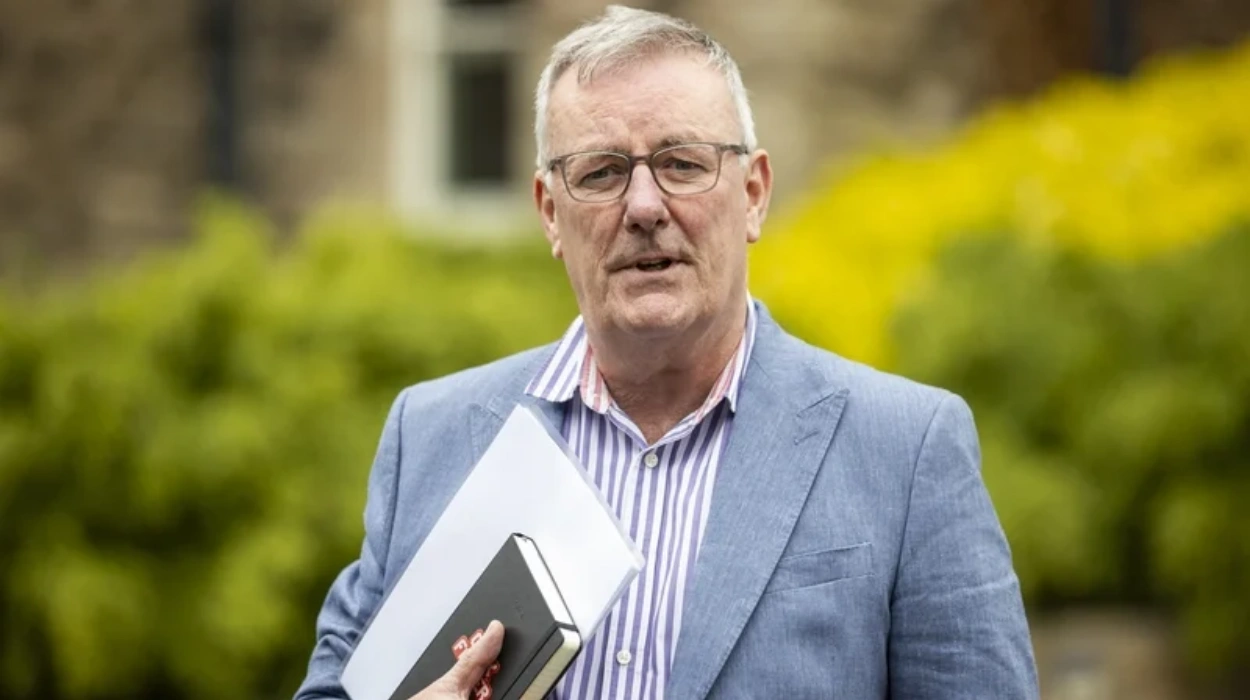
UK (Parliament Politics Magazine) – Mike Nesbitt has announced he will step down as leader of the Ulster Unionist Party, triggering a leadership transition within the party.
On Friday morning, he notified party officers and assembly members (MLAs).
Nesbitt said he made the choice to give his successor a “reasonable amount of time” to settle in and run in the next assembly election in an interview with BBC News NI on Friday.
He claimed that taking on the roles of health minister and party leader during the election would have “become too much of an ask” and that his choice to return as leader for a second term had always been a “short-term” strategy.
He said that he has “no preference” for the person who will take over as leader.
Additionally, Nesbitt stated that he is “keen to stay on” as health minister, but that his successor will have the opportunity.
In a statement, he said:
“The next five-year mandate stretches to May 2032, the month I hope to celebrate my 75th birthday. That’s a commitment to full-time politics I just do not feel I can make.”
He added:
“I would not be comfortably seeking a vote knowing that privately I was intending to retire during the mandate.”
“That job is now done so the time is right to select the politician who will lead us into the May 2027 polls promoting our brand of confident, responsible unionism.”
August 2024 marked Nesbitt’s second term as UUP leader.
Despite winning the race in 2012, he resigned in 2017 due to unsatisfactory assembly election outcomes.
Since then, the once-dominant party’s fortunes have not significantly improved, and Robin Swann, Steve Aiken, Doug Beattie, and Nesbitt have all been given leadership positions without opposition.
Nesbitt’s resignation was called a “pivotal moment” by a party spokesman.
“Party officers will shortly outline the leadership selection process, ensuring an inclusive, engaging and seamless transition.”
Robbie Butler, the party’s deputy leader, is a liberal. During his first term as leader, Nesbitt introduced him to politics.
Reviving the party while managing the health department was perhaps too much for Nesbitt to handle.
A few months ago, he stated that he would make a decision “in fairness to whoever might be coming in” by January at the latest.
He will be hoping that the incoming leader would grant his request to stay in the position until May of next year.
He was a progressive leader, just like Doug Beattie, his predecessor in the UUP hot seat.
Robbie Butler would be an example of that trend continuing.
Jon Burrows, meanwhile, is far more of an unknown.
It’s an endless game of follow the leader in the Ulster Unionist Party.
On social media, Butler and Burrows have both honored their departing leader.
Nesbitt’s “leadership and service to modern and positive unionism and vision to make Northern Ireland work for everyone” was acknowledged by Butler.
“It’s been a pleasure and I look forward to working closely with you in the coming months and year,”
the UUP deputy leader added.
Burrows wrote:
“Mike Nesbitt welcomed me into the Ulster Unionist Party and will always have my admiration.
He stepped up to party leadership again at a difficult time, while holding one of the most demanding ministries.
Selfless, service-driven and stable leadership, for which he has my respect.”
Who are the likely successors to Mike Nesbitt?
Mike Nesbitt’s abdication as UUP leader opens a leadership contest with two frontrunners deputy leader Robbie Butler and North Antrim MLA Jon Burrows.
Liberal- leaning deputy since 2021, championed Nesbitt preliminarily, emphasizes experience and avoiding contestation. New MLA since July 2025, grassroots favorite for bold, traditional unionist rhetoric breathing” new life” into the party.
First leadership race since 2012; Butler offers durability, Burrows energy amid UUP’s 9 seats and decline.