
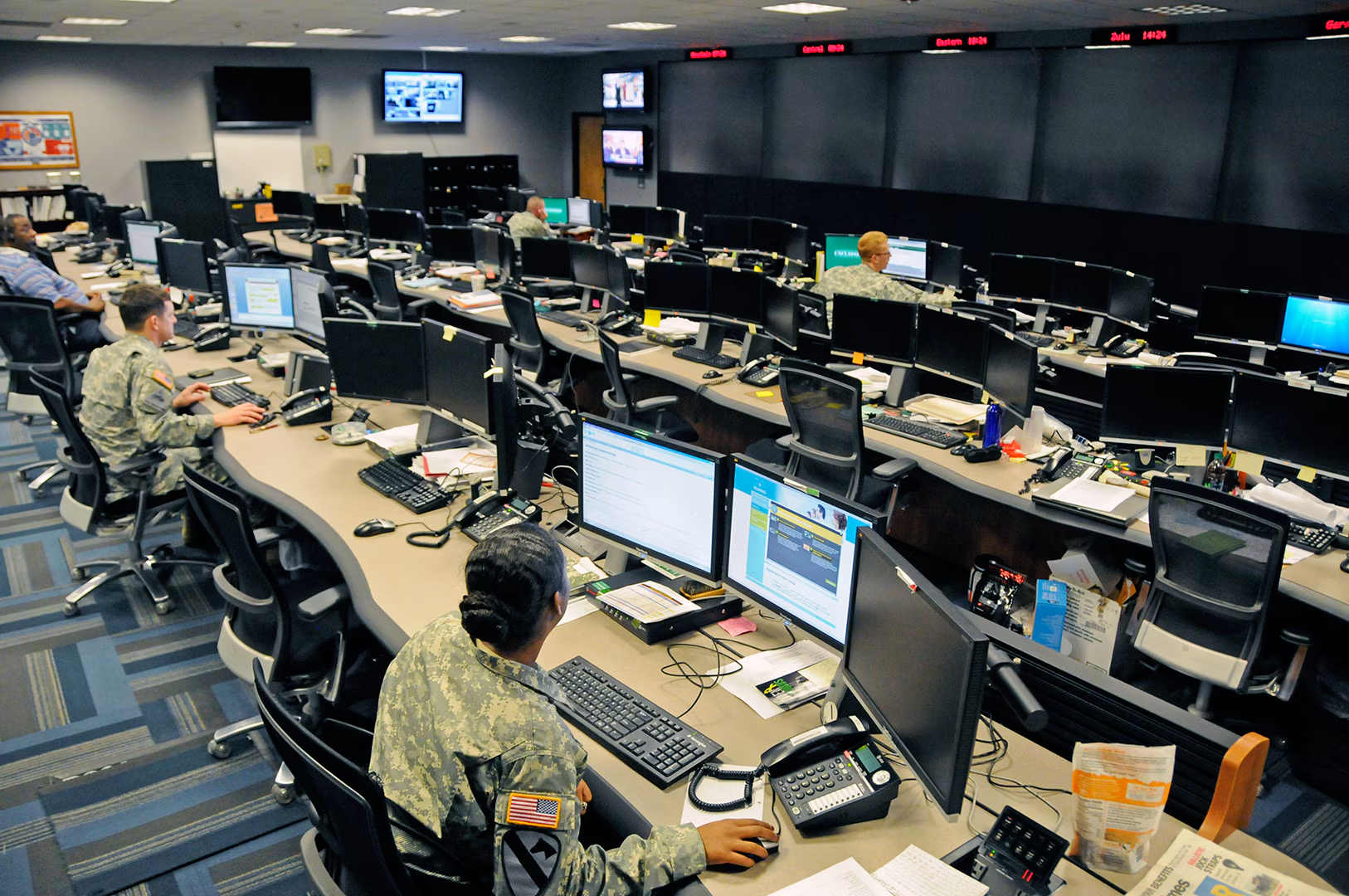
Iran January 2026 – parliament news Highlights that Middle East cyber conflict has become one of the most consequential security challenges facing the region as governments confront escalating digital attacks targeting state institutions media organizations and critical infrastructure. Parliamentary discussions in Iran and across neighboring states increasingly frame cyber security as a national defense priority rather than a technical concern. As geopolitical rivalries deepen cyber space is now a primary arena where pressure deterrence and influence are exercised without direct military confrontation.
The rapid expansion of digital governance online banking and networked energy systems has transformed daily life across the Middle East. Yet this transformation has also created new vulnerabilities exposing governments businesses and citizens to disruption on an unprecedented scale. Cyber incidents once considered isolated technical failures are now widely interpreted through a political and strategic lens reflecting the evolving nature of regional power competition.
Parliamentary scrutiny and cyber legislation
Across the Middle East parliamentary bodies are devoting growing attention to cyber legislation. Lawmakers are debating data protection standards national cyber command structures and coordination between civilian agencies and security forces. These discussions reflect recognition that cyber resilience requires legal authority budgetary oversight and institutional accountability.
In Iran members of parliament have called for stronger domestic cyber capabilities and reduced reliance on foreign technology suppliers. Similar debates are taking place in other capitals where legislators face public concern over digital privacy service reliability and national sovereignty. Analysts argue that Middle East cyber conflict has accelerated legislative action by demonstrating how digital vulnerabilities translate directly into political and economic risk.
Parliamentary involvement also signals a shift toward long term policy planning. Rather than reacting to individual incidents governments are increasingly seeking comprehensive frameworks that define responsibilities clarify response protocols and establish thresholds for escalation.
Escalating digital attacks across the region
Cyber incidents affecting government portals financial systems and transportation networks have increased in frequency and sophistication. These operations often exploit common software vulnerabilities phishing campaigns or distributed denial of service techniques that overwhelm servers and disrupt access.
Security specialists describe Middle East cyber conflict as a pattern of persistent engagement rather than episodic confrontation. Attacks may not always cause visible damage yet their cumulative effect erodes trust in institutions and imposes ongoing defensive costs. The constant threat environment forces governments to allocate significant resources to monitoring detection and recovery.
The lack of transparent attribution further complicates response strategies. States may suspect foreign involvement but hesitate to escalate diplomatically without conclusive evidence reinforcing cycles of accusation and denial.
Media organizations as strategic targets
News agencies and independent media outlets have increasingly found themselves targeted during periods of political tension. Disrupting media platforms limits the flow of information shapes narratives and amplifies uncertainty among domestic and international audiences.
The targeting of media underscores how Middle East cyber conflict extends beyond military objectives. Information control has become a strategic goal in itself reflecting the central role of public perception in modern geopolitics. Media organizations face the dual challenge of defending their infrastructure while maintaining editorial independence under pressure.
Journalists and editors across the region have called for stronger protections and international norms to safeguard media from cyber interference. However enforcement remains limited and media outlets often operate with constrained technical resources.

State rivalry and digital deterrence
Cyber capabilities offer states a means of signaling power without crossing conventional red lines. This has encouraged the development of digital deterrence strategies based on ambiguity and plausible deniability.
In the Middle East where traditional conflicts remain unresolved cyber operations provide an alternative channel for competition. Analysts note that Middle East cyber conflict mirrors broader rivalries allowing states to test defenses gather intelligence and exert pressure while avoiding direct military escalation.
This environment however increases the risk of miscalculation. Cyber actions intended as signals may be interpreted as preparations for larger operations particularly when combined with political or military developments.
Attribution challenges and political narratives
Determining responsibility for cyber attacks remains one of the most difficult aspects of digital security. Attackers can route operations through multiple jurisdictions and use compromised systems to obscure origins.
As a result Middle East cyber conflict often unfolds through competing narratives rather than verified technical findings. Governments release statements blaming adversaries while opposing sides deny involvement. These narratives shape public opinion and diplomatic relations even when evidence remains classified or inconclusive.
The politicization of attribution complicates international cooperation and undermines trust in shared investigative mechanisms. Without agreed standards disputes risk becoming entrenched.
Economic impact and infrastructure vulnerability
Critical infrastructure across the Middle East increasingly depends on interconnected digital systems. Energy production water management transportation and telecommunications rely on networked control platforms vulnerable to cyber intrusion.
Disruption to these systems carries immediate economic consequences. Energy exporting states face risks to production continuity while import dependent economies suffer from supply instability. In this context Middle East cyber conflict poses threats that extend far beyond the region influencing global markets and trade flows.
Private sector actors are also affected. Banks logistics firms and technology providers must invest heavily in cyber defense increasing operational costs and affecting competitiveness.
Regional cooperation amid mistrust
Despite political tensions there is growing acknowledgment of shared cyber risk. Some regional forums have explored limited information sharing on threats best practices and incident response.
However cooperation remains constrained by mistrust and strategic competition. States fear exposing vulnerabilities or revealing capabilities that could be exploited. Consequently Middle East cyber conflict often undermines collective initiatives even as common interests become clearer.
Progress tends to occur through bilateral arrangements or technical exchanges rather than comprehensive regional frameworks. These incremental steps nevertheless contribute to improved situational awareness.
International law and evolving cyber norms
Global discussions on responsible state behavior in cyber space increasingly influence regional policy. International organizations advocate norms that restrict attacks on civilian infrastructure and protect essential services.
Middle Eastern governments face the challenge of aligning national strategies with these evolving expectations while safeguarding sovereignty. The absence of binding enforcement mechanisms means Middle East cyber conflict continues to develop in a largely normative gray zone.
Legal scholars emphasize the need for clearer definitions of acceptable conduct and proportional response. Without such clarity cyber incidents risk escalating unpredictably.

Public awareness and societal resilience
Cyber security is not solely a government responsibility. Public awareness plays a crucial role in reducing vulnerability. Phishing misinformation and social engineering attacks often exploit human behavior rather than technical flaws.
Governments and institutions have begun investing in digital literacy programs training campaigns and public guidance. Building societal resilience is increasingly recognized as essential to managing Middle East cyber conflict and reducing its impact on daily life.
Educational initiatives aim to empower citizens to recognize threats protect personal data and maintain trust in digital services.
Technological evolution and future risks
Advances in artificial intelligence automation and cloud computing are transforming cyber operations. These technologies lower barriers to entry and increase both defensive and offensive capability.
Experts warn that Middle East cyber conflict may intensify as access to sophisticated tools spreads beyond state actors to non state groups and individuals. This diffusion complicates deterrence and accountability raising the stakes for policy coordination.
Investment in research development and talent retention has become a strategic priority for governments seeking to maintain an edge.
Diplomatic consequences of cyber escalation
Cyber incidents often coincide with diplomatic crises amplifying tension and reducing trust. Accusations of cyber interference can derail negotiations and harden positions.
In this environment Middle East cyber conflict functions both as a reflection of political disputes and a catalyst for further escalation. Diplomats increasingly incorporate cyber considerations into broader security dialogue.
Confidence building measures including communication hotlines and transparency initiatives may reduce risk but require sustained political commitment.
One senior regional diplomat said,
“Sustainable calm requires dialogue that addresses security concerns alongside economic realities rather than postponing one for the other.”
Strategic outlook for the coming years
Looking ahead cyber security will remain a defining element of regional strategy. Governments are likely to continue investing in defensive capacity legal frameworks and domestic technology ecosystems.
The trajectory of Middle East cyber conflict will depend on whether states prioritize restraint cooperation and norm building or continue operating within cycles of retaliation and suspicion. Choices made today will shape regional stability for years to come.
A digital battleground redefining power
Cyber space has emerged as a domain where power is exercised continuously rather than episodically. Influence now flows through networks data and information systems alongside traditional military and economic tools.
As Middle East cyber conflict evolves it is redefining how security sovereignty and competition are understood in the region. Managing this transformation will require leadership that balances deterrence with dialogue innovation with regulation and national interest with collective stability.

The final test of cyber governance
The effectiveness of regional responses to cyber threats will ultimately depend on governance. Transparent institutions skilled professionals and informed citizens form the foundation of resilience.
Whether the Middle East can navigate the cyber era without deepening instability remains an open question. What is clear is that cyber space will continue to shape regional dynamics long after individual incidents fade from headlines.
Cyber escalation and regional risk
The rapid expansion of digital confrontation has intensified Middle East cyber conflict as governments rely more heavily on networked systems for governance security and economic activity. Cyber incidents targeting state platforms media outlets and critical infrastructure have become more frequent raising concern that digital operations are no longer isolated technical events but part of broader strategic rivalry. Regional analysts note that Middle East cyber conflict now operates alongside traditional power competition creating an environment where pressure can be applied continuously without visible military engagement.
This escalation has complicated crisis management. Unlike conventional confrontations cyber operations often unfold quietly making intent difficult to assess. As a result misinterpretation and mistrust can grow quickly reinforcing existing political divides and increasing the risk of wider instability.
Cyber security policy and regional stability
Governments across the region are responding by strengthening legal frameworks and investing in cyber defense capabilities to manage Middle East cyber conflict more effectively. Parliamentary debates and policy reviews increasingly treat digital security as a core element of national defense rather than a technical afterthought. This shift reflects recognition that Middle East cyber conflict has direct implications for public trust economic continuity and regional stability.
Efforts to improve resilience include upgrading infrastructure enhancing coordination between civilian and security agencies and promoting public awareness. While cooperation remains limited by political rivalry these steps suggest a gradual acknowledgment that long term stability depends on managing cyber risks alongside traditional security challenges.
A defining chapter in regional security history
The rise of cyber confrontation marks a defining chapter in the Middle East’s security history. Digital conflict now intersects with politics economics and society in ways that challenge traditional assumptions.
How leaders respond to Middle East cyber conflict will determine whether cyber space becomes a source of perpetual tension or a domain where cooperation gradually tempers rivalry.