


New York (Parliament Politics Magazine) January 14, 2026 – Saks Global Enterprises, owner of Saks Fifth Avenue, Neiman Marcus, and Bergdorf Goodman, filed for Chapter 11 bankruptcy protection late Tuesday in the US Bankruptcy Court for the Southern District of New York. The filing secures a $1.75 billion debtor-in-possession financing package from existing lenders to maintain operations during restructuring. The company reports assets and liabilities between $10 billion and $100 billion, with a pre-packaged plan supported by over 97 percent of senior creditors.
Saks Global operates 113 Saks Fifth Avenue stores, 36 Neiman Marcus locations, and the Bergdorf Goodman flagship in Manhattan alongside its off-price Saks OFF 5TH chain. The restructuring aims for emergence by late March 2026 with approximately $4.7 billion in debt reduction.
Saks Global Details Chapter 11 Filing and DIP Financing
Saks Global Enterprises confirmed the voluntary Chapter 11 petition covers 39 affiliated debtors, preserving all store operations, employee payroll, and vendor payments. The $1.75 billion DIP facility includes $1.4 billion in new term loans and $350 million revolver capacity, providing over $2.5 billion total liquidity with existing cash reserves.
As reported by Rachel Abrams of The New York Times, the filing addresses
“unsustainable debt loads exacerbated by post-pandemic luxury spending slowdowns and vendor financing disruptions.”
Court documents list $7.2 billion in secured debt, $2.8 billion in senior notes, and $1.9 billion in term loans as primary obligations targeted for restructuring.
Executive Chairman Ian Putnam stated in the first-day declaration,
“This agreement with our lender group delivers the cleanest path to deleverage our balance sheet while protecting all stakeholders’ interests during a brief, efficient process.”
Media Reports Highlight Saks Global’s Financial Collapse
News of the filing spread rapidly across financial media late Tuesday evening. Toria Brooke of Fox Business captured the immediate reaction to the New York Times reporting, noting the broader portfolio impact. Toria Brooke said in X post,
“SAD — Saks Global, the company that owns Saks Fifth Avenue, Neiman Marcus and Bergdorf Goodman, filed for bankruptcy protection late Tuesday, crumbling under billions of dollars in debt, a fraying relationship with vendors and lagging sales. (NYT)”
SAD — Saks Global, the company that owns Saks Fifth Avenue, Neiman Marcus and Bergdorf Goodman, filed for bankruptcy protection late Tuesday, crumbling under billions of dollars in debt, a fraying relationship with vendors and lagging sales. (NYT)
— Toria Brooke (@realtoriabrooke) January 14, 2026
The company’s fiscal third-quarter results showed a 5.8 percent revenue decline to $3.1 billion, with same-store sales down 4.2 percent amid reduced high-net-worth customer traffic. Adjusted EBITDA fell 22 percent to $285 million due to markdown pressures and occupancy costs.
Restructuring Support Agreement Secures Creditor Backing
The pre-negotiated RSA converts $2.8 billion in senior notes to 89.1 percent equity in the reorganized debtor, while term loan holders receive 10.9 percent. Legacy equity faces cancellation consistent with bankruptcy priority rules. Chief Restructuring Officer John Reintjes affirmed,
“Over 97 percent consenting noteholders and majority term lenders executed the RSA, minimising value destruction and litigation risk.”
First-day motions seek approval for $225 million in professional fees, critical vendor payments up to $150 million, and continued use of $800 million cash collateral. The plan projects $350 million annual interest savings post-emergence, with a $1.2 billion exit facility.
Bankruptcy counsel Kirkland & Ellis and financial advisor Perella Weinberg Partners lead the debtor side, facing Weil Gotshal for lenders and Richards Layton for the creditors’ committee.
Private Equity Criticism Emerges in Financial Commentary
Earlier speculation about Saks Global’s distress drew pointed commentary from market observers. Constantin Gurdgiev highlighted private equity involvement in the lead-up to the filing. Constantin Gurdgiev said in X post,
“#PE Private Equity crowd strikes again… solid gold from the geniuses… Saks Global Enterprises could file for Chapter 11 protection as soon as Sunday. They are looking for $1.25 billion financing package that would require the removal of its current management. +”
#PE Private Equity crowd strikes again… solid gold from the geniuses… Saks Global Enterprises could file for Chapter 11 protection as soon as Sunday. They are looking for $1.25 billion financing package that would require the removal of its current management. +
— Constantin Gurdgiev (@GTCost) January 9, 2026
Saks Global’s 2024 $2.65 billion acquisition of Neiman Marcus from TPG Capital and Ares Management leveraged the balance sheet further, following Hudson’s Bay Company’s 2021 spin-off of Saks Fifth Avenue. Cumulative leverage reached 5.8 times EBITDA by Q3 2025.
Saks Fifth Avenue and Neiman Marcus Store Operations Continue
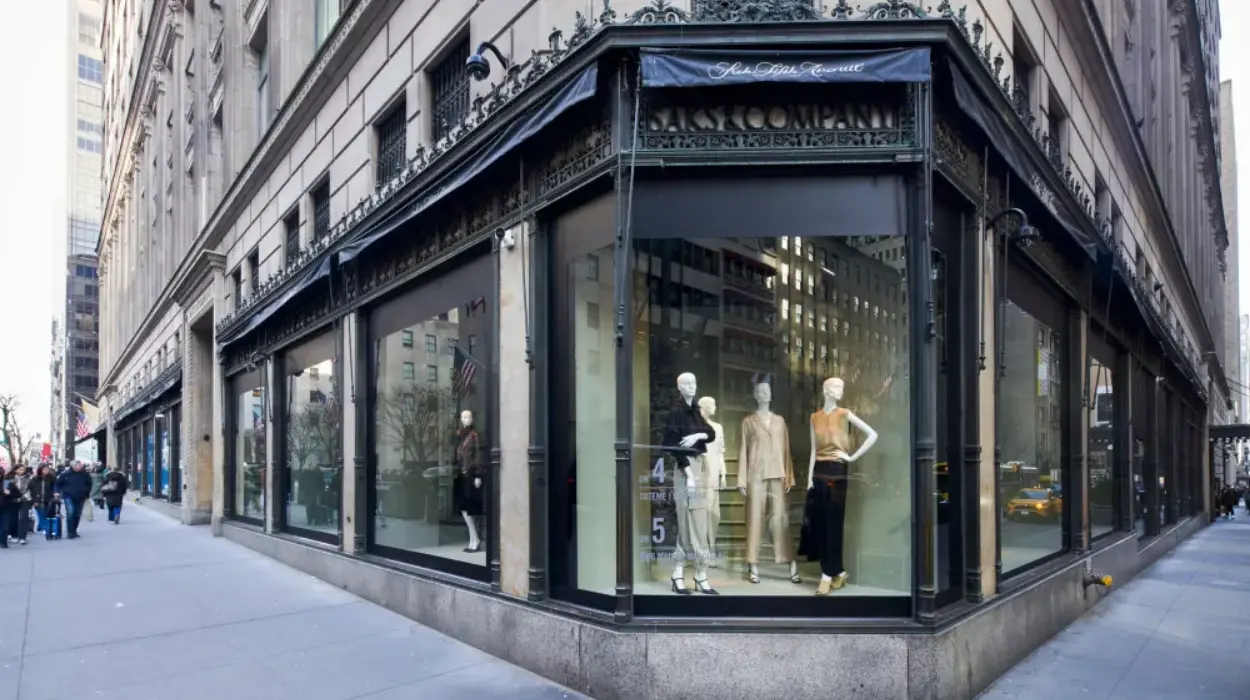
All 113 Saks Fifth Avenue stores, 36 Neiman Marcus locations, two Bergdorf Goodman stores, and 24 Saks OFF 5TH outlets remain fully operational. The Herald Square flagship and Manhattan Bergdorf Goodman report normal holiday return traffic processing. No lease rejections or store closures accompany the filing.
SaksFirst and Neiman Marcus rewards programmes function without interruption, alongside Saks.com, NeimanMarcus.com, and BergdorfGoodman.com platforms. Inventory levels support first-quarter replenishment through preserved vendor relationships.
“Our customers will experience no changes in service across physical and digital channels,”
Putnam assured in stakeholder communications. Employee retention bonuses total $50 million for frontline retention through emergence.
Luxury Retail Sector Faces Mounting Pressures
Saks Global joins Express, and Bed Bath & Beyond among recent luxury and department store bankruptcies. The sector contends with 12 percent luxury goods sales declines in 2025 per Bain & Company data, driven by Chinese economic slowdowns and reduced US tourism spending.
As reported by Laura Reiley of The Washington Post,
“Affluent consumers shifted allocations toward travel and experiences, leaving physical luxury retail overleveraged amid e-commerce gains by competitors like Farfetch and Mytheresa.”
Saks Global’s off-price Saks OFF 5TH banner outperformed full-line stores with 2.1 percent comp growth.
Competitors Macy’s and Nordstrom report stabilising traffic through private label expansions and loyalty programme enhancements, though both carry elevated debt post-pandemic investments.
Court Proceedings Timeline and Milestones
Judge Michael E. Wiles presides over the Southern District of New York case, with first-day hearings approving cash collateral and wage motions Wednesday afternoon. DIP financing approval hearing follows January 17, targeting plan confirmation by February 28 and emergence by March 31.
Milestones include disclosure statement approval by February 1 and creditor voting completion by February 15. The plan allocates $30 million for administrative claims and $120 million for secured deficiency recoveries.
Saks Global projects $1.1 billion EBITDA for fiscal 2026 post-restructuring, supporting covenant-compliant operations under reduced leverage below three times.
Historical Ownership Timeline of Saks Brands
Saks Fifth Avenue traces to 1867, founder Andrew Saks’ dry goods store, acquired by Gimbels in 1923 and BATUS in 1973. Investcorp took private control in 1990 before Hudson’s Bay Company’s $2.9 billion purchase in 2013. Saks Global launched as a public entity in 2021, acquiring Neiman Marcus in 2024 from its 2005 leveraged buyout by TPG and Warburg Pincus.
Bergdorf Goodman remains family-controlled since 1999 within the Neiman portfolio. The combined entity generated $6.2 billion annual revenue pre-filing, holding 18 percent US luxury department store market share per Euromonitor.
Vendor and Landlord Protections in Restructuring Plan
Trade creditors qualify for 100 percent recovery through preserved payment terms and $100 million critical vendor authorisation. Real estate lessors receive administrative priority on post-petition obligations, with no proposed rejections among 2,500 active leases.
“Our vendor partnerships remain foundational to merchandise quality and availability,”
Reintjes stated in filings. Key suppliers including LVMH, Kering, and Richemont affirm continued shipments under court protections.
The plan preserves unionised distribution centre operations in Secaucus, New Jersey, and Rancho Cucamonga, California, supporting 4,500 logistics roles.
Post-Emergence Governance and Strategic Outlook
The reorganized board comprises seven directors: three senior noteholder designees, two term lender representatives, Putnam as chairman, and one independent director. Fresh-start accounting resets the balance sheet at $3.5 billion enterprise value.
Saks Global plans omnichannel investments including Saks Fifth Avenue experiential store refreshes and Neiman Marcus personal stylist expansions. Off-price growth targets 40 Saks OFF 5TH units by 2028.
“With deleveraged capital structure, Saks Global stands positioned for sustainable luxury leadership,”
Putnam concluded in forward-looking statements. Confirmation hearings commence next week in Manhattan federal court.
What Chapter 11 Bankruptcy Protection Means
Chapter 11 bankruptcy protection under US law allows a debtor to reorganise finances while continuing business operations as a going concern. The filing triggers an automatic stay halting creditor collection actions, lawsuits, and foreclosures, providing breathing room for restructuring negotiations.
Debtors retain possession and control of assets as “debtor-in-possession,” operating day-to-day under court oversight while proposing a consensual plan of reorganisation. Pre-packaged Chapter 11 cases like Saks Global’s feature pre-filing creditor agreements, enabling expedited confirmation typically within 45-60 days.
Bankruptcy Code Section 1129 requires impaired creditor class acceptance and fair valuation, ensuring equitable treatment per priority rules. Successful emergence yields a reorganized entity with reduced liabilities and fresh-start accounting.
How Saks Global Enterprises Was Formed
Saks Global Enterprises emerged from strategic separations and acquisitions within the luxury retail sector. Hudson’s Bay Company completed a $2.9 billion acquisition of Saks Incorporated in 2013, followed by the 2021 spin-off creating Saks as an independent public entity focused on US luxury operations.
The transformative 2024 merger saw Saks acquire Neiman Marcus Group for $2.65 billion from TPG Capital and Ares Management, incorporating 36 Neiman Marcus stores and the Bergdorf Goodman brand into a combined portfolio generating $6.2 billion annual revenue. This transaction positioned Saks Global as North America’s leading luxury department store operator with 18 percent market share.
As chronicled by Jonathan Maze of Retail Dive, the formation consolidated historic brands under unified management while layering significant debt onto the balance sheet.