
Headline:
Funding Cuts Threaten Joggins Fossil Institute’s Vital Programs
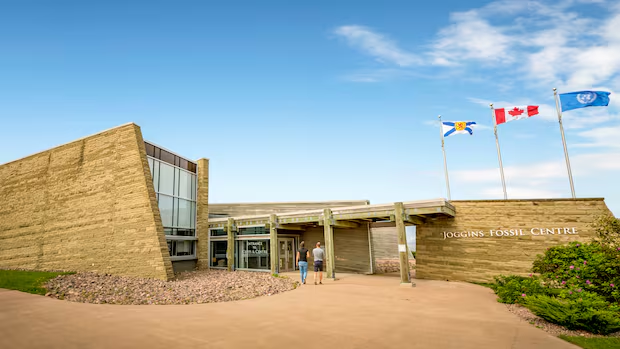
In a troubling turn of events for the Joggins Fossil Institute, the Nova Scotia provincial government announced significant funding cuts affecting its operations. This decision, made public earlier this week, raises concerns among staff and the community regarding the preservation of critical fossil resources and ongoing educational initiatives. The Institute, located in Joggins, N.S., has been a cornerstone of paleontological research in Canada and is now at a crossroads due to budget constraints.
The Joggins Fossil Institute has long been celebrated for its remarkable fossil collection and its initiatives to educate both the public and future scientists about the unique ecosystems that existed millions of years ago. As a UNESCO World Heritage site, it stands as a fascinating reminder of Earth’s prehistoric past. However, recent cuts from the provincial budget threaten the Institute’s ability to continue its essential work.
Curator Emma Smith expressed her deep distress over the funding reductions, stating, “It guts us. The Joggins Fossil Institute is not just a museum; it’s a vital research center that provides ongoing contributions to our understanding of Earth’s history. The loss of funding jeopardizes our ability to maintain exhibits, support educational programs, and sustain research initiatives that are crucial not only to Nova Scotia but to the global scientific community.”
The budget cuts, which amount to a substantial percentage of the institute’s annual funding, come as the provincial government faces financial pressures. In a public statement, the Minister of Finance cited the need for austerity measures, a decision that has been met with widespread criticism from various stakeholders, including scientists, educators, and local community members who rely on the institute for academic and cultural enrichment.
The importance of the Joggins Fossil Institute extends far beyond its walls. It serves as a primary research facility for paleontologists and geologists who study the rich fossil beds that date back to the Carboniferous period. The site has yielded some of the most important fossils in North America, and its research has provided crucial insights into the formation of coal and the evolution of life on Earth.
One of the major programs at risk is the Institute’s educational outreach, which attracts thousands of students each year. “We have educational workshops designed to inspire the next generation of scientists,” Smith noted. “Without funding, we can’t ensure that local schools and communities have access to these invaluable experiences.”
Thousands of children and adults alike have been engaged through interactive programs and field trips that could soon vanish due to the funding cuts. The Institute works closely with schools across Nova Scotia to provide hands-on learning experiences, but reduced operational resources may disable these programs, adversely affecting the region’s education system.
In response to the funding dilemma, local leaders have rallied in support of the Joggins Fossil Institute. Doug Landry, the mayor of Joggins, voiced his concerns, stating, “The cuts are shortsighted. Investing in the Fossil Institute is essential for our community—not just from a historical and educational perspective, but also for tourism and the local economy.”
Tourism is another significant factor that weighs heavily in this discussion. The Joggins Fossil Institute attracts thousands of visitors each year, contributing to the local economy and promoting the natural beauty of the region. The potential loss of this landmark could impact businesses that thrive on the influx of tourists drawn to the rich geological history of Joggins and its environs.
Community support has been robust, with residents organizing campaigns and petitions to call for a reconsideration of the budget cuts. “We are passionate about preserving not just our fossils but also our community’s heritage,” remarked local historian Marcie Reynolds. “This is our history—our legacy. Losing the Fossil Institute would be a loss of our identity.”
Opposition parties in the provincial legislature have also criticized the government’s decision, arguing that such funding cuts compromise the province’s historical and scientific assets. “Investing in our heritage is investing in our future,” remarked a prominent spokesperson. “This decision needs to be reversed, and discussions need to happen about sustainable funding that supports invaluable institutions like the Joggins Fossil Institute.”
While the future looks uncertain, Smith remains hopeful. She plans to coordinate meetings with local government officials, business leaders, and community members to explore alternative funding streams and partnerships. “We need to be proactive,” she emphasized. “Collaboration is key to our survival.”
The Joggins Fossil Institute remains a treasure trove of history, preserving artifacts essential for scientific research and education. The choices made today will significantly impact future generations and their understanding of life on Earth.
Local advocacy efforts are gaining traction—but as time goes on, the urgency increases. The provincial lawmakers have a chance to reconsider their position, ultimately recognizing that investing in education and science pays dividends not just in immediate economic return, but in fostering a knowledgeable and engaged populace.
As the community awaits the government’s response, the sense of urgency continues to mount. The collective hope is that awareness and advocacy can spur action that will lead to renewed support for this vital institution. Public forums and social media campaigns have already begun to take shape, showcasing the importance of the Joggins Fossil Institute and rallying support for its perseverance.
In the end, the fate of the Joggins Fossil Institute is a reflection of the societal values placed on science, history, and education. As the community and its supporters grapple with the implications of these funding cuts, one principle stands clear: heritage is worth fighting for.