Middle East, April 07, 2026 (Parliament Politics Magazine) Middle East escalation risk is rapidly intensifying in 2026, as Qatar warns of a potential regional “spiral” amid rising tensions involving Iran and Israel. Officials emphasized that the window for diplomacy is closing, increasing the likelihood of broader conflict across the region.
The warning reflects growing concern among regional leaders that ongoing developments are moving faster than diplomatic efforts can manage. As tensions escalate, the risk of miscalculation continues to rise.
A senior Qatari diplomat stated:
“We are approaching a point where the Middle East escalation risk could move beyond control if diplomacy fails.”
Diplomatic Window Narrowing Rapidly
The Middle East escalation risk is closely tied to the shrinking space for diplomatic engagement. While discussions are ongoing, progress has been limited, and positions remain firmly entrenched.
Experts note that once diplomatic options are exhausted, the likelihood of escalation increases significantly. The current situation suggests that time is becoming a critical factor.
This phase of the Middle East escalation risk highlights the urgency of coordinated international efforts to prevent further deterioration.
Understanding the ‘Regional Spiral’
Qatar’s warning of a “regional spiral” refers to a cycle of actions and reactions that can quickly escalate into a broader conflict. Each move by one party prompts a response from another, creating a chain reaction that becomes increasingly difficult to contain.
In the context of the Middle East escalation risk, this spiral could involve multiple countries and extend beyond current flashpoints.
A regional analyst explained:
“A spiral develops gradually, but once it gains momentum, it can be extremely difficult to stop.”
Qatar’s Strategic Diplomatic Role
Qatar has long played a role as a mediator in regional and international conflicts. Its ability to engage with multiple stakeholders gives its warnings added significance.
The country’s concerns about Middle East escalation risk are based on its close involvement in diplomatic processes. By issuing this warning, Qatar is signaling that the situation has reached a critical threshold.
This underscores the importance of mediation efforts in maintaining regional stability.
Global Implications and Economic Concerns
The Middle East escalation risk has implications far beyond the region. Global markets, particularly in the energy sector, are highly sensitive to developments in the Middle East.
Any escalation could disrupt supply chains, affect oil prices, and create uncertainty for investors. While immediate impacts have been limited, the potential for broader consequences remains.
Financial analysts are closely monitoring the situation as part of a wider assessment of geopolitical risk.
Military Activity and Strategic Balance
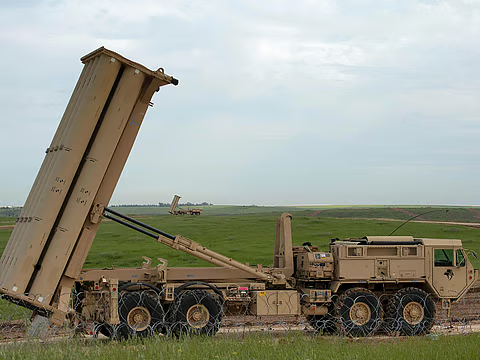
The Middle East escalation risk is influenced by ongoing military activity and strategic calculations. Countries are attempting to demonstrate strength while avoiding full-scale conflict.
This balancing act is inherently unstable. Small missteps or misinterpretations can quickly alter the situation, increasing the risk of escalation.
A defense expert noted:
“Maintaining balance in such a volatile environment is extremely challenging, especially as tensions continue to rise.”
Civilian Impact and Human Cost
The effects of the Middle East escalation risk extend beyond political and military considerations. Civilians across the region are experiencing uncertainty and disruption in their daily lives.
Economic instability, transportation disruptions, and security concerns are affecting communities in various ways. The human cost of the crisis is an important aspect that often receives less attention.
A humanitarian observer stated:
“The impact on ordinary people is significant, even when the focus remains on high-level developments.”
International Calls for Immediate Action
Global leaders and international organizations have responded to Qatar’s warning by calling for restraint and renewed diplomatic engagement. The emphasis is on preventing the situation from escalating further.
However, achieving consensus among stakeholders remains a challenge. The Middle East escalation risk continues to evolve, requiring sustained effort and coordination.
Diplomatic initiatives are ongoing, but their effectiveness will depend on the willingness of all parties to engage constructively.
What Comes Next?
The trajectory of the Middle East escalation risk will depend on decisions made in the coming days and weeks. Qatar’s warning serves as a critical reminder of the urgency of the situation.
Observers stress the importance of maintaining communication channels and avoiding actions that could trigger further escalation.
The situation remains fluid, with multiple possible outcomes.
A Defining Moment for Regional Stability
The Middle East escalation risk has reached a pivotal stage in 2026, as Qatar warns of a regional spiral and a closing diplomatic window. The situation highlights the delicate balance between conflict and stability in the region.
With global implications and rising uncertainty, the need for effective diplomacy is more urgent than ever. The actions taken now will shape the future of regional and international stability.