
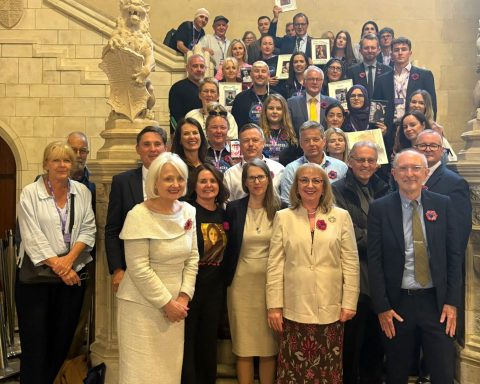
Earlier this week, I was proud to secure a debate in the House of Commons on the experiences and outcomes for young people with cancer – a subject too often overlooked, but one that affects thousands of families across the UK.
Every few hours in the UK, a young person hears the words no one ever expects at that age: “you have cancer.” Yet too often, their experiences are misunderstood, their needs overlooked and their outcomes fall short of what they should be.
As a Member of Parliament and Parliamentary Champion for Teenage Cancer Trust, I regularly hear from families in Mansfield whose lives have been turned upside down by cancer. They do not just speak about treatment, but about fear, uncertainty and the profound disruption to education, work, and relationships. Their message is clear: the system is not working well enough for young people.
The challenge is growing. Cancer rates among young people have risen by a quarter since the early 1990s, and they are projected to increase further. Cancer remains the leading cause of disease-related death among teenagers and young adults in the UK. Even for those who survive, the impact can last a lifetime – physically, emotionally, and socially. This is happening at a time when many young people are already struggling with their mental health and their future prospects. A cancer diagnosis compounds all of that.
We know what works. Teenage Cancer Trust has transformed care by creating specialist units for 13 to 24-year-olds within the NHS – spaces designed not just for treatment, but for dignity, independence, and mental wellbeing. These units recognise a simple truth: cancer at that age is not just a medical condition; it disrupts identity, relationships and life chances. But only around half of young people currently benefit from this kind of age-appropriate care. That must change.
One of the most urgent issues is diagnosis. Young people often face dangerous delays, with nearly half seeing a GP three or more times before being referred. Awareness of cancer symptoms among 18 to 24-year-olds is worryingly low, with fewer than half able to identify key warning signs such as persistent pain, unexplained lumps, or extreme fatigue. The consequences can be devastating – not just clinically, but psychologically. Long waits for diagnosis are strongly linked to increased anxiety and depression and young people must no longer be treated as an afterthought in diagnostic pathways – they are a distinct group with distinct needs.
Psychological support is another area where the system is falling short. Research shows that 90% of young people undergoing cancer treatment experience anxiety, 83% report loneliness, and 70% experience depression. These are not marginal figures – they represent the overwhelming majority.
Despite NHS commitments, access to specialist mental health support remains inconsistent. Too many families describe a postcode lottery, with little structured support during or after treatment. This is unacceptable. Every young person with cancer should have access to sustained psychological care, not just during treatment, but in the critical years that follow.
Access to clinical trials is also failing this group. Teenagers and young adults are significantly less likely to take part – not because they do not want to but because the system excludes them. Many fall between paediatric and adult services, while others face a lack of available trials for rare cancers. No young person should miss out on a potentially life-saving opportunity because of arbitrary age barriers.
Finally, we must confront a fundamental issue: data. Too often, young people with cancer are effectively invisible in the system. Without consistent, age-specific data we cannot identify inequalities or drive improvement.
The solutions are clear. We must improve early diagnosis, expand access to age-appropriate care, guarantee psychological support, increase participation in clinical trials and strengthen data collection.
If we are serious about improving outcomes, the commitments in the National Cancer Plan must be delivered with urgency, funding and accountability.
Young people with cancer cannot afford to wait. The question is whether we are prepared to listen – and act.
Young People with cancer are being overlooked – that must change

5 mins read


Latest from UK Parliament

Pensioners who have worked hard throughout their lives deserve dignity and security in retirement. They have
I recently had the privilege of opening a Westminster Hall debate responding to a petition calling

Last week I led a Westminster Hall debate on community hospitals, in response to widespread concern
Across Cheshire, one issue has united residents, farmers, landowners and rural communities: the proposed Peak Cluster

The issue of the condition of roads across Mansfield is raised with me frequently. Since becoming