If you listen closely enough to Westminster this week, you can hear more than the usual hum of aides, advisers and overworked officials. You can hear the sound of a government that keeps insisting it is calm and disciplined while everyone around it appears to be openly at war.
Keir Starmer came in promising seriousness, order and proper process. What he has instead, at least in this increasingly toxic row over Peter Mandelson’s appointment to Washington, is a very public argument about cronyism, patronage and whether Downing Street has been treating the machinery of government as a minor inconvenience.
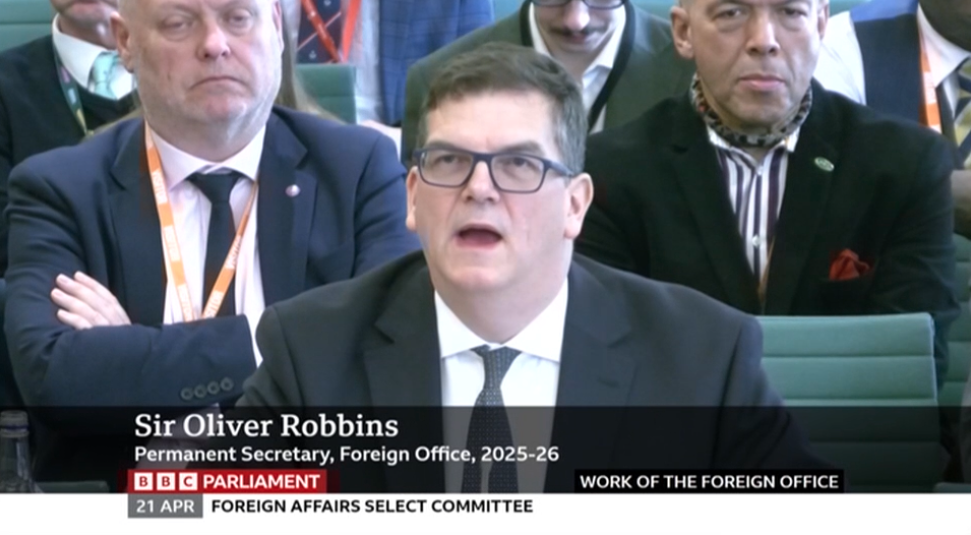
The most damaging account so far has come from Sir Olly Robbins in his testimony to the Foreign Affairs Committee. Robbins described what he said was a “dismissive attitude” from No 10 towards security vetting of Peter Mandelson. This is not just a spat over personalities or bruised egos. It is an accusation that political operatives around the Prime Minister looked at civil service safeguards, diplomatic procedure and security concerns and decided they were there to be bulldozed.
Robbins also said there was “constant pressure” to get Mandelson to Washington “as soon as humanly possible”, a line that neatly captures the mood of the whole affair: urgency first, caution later, if at all.
That pressure appears to have run right through Whitehall. At the centre of it is the argument over vetting, and whether it was taken seriously enough in the first place.
One of the more extraordinary claims in circulation is that the Cabinet Office suggested full vetting was unnecessary because Mandelson was already a peer. That defence has landed badly, to put it mildly. Being in the Lords is not, as many critics have pointed out, some magical substitute for scrutiny when someone is being handed one of the most sensitive diplomatic jobs in British politics. It has only looked worse because the background concern was not trivial gossip but Mandelson’s long-shadowed links to Jeffrey Epstein and commercial links to Russia and China, issues that have clear reputational and security implications.
Now Mandelson is also facing a police inquiry over the alleged leaking of documents to Epstein, deepening the sense that the warnings were not just bureaucratic fussiness but something more serious.
The row has become even uglier because it did not stop with Mandelson. Robbins also revealed that No 10 pushed for an ambassadorship for Matthew Doyle, Starmer’s former communications chief, another detail that makes this look less like an isolated error and more like a culture.
More striking still, Robbins said he was told not to tell Foreign Secretary David Lammy about the Doyle search. That is the kind of detail that makes ministers and officials alike sit up straight, because it suggests not just pressure from the centre but an attempt to work around normal lines of accountability. If true, it feeds exactly the impression now hardening across Westminster: that a small group around Starmer saw top posts as things to be arranged for allies, with the departments expected to catch up afterwards.
Doyle’s own position makes the story even more politically radioactive. He was later suspended from Labour after it emerged he had supported a friend who had been charged with possessing indecent images of children. That revelation has given critics an easy way to argue that the judgment of Starmer or his inner circle was not just politically clumsy but fundamentally poor. It also throws fresh light on why officials may have been uneasy about being leaned on over appointments linked to figures already carrying reputational baggage.
Then there is the quote that has come to define the whole mess. According to reports, Morgan McSweeney told Philip Barton to “just f***ing approve it”. Whether No 10 likes it or not, that line has stuck because it sums up the allegation in one burst of profanity – the process was not being respected, it was being set aside.
For a government that sold itself as the grown-up alternative to the chaos and entitlement of the Conservatives, that is especially damaging. The complaint is no longer simply that mistakes were made. It is that the instinctive operating culture at the top may not be all that different from the one Labour spent years denouncing.
The political fallout is now moving well beyond the civil service. Yvette Cooper and Ed Miliband were among the first senior cabinet figures to show dissent, an early sign that this was not going to stay boxed inside a fight between mandarins and special advisers. Once cabinet ministers start letting their discomfort be known, even discreetly, the problem becomes much harder for No 10 to dismiss as media noise. Cooper, given her brief, had obvious reason to worry about any suggestion that security concerns were being brushed aside. Miliband’s unease pointed to something broader: the sense that Labour risked slipping into the habits of patronage politics it once claimed to have left behind.
That has given the opposition a huge opening. Kemi Badenoch has gone straight for the central point, saying Starmer is “not fit to lead”. In ordinary circumstances, that might sound like routine opposition rhetoric. In the middle of a row defined by friends fixing things for friends, ministers being kept in the dark and officials saying they were pressured to wave appointments through, it lands with much more force than No 10 would like.
The real damage here is not any single headline, but the cumulative impression of a government whose claims to integrity are being eaten away from within, while taking its’ eyes off the issues that matter: the cost of living crisis, the NHS, the economy and defence.
What began as a dispute over Mandelson’s route to Washington has morphed into an argument about who really runs this government, how they use power, and whether the line between politics and the state is being rubbed out by a culture of patronage that has left the civil service and Downing Street glaring at each other across an ever-widening rift.
Starmer’s Cabinet wobbles as Mandarin strikes back