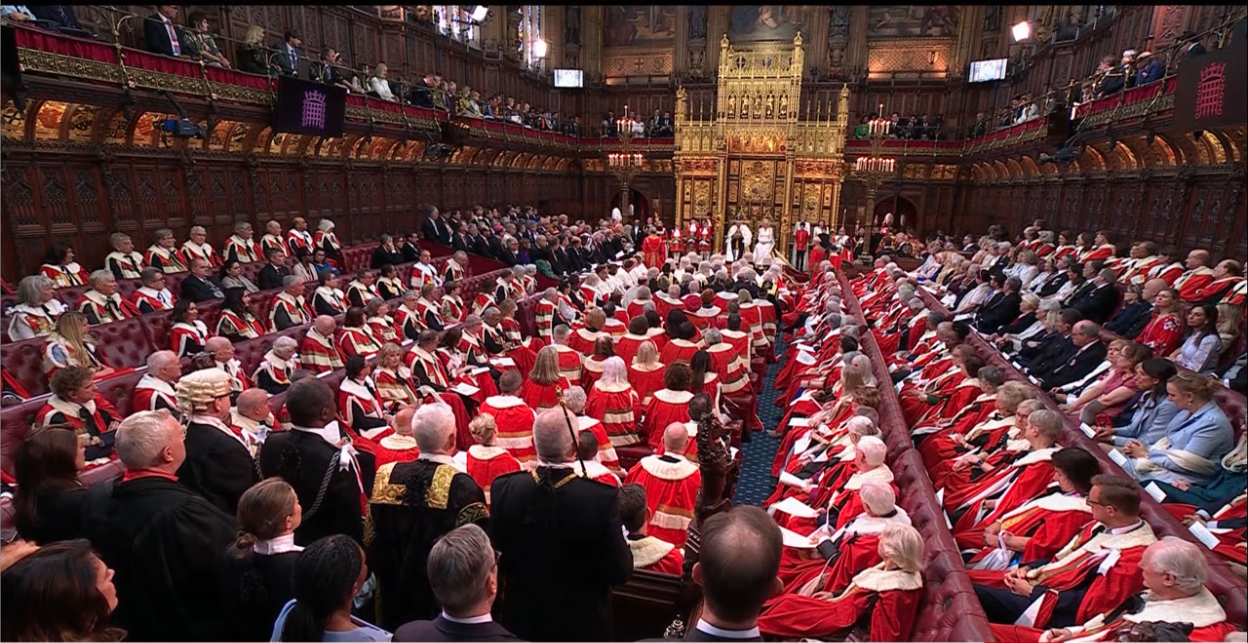
The red benches of the Upper House often serve as the conscience of Westminster, providing a space where long-term strategic threats are weighed against the immediate political pressures of the day.
During the recent Lords proceedings following the King’s Speech, the chamber turned its attention to the foundational challenges facing the United Kingdom in an increasingly volatile global landscape.
Lord Alton of Liverpool, a veteran parliamentarian known for his unwavering focus on human rights and international justice, rose to address the House, following a thoughtful contribution from the noble Lord, Lord Thomas of Gresford. His address served as a sobering reminder that the gracious Address rightly identifies antisemitism, political fragmentation, and alienation as challenges that demand a renewed commitment to our institutions and the prioritisation of the national interest above all else. In the context of contemporary UK politics, Lord Alton’s intervention highlighted two critical pillars for the future of the British state: resilience and dependency.
At the heart of his argument lay what he described as the “deadly quartet”. This axis, comprising Russia, China, North Korea, and Iran, represents what Lord Alton characterised as the most severe threat to the liberal democratic order since the conclusion of the Second World War. His perspective is not merely academic; as a peer who has been sanctioned by each of these four regimes, he noted that he has “skin in the game.” This quartet operates through a complex web of mutual support and shadow networks, often utilising hubs like Hong Kong for the operation of shadow fleets of tankers selling oil to China and providing a base for companies producing technical components found in Iranian drones and ballistic missiles: weapons that are subsequently deployed in theatres of conflict across the globe.
The integration of these hostile powers is increasingly visible on the battlefield. Lord Alton pointed to reports from the BBC indicating that at least 11,000 North Korean soldiers have been dispatched to fight alongside Russian forces in Ukraine, with some reportedly being used in the horrific capacity of human minesweepers. This military cooperation is bolstered by Iran’s provision of weaponry, ammunition, and technology to the Kremlin. To face this axis, the argument for bolstered national resilience through increased defence spending is becoming an urgent priority in british politics. Lord Alton argued that such spending must happen now, before it is too late, and must be guided by a coherent strategy designed to defend not only British citizens but the very values upon which the democratic world is built.
Having travelled extensively through various dictatorships: including the former Soviet Union, Burma, North Korea, and China: Lord Alton spoke of the “inspiring desire for the liberties we often take for granted” that he witnessed firsthand. This desire for freedom is currently being exhibited with immense courage in Ukraine and vibrantly in Taiwan. He reflected on a recent meeting he co-chaired in Parliament with Thae Yong-ho, the former deputy North Korean ambassador to the UK who defected in 2016. Their discussion centered on a United Nations commission of inquiry report which documented North Korea as a state that “does not have any parallel in the contemporary world.” Despite the report’s call for crimes against humanity to be prosecuted by the International Criminal Court, no such action has been taken, and hundreds of thousands continue to perish in political prison camps. The brutality of the regime was illustrated by the tragic case of a 22-year-old man who was publicly executed simply for the “crime” of listening to South Korean music.
The situation in China remains equally dire. Lord Alton recounted his visits to persecuted Christians, his witnessing of the suppression of Buddhists in Tibet, and his meetings with Uyghur Muslims who are enduring what has been described as a genocide. In Hong Kong, where he served as an international election monitor in 2019, he witnessed an unprecedented turnout that saw pro-democracy candidates gain a landslide victory in what would be the city’s last fair and free elections. The response from the Chinese Communist Party (CCP) was the systematic dismantling of the “one country, two systems” framework, the disqualification of elected legislators, the enactment of a draconian national security law, and the imprisonment of up to 1,900 political prisoners. Among them is the young activist Joshua Wong and the British citizen Jimmy Lai, who, as Lord Alton warned, is at risk of dying in solitary confinement unless international pressure secures his release.
As the Chair of the Joint Committee on Human Rights (JCHR), Lord Alton highlighted the committee’s findings on transnational repression, which identified China as the greatest internal threat to the UK. The committee has called for China to be placed in the advanced tier of the foreign influence registration scheme to better protect the integrity of parliamentary news and democratic processes. Furthermore, in the realm of economic reporting uk, the JCHR’s report on supply chains and slave labour has called for radical changes to the Modern Slavery Act. These changes are deemed essential to prevent slavery from tainting global supply chains, a move that would require a significant shift in how the UK handles its trade relationships. Lord Alton questioned whether these recommendations would feature in forthcoming legislation, stressing that for British industry to provide jobs and compete effectively, there must be an end to unfair competition based on slave labour.
The economic dimensions of national resilience are stark. The UK currently faces a trade deficit of £43.5 billion with China, a figure that Lord Alton argues we should be seeking to reduce rather than expand. He advocated for a strategy of “weaning ourselves away” from dependency on authoritarian regimes and instead deepening trade ties with partners such as Taiwan: particularly in critical sectors like Taiwan chip manufacturing: as well as South Korea, Japan, India, and other emerging democracies. The ability to rebuild a resilient manufacturing base and protect jobs against rising unemployment is, in his view, permanently compromised as long as the UK remains dependent on states that utilise slave labour to undercut fair market prices. This extends to the green energy transition; as the JCHR report and his own amendments to the Energy Act made clear, national energy resilience cannot be built on the back of solar panels produced by Uyghur slave labour.
The current geopolitical and economic dangers, including the burden of prohibitive energy bills, also require a pragmatic approach to domestic resources. Lord Alton suggested that the UK must be prepared to open new gas and oil fields and responsibly utilise its own natural resources to ensure energy security. This mirrors the challenges posed by the rapid development of Artificial Intelligence, which is currently being examined by the JCHR. He warned against repeating the mistakes of the 1980s, where too rapid deindustrialisation led to a reliance on state handouts. Such handouts, he argued, are no substitute for the “dignity of work,” asserting that no citizen should be better off on benefits than in doing a day’s work. This focus on uk infrastructure investment and domestic stability is central to his vision of a resilient democracy.
A resilient democracy must do more than just protect its own borders; it must bolster its citizens and its international alliances while acting confidently to promote the rule of law and democratic values. To this end, Lord Alton urged the Government to accept the JCHR’s recommendation to extend universal jurisdiction against perpetrators of mass atrocity crimes. This is an issue he intends to revisit in a balloted debate secured for June 4th and through his Private Member’s Bill on genocide determination. By taking these steps, and by maintaining a strong commitment to uk humanitarian aid and ethical foreign policy, the Government can demonstrate that it is serious about the promise made in the gracious Address to take measures that contribute to the United Kingdom’s “strength on the world stage.” As the debate continues, the focus remains on whether the UK can successfully navigate the influence of the deadly quartet while fostering the ai governance and industrial resilience necessary for the mid-21st century.
Top human rights expert and peer challenges Government to do more on the “deadly quartet”