
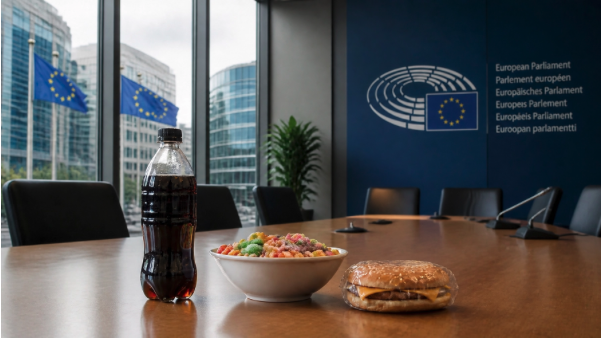
“Sin taxes never made anyone healthier or richer.” That is the blunt verdict of Adam Bartha, Director of EPICENTER, as Brussels enters what may prove to be the most consequential six months of the EU’s long-running battle over ultra-processed foods.
From July, Ireland assumes the Presidency of the Council of the European Union for the eighth time, placing itself at the centre of European decision-making for six months. It takes the chair at precisely the moment a sprawling, increasingly bitter argument over diet, taxation, industry power and public health is coming to a head.
The numbers driving that argument are hard to ignore. The latest WHO European Childhood Obesity Surveillance Initiative, covering almost 470,000 children across 37 countries, found that 25% of children aged seven to nine were living with overweight or obesity, and 11% with obesity alone. In Europe as a whole, 14 million children were living with obesity in 2025. No EU country is on track to meet the WHO target of halting the rise in obesity at 2010 levels.
This week, around 20 health and nutrition groups fired the latest shot in the regulatory battle, writing to Agriculture Commissioner Christophe Hansen and Health Commissioner Olivér Várhelyi to urge Brussels to impose concrete curbs on ultra-processed foods. Signatories including the European Public Health Alliance and the Alliance for European Cancer Leagues are calling for mandatory front-of-pack nutritional labelling, curbs on marketing to children, and subsidies to make healthier food more affordable.
The groups are calling on the Commission to take a “science-based” approach, including by ending “aggressive” marketing to children, introducing clear, mandatory nutritional labelling and encouraging healthier food environments through subsidies.
The study, expected before the end of 2026, will land squarely in Ireland’s in-tray.
The backstory explains why the health coalition is so anxious. In September 2025, Commissioner Várhelyi signalled his openness to a taxation system on products high in fat, sugar and salt, telling the European Parliament’s public health committee it was “something we can reflect on” within the EU’s Cardiovascular Health Plan. FoodDrinkEurope pushed back hard, warning that discriminatory food taxes could have unintended effects including higher consumer food bills, and argued the concept of ultra-processed food lacked scientific consensus.
The industry’s intervention had a visible effect. When the Safe Hearts Plan landed in December, a clear, time-bound commitment to EU-wide levies on UPFs in 2026 had disappeared, replaced by more cautious language and a promise of “better information on ultra-processed foods.” Health advocates were scathing, arguing the retreat risked diluting ambition and delaying action despite solid and consistent evidence linking UPFs to cardiovascular health impacts.
That is the landscape into which this week’s letter arrives and into which Bartha highlights EPICENTER’s competitiveness analysis.
“The Hungarian Commissioner, Oliver Várhelyi, is keen to import a policy that already failed in his home country: a tax on ultra-processed food,” he said. “With a looming fiscal hole created needlessly by the Commission for the next EU budget, Brussels is looking for money in every corner it can find. Whether it is smokers and vapers with the proposed tobacco own resource, or consumers of processed food, the main goal is to find the resources for a bloated budget. EPICENTER’s competitiveness analysis is clear: sin taxes never made anyone healthier or richer, they punish the poorest, and a UPF levy would simply make more Europeans have less money in their pocket. If the goal is to improve health outcomes and help Europeans live longer, there is only one way to do it: through increased prosperity. This requires faster economic growth and a more responsible EU budget.”
The health coalition does not explicitly call for a UPF tax in its letter; a careful omission that reflects both the political difficulty of the moment and the genuine complexity of the evidence. It argues that taxes alone would be insufficient, and that low-income households would bear a disproportionate burden. Its ask is more structural: incentivise reformulation, subsidise healthy food, and above all keep the study clean and free from industry fingerprints.
“We are striving for the prioritisation of public health and a fundamental change in business models where producing UPFs is not financially interesting for corporations,” said Alba Gil, senior policy officer at the Association of European Cancer Leagues.
With Ireland’s presidency beginning just weeks before the study is due, Dublin will be chairing Council discussions at the precise moment the findings land. The battle over ultra-processed foods in Brussels is no longer a question of if. It is a question of who wins the argument first – and whether Ireland has the appetite to push it through.
Ultra-processed, under pressure: the EU’s biggest food fight is just getting started

6 mins read
Latest from Europe

WASHINGTON, June 12 (Parliament Politics Magazine) – The United States plans a significant reduction in the
A petition calling for international recognition of the genocides committed in the Democratic Republic of Congo

Across Europe, governments and EU institutions are expanding taxes and regulations aimed at shaping personal behaviour.
The European Commission announced last week that a new age verification app designed to protect children

Italy is moving to extradite a suspected Chinese hacker wanted by US authorities. The case highlights