
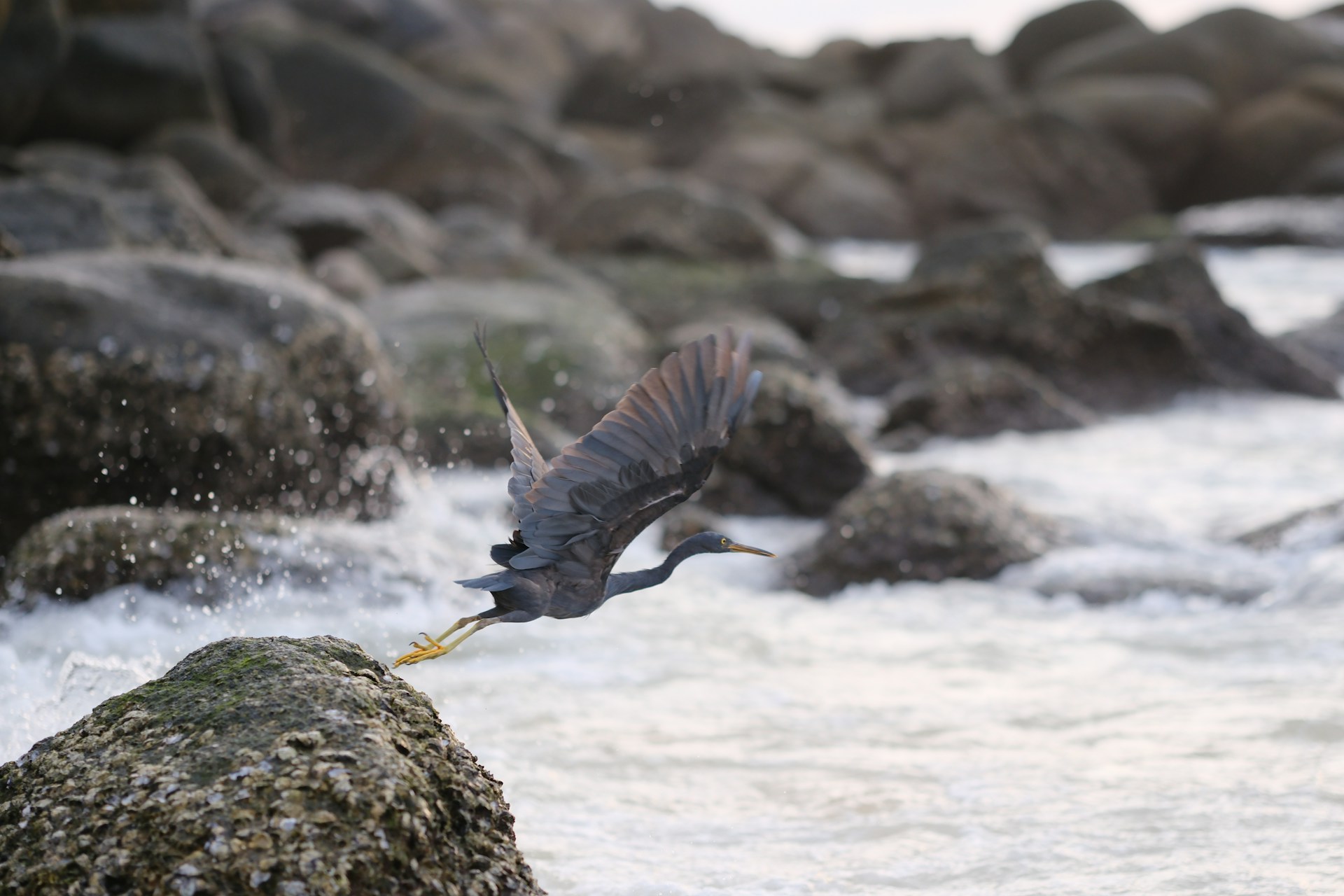
CAERNARFON, WALES, June 13 (Parliament Politics Magazine) – Hundreds of birdwatchers from across the UK have descended upon a seaside town in north Wales following the discovery of a rare western reef heron. The sighting marks the first time this species, typically found in Africa, southern Europe, and parts of Asia, has been recorded in Britain.
Ornithologist Simon Hugheston-Roberts first identified the grey-blue bird at Y Foryd in Caernarfon at 10:00 BST on Saturday while conducting his regular bird count.
Experienced Observer Makes Discovery
Hugheston-Roberts has decades of experience in the field and immediately recognized the distinct characteristics of the visitor. After observing the bird flying over the shore, he cross-referenced his knowledge from previous birdwatching trips in West Africa and the Middle East. To ensure the accuracy of his identification, he utilized a nearby little egret to conduct a side-by-side comparison of size and physical structure.
“After getting a better look I thought this is a rare thing,” he said.
Once confident in his findings, Hugheston-Roberts shared the news with a local birdwatching group. Word of the rare arrival spread quickly, leading to a significant influx of enthusiasts to the area. By Saturday afternoon, approximately 300 ornithologists had arrived in the town, hoping to capture a glimpse of the egretta gularis.
Bird Attracts Massive Crowds
The western reef heron has been spotted in various locations around the town throughout the weekend. Enthusiasts have tracked the bird as it fed in the harbour near Cei Llechi and roosted in trees by the Aber Bridge. Sightings have also been reported over the fields of Morfa Dinlle, back at the Foryd, and even passing above Caernarfon Castle.
The gathering has drawn a diverse group of nature lovers, including photographers and artists. Richard Partis, an ornithologist and artist, spent nearly 12 hours tracking the bird to capture it in his sketchbook. He noted the respectful behaviour of the visitors who have kept their distance to avoid disturbing the heron. Observers reported that some birdwatchers traveled from as far as Essex, while others planned overnight stays in the hope of continuing their watch.

Expert Insight into the Arrival
Naturalist and broadcaster Iolo Williams, who was filming in the region when the news broke, described the visitor as a “smart bird” with a “lovely grey-blue” appearance. He emphasized that the significant level of interest from the birdwatching community is due to this being the first ever recording of the species in Britain. While the sighting followed a period of record-breaking temperatures in Wales, experts do not attribute the event to climate change.
Instead, the arrival is likely the result of meteorological conditions. Williams explained that the bird was likely blown off course during its migration. He suggested that strong southern winds carried the heron out to sea, where it eventually became lost and arrived on the Welsh coast. He noted that while such occurrences happen rarely, it is uncommon for a first national record to be spotted in Wales. The estuary areas of Y Foryd and the Afon Seiont provide suitable feeding grounds for the bird, which hunts small fish in a manner similar to a little egret.
Formal Confirmation Process
The documentation process for such a significant ornithological find is underway. Hugheston-Roberts is currently preparing a detailed report to be submitted to the British Birds Rarities Committee. This formal documentation is a necessary step to officially confirm the sighting and add the record to the national database. Until the committee concludes its review, the bird remains a major point of interest for the local community and the visiting birdwatching public. The event highlights the unique wildlife diversity that can occasionally be found in coastal Welsh habitats when migratory paths are interrupted by natural weather patterns.