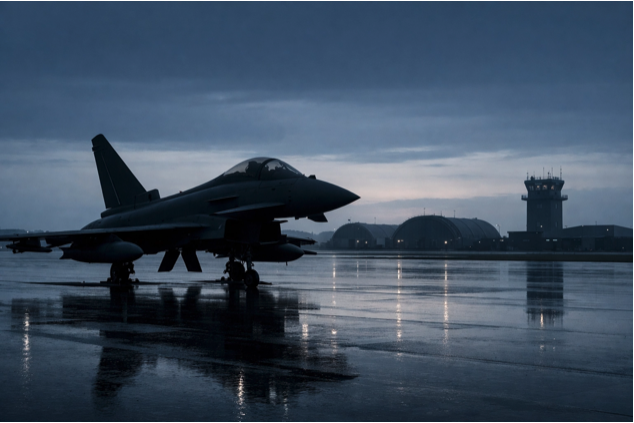
The security status of British forces and assets in the Eastern Mediterranean has been raised following a “kinetic impact” at RAF Akrotiri, as Prime Minister confirms the US can use UK bases for military operations.
Last night, an Iranian-manufactured long-range unmanned aerial vehicle (UAV) breached the exclusion zone of RAF Akrotiri in Cyprus. Technical assessment reports indicate the drone entered a terminal dive sequence, impacting the perimeter of the airfield. The Ministry of Defence (MoD) reports that the impact caused minor damage to non-essential maintenance facilities. It went on to confirm zero casualties resulted from the detonation.
This incident follows a series of regional escalations involving the Islamic Republic of Iran and its proxies as the US and Israel continue to pound military targets for the third day.
Technical analysis of the debris suggests the UAV was a high-endurance variant capable of trans-regional flight, putting the base on high alert and authorities to instruct the families of RAF personnel with the base to disperse.
Following the attack the Prime Minister, Sir Keir Starmer, has issued new orders allowing the US to conduct military operations from RAF Fairford, Diego Garcia, and RAF Akrotiri.
The authorisation allows the deployment of US assets from these locations for “limited defensive purposes”, although there remains a certain amount of ambiguity around exactly what this change in policy means.
It also represents a significant reversal of the Government’s position, which at the start of the conflict had refused use of British bases by US forces. The Government claims the change is a “recalibration” because of the Cyprus attack and complies with international legal frameworks, a view disputed by some of his own party and the leader of the Green Party.
Labour MP, John McDonnell told the BBC that he feared the Prime Minister hadn’t learnt the lessons of the Iraq War and feared the UK being drawn into dangerous and reckless conflict, that could set the “region ablaze”, and further damage the UK’s economy.
The former Labour MP Lloyd Russell-Moyle, and now Green Party member, commented: “Using British airbases makes us less safe. An Iranian drone has already hit an RAF base in Cyprus. This is a war of aggression by the USA and Israel regimes. I want the Iranian regime to fall, but this illegal war will only cause more death and make that harder.”
A view echoed by Zack Polanski, who took to twitter to say: “The majority of people in this country do not want us to be involved in this war. Keir Starmer of a few years ago wouldn’t have supported this war. The only reason he does now is he will do anything Donald Trump wants – and it makes us all less safe.”
However, their concerns were not shared universally. Shadow Defence Secretary James Cartlidge took a more combative pro-US line, telling GB News that the Conservatives would “take the side of the US and Israel” over the strikes on Iran if they were in Government. He went on to accuse the Prime Minister of “sitting awkwardly on the fence” and performing another U-turn by belatedly permitting the US to use UK air bases.
More broadly, there is concern that the theatre of operations is expanding. Iran has directly targeted Qatar, the UAE, Bahrain and Kuwait, striking civilian targets such as hotels and airports, and is now using its proxies to target Israel. Just hours ago, Iranian proxy Hezbollah fired missiles from its base in Lebanon into northern Israel, triggering reprisal bombing raids by the Israeli air force.
These developments have also impacted global energy markets significantly. Brent Crude pricing reached $80 per barrel on March 2, 2026 and are predicted to go higher as the Strait of Hormuz, a vital shipping lane that carried more than 20 per cent of the world’s oil supplies is closed off to civilian vessels.
Britain’s Strategic “Recalibration” in the US-Iran Conflict