
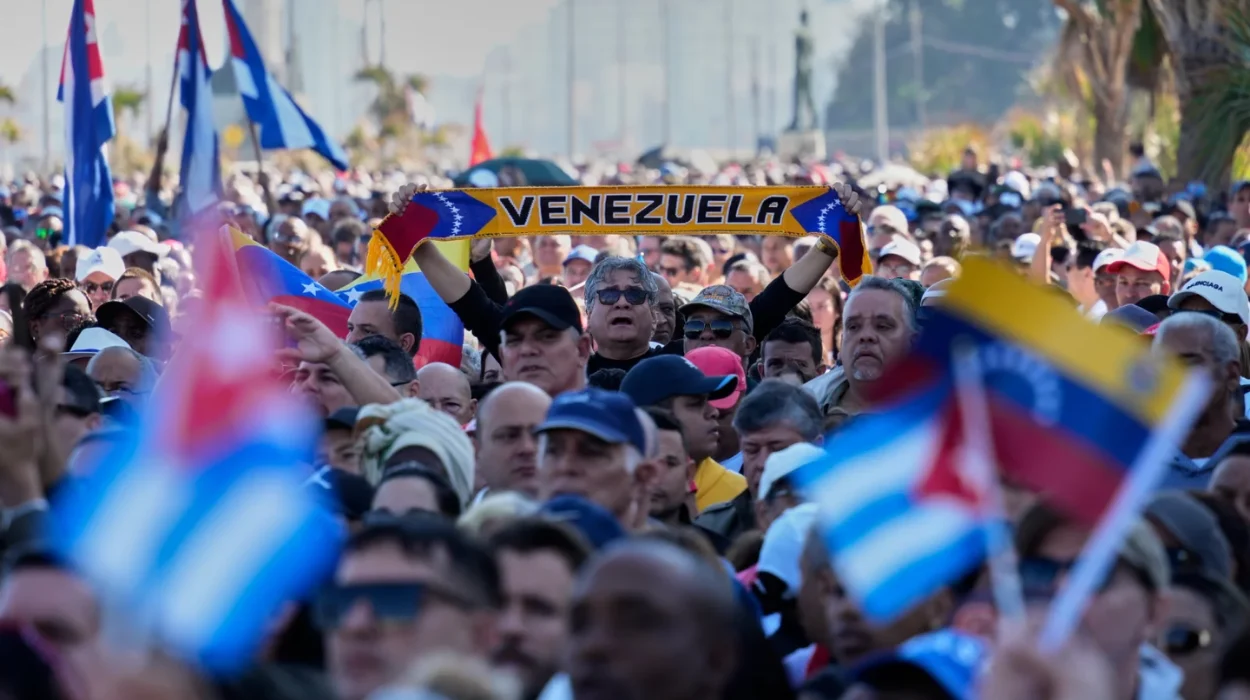
USA (Parliament Politics Magazine) – Following US attacks on Venezuelan military bases and the capture of Nicolás Maduro, Cuba appears increasingly in Trump administration’s strategic focus.
Director Dulce María Limonta del Pozo points to the tanks and weaponry that Cuban forces used to fend off the attack inside the Girón Museum.
“The plan,”
she says,
“was to establish a beachhead and form a transitional government.”
President Trump has revived a nearly 200- year-old political conception with his attack on Venezuela. The idea that the United States has exclusive authority over the Western Semicircle is known as the Monroe Doctrine.
Cuba has a deeper understanding of the counteraccusations of that conception than most other nations. Also, the islet is now again under U.S. scrutiny following Washington’s dramatic intervention in Venezuela.
Limonta del Pozo views the 1961 irruption attempt in Cuba as a turning point for the Monroe Doctrine due to the irruption’s stunning failure. Chroniclers may differ on the specifics.
“It showed the people that we should not fear an empire,”
Limonta del Pozo says.
Cuba’s perception of Washington is still shaped by that lesson.
“Expansionism is in their veins. We are talking about historical ideas and strategies designed more than 200 years ago,”
says Alejandro García del Toro, who handles bilateral relations with the U.S. government.
“So, you cannot be surprised.”
Under President Miguel Díaz-Canel’s leadership, the Cuban government believes that American expansionism is ingrained in American history, starting soon after independence with the Louisiana Purchase in 1803, when the US started methodically driving European countries out of the hemisphere.
These aspirations have been publicly rekindled by President Trump. On Sunday, while traveling to Washington, D.C., Trump told reporters on Air Force One that the communist regime in Cuba would soon fall.
“Cuba looks like it’s ready to fall,”
he said, noting the island’s reliance on Venezuela’s subsidized oil. But he dismissed the idea that U.S. troops would intervene directly.
“I don’t think we need any action. It looks like it’s going down.”
Secretary of State Marco Rubio often says the same thing. Over the weekend, Rubio, a longtime Cuba hawk and the son of Cuban immigrants, sent a warning to Havana.
Cuba and Venezuela have been strong allies for a long time. Cuba has provided security and medical personnel in exchange for Venezuela’s decades-long supply of cheap oil.
The Cuban government claimed that 32 of its citizens, including members of its armed forces and intelligence services, were killed while defending Maduro and his wife during the U.S. effort to seize him. This led to two days of national mourning on the island.
Raul Rodríguez, a scholar at the Center for Hemispheric and U.S. Studies, cites Trump’s previous demands to acquire Greenland and recapture control of the Panama Canal, two long- standing U.S. strategic objects.
“It’s a kind of imperial nostalgia,”
Rodríguez says.
From that angle, after the United States moved west to California, the Caribbean was the next frontier. Furthermore, Rodriguez contends that Cuba, a nation that has opposed US intervention since 1959, may be the deeper aim, even though overthrowing Nicolás Maduro in Venezuela may be in line with US objectives.
According to Rodríguez, Washington’s current hope is that Venezuela’s collapse will cut off Cuba’s decades-long supply of cheap oil, worsening the country’s already dire economic situation and inciting unrest that might overthrow the regime.
“For Mr. Rubio,”
Rodriguez says,
“it would be his coronation and I would argue that this is his ultimate goal.”
These strains are already evident in Playa Girón’s streets. Fabiana Hernández Ortega waits for a truck to deliver milk, a basic necessity that is getting harder to come by. During the Bay of Pigs, her father was taken prisoner by the invading soldiers.
“As Cuban citizens, we feel that moment as a victory,”
Hernández says. But today, she says, they are facing a different struggle.
The administration frequently has to decide between importing food or medicine and keeping the lights on due to economic mismanagement and U.S. sanctions.
Hernández claims that she can no longer consistently locate the medication she requires. Government-subsidized milk, bread, and sugar have become more scarce.
“Right now, we are fighting for our lives,”
Hernández says.
“We live day to day.”
Nevertheless, she shrugs, a popular expression on the island.
“These are the cards we were dealt, so, we keep going. What else can we do?”
As she speaks, the milk truck finally arrives and for a moment, at least, there is relief.
How is Cuba responding diplomatically to the Maduro capture?
Cuba’s politic response to the U.S. prisoner of Nicolás Maduro on January 3, 2026, has been one of vehement commination, framing the operation as” state terrorism” and a direct trouble to indigenous sovereignty.
President Miguel Díaz- Canel declared public mourning, denouncing the strikes as a” felonious assault against our America” and demanding critical transnational intervention to uphold Latin America as a” zone of peace”; Foreign Minister Bruno Rodríguez labeled Maduro’s seizure a” hijacking ” of a licit leader on social media.
Havana expelled U.S. diplomats, rallied abettors like Russia and China via CELAC/ UN channels for UNSC exigency sessions, and heightened military cautions amid claims of 32 Cuban casualties in Maduro’s security detail; no direct retribution gestured, fastening rather on portraying U.S. aggression as precedent for hemispheric domination.
