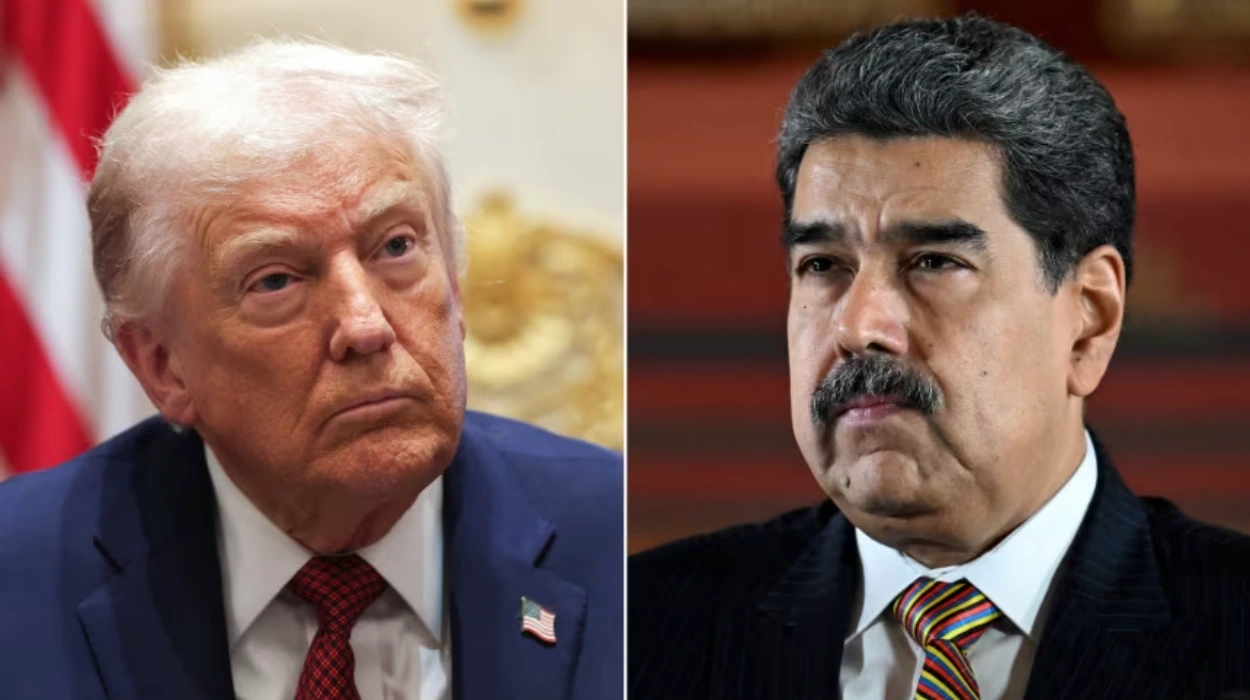
USA (Parliament Politics Magazine) – Donald Trump’s move against Venezuelan leader Nicolás Maduro marks a new phase of assertive US power, reshaping global political dynamics.
Abducting a sitting president from his capital in the middle of the night is one of the most blatant examples of unchecked power.
In a 74-word social media post, President Donald Trump demonstrated his ability to act decisively, abruptly, and possibly recklessly in pursuit of his many foreign policy objectives, with little concern for precedent, consequences, or, it appears, international law.
For what the US refers to as a fugitive with a $50 million bounty on his head, the effort to transport Venezuelan President Nicolás Maduro and his wife from their closely guarded location in Caracas to presumably face the American legal system follows a typical, if extreme, pattern.
However, there is a serious caveat in this case: Maduro is a head of state whose country is vulnerable to a number of continuing US political goals. This will always feel political, regardless of what the indictments say.
For various reasons, such as combating drug trafficking, oil, or regional alignment, successive White Houses have sought to overthrow Venezuela’s left-leaning but dictatorial and occasionally violent dictatorship.
One of the main justifications for Trump’s second term was to put an end to Maduro’s position as the head of a large regional drug trafficking network. However, they encountered a dilemma when they proposed that Maduro simply resign from office: he could not be both the kingpin and a man who could abruptly resign from his position.
In addition to being better for US hydrocarbon markets, a compliant Venezuela offers millions of Venezuelans who are currently fleeing to the United States a place to return.
However, it is now unclear what will happen next or if there is a direct successor who is prepared to bear the same risk of kidnapping. It’s also unclear if this sparks anti-American rage or ushers in days of celebration following the overthrow of a government that mismanaged Venezuela’s economy into collapse.
Trump has won with Maduro’s exit, but anarchy or collapse following him would be a cascading loss. The startling demonstration of US power over Caracas’ sky early on Saturday morning is less significant than the strategy for “what next.”
What are the likely international law implications of the operation?
The U.S. operation to capture Venezuelan President Nicolás Maduro via targeted strikes raises profound challenges under transnational law, primarily violating core UN Charter proscriptions while potentially invoking queried tone- defense claims.
Composition 2( 4) of the UN Charter bans force against another state’s territorial integrity; the raid constitutes an fortified irruption without Security Council authorization or Venezuela’s concurrence, akin to the U.S. Nicaragua( 1986) ICJ ruling condemning extraterritorial enforcement.
Customary law prohibits intervention in internal affairs, including unilateral apprehensions of foreign leaders; precedents like the 1989 Noriega prisoner faced analogous reviews but demanded formal ICJ adjudication, potentially stealing future ” rendition” operations.