
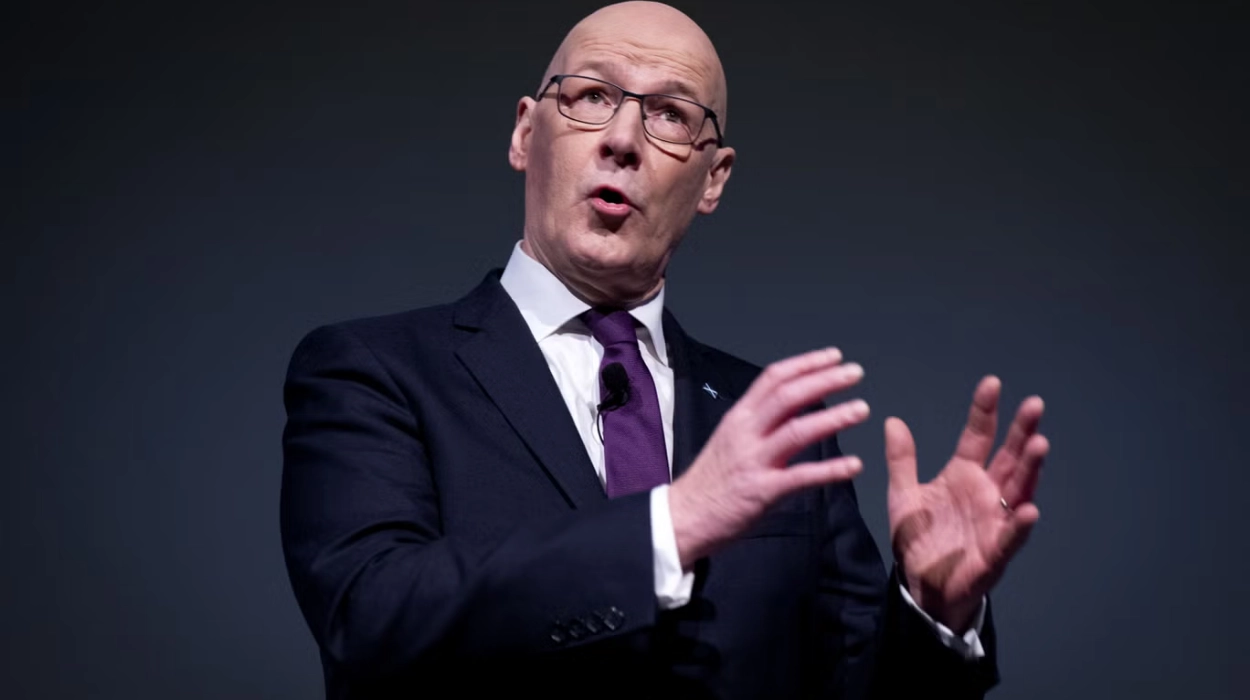
Glasgow (Parliament Politics Magazine) – SNP leader John Swinney says Scottish independence could cut energy costs by a third, freeing funds for the NHS and economic development.
As reported by The Independent, John Swinney said an independent Scotland could cut household energy bills by a third, with savings supporting the NHS and economic growth.
What did John Swinney say about Scottish independence and energy policy?
John Swinney argued Scotland could benefit from independence, putting
“Scotland’s energy in Scottish hands.”
Five months before the Holyrood election, with the SNP aiming to win a majority of seats to secure a second independence vote, the party leader highlighted the
“fresh start only independence can bring.”
The First Minister claimed that the UK’s north-east Scotland oil and gas industry had been “left high and dry” by the energy profits levy.
Mr Swinney warned that the levy, introduced by the former Conservative government and upheld by Labour, is
“sucking the economic life out of one of our country’s most dynamic and important industries.”
The SNP leader said he made clear to Prime Minister Sir Keir Starmer the “existential threat” facing the industry. He stated,
“I left him in no doubt that, unless he changes course, what we face is a second wave of 80s-style deindustrialisation, 80s-style economic devastation.”
Mr Swinney added,
“Sir Keir Starmer is an even less popular Prime Minister than Liz Truss – and that takes some doing. But if he does not change course on the energy profits levy, he will enter our national story as a second Thatcher, a second destroyer of industry, a second destroyer of communities, and Scotland will not forget.”
In a speech, the First Minister criticized the energy profits levy and called for Scotland to pursue
“a different path, a different future.”
According to him, independence would provide a
“fresh start from the Westminster system”
and a
“fresh start financially and economically.”
Mr Swinney insisted that
“with Scotland’s future in Scotland’s hands, our nation, our fellow citizens, can finally see the benefit of our vast energy wealth.”
The First Minister said that after the switch to renewable energy, Scotland’s resources were once “just oil” but are now “Scotland’s energy,” echoing a former SNP slogan.
He added that leaving the UK would enable Scotland to use its
“energy wealth to deliver a true transformation of society and the economy.”
Mr Swinney said analysis released for the energy regulator Ofgem had predicted a
“different policy approach would enable Scotland to have the lowest wholesale electricity prices in western Europe.”
The SNP leader added that scrapping
“unnecessary costs like the UK’s nuclear levy”
would allow Scotland to “deliver significant benefits.”
He stated that this
“includes being able to lower household electricity bills by over one third.”
Mr Swinney argued that this would be
“a big saving for families across Scotland, offering the real hope that cost-of-living pressures will finally begin to ease.”
The First Minister said,
“Think what that will mean for our NHS. Less money spent on energy bills means more money to spend on doctors and nurses, on more operations and appointments.”
He insisted there was
“no doubt a policy of low energy costs for Scottish businesses can be as transformational for our country and its prospects as the policy of low corporation tax was for Ireland.”
The SNP leader continued,
“With a commitment to delivering low energy costs as the bedrock of our national economic strategy, we can not only make every Scottish business more competitive than it is today – creating new jobs, better paid jobs, opening up new opportunities for investment, innovation and growth. We can attract new business to our shores.”
What did Tories say about John Swinney’s independence push?
Scottish Tories accused John Swinney of
“pushing his independence obsession at every turn,”
despite ordinary Scots wanting him to “move on.”
The deputy leader, Rachael Hamilton, said,
“This latest speech just sums up why we must get rid of the SNP at next year’s Holyrood election.”
She stated,
“If we don’t, the nationalists will spend another five years demanding an independence referendum to the further detriment of Scotland’s economy and public services.”
Ms Hamilton added,
“Our NHS is in the grip of a winter crisis, people are struggling with rising bills and Scotland’s education system is a shadow of its former self, but still John Swinney can only focus on his lifelong obsession with breaking up the United Kingdom.”
What did the poll reveal about Scottish politics and independence?
The latest YouGov poll shows 56% of Scots disapprove of the Scottish government, while 75% disapprove of the UK government. At the same time, 37% said they might vote SNP in the next general election.
The survey reveals that only half of 2024 Scottish Labour voters would consider backing the party again. Meanwhile, the public is almost evenly split, 49% to 51%, on whether they would support independence in a second referendum.
According to the survey, John Swinney is the top-ranked party leader in Scotland.
Another poll finds Sir Keir Starmer slightly less popular than US President Donald Trump in Scotland, with 16% of Scots viewing Starmer favourably versus 20% for Trump.
