

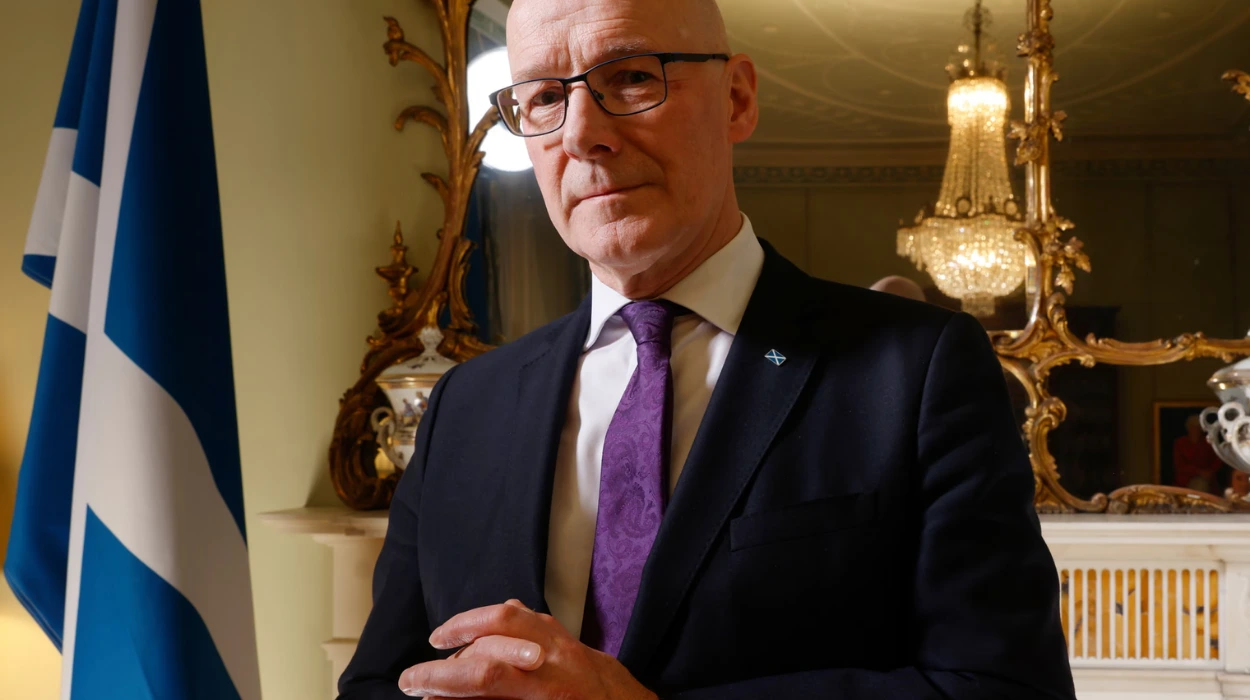
Scotland (Parliament Politics Magazine) – Scotland’s First Minister John Swinney defends immigration, citing economic benefits and diversity amid rising support for Reform UK ahead of May elections.
As reported by The Guardian, John Swinney argued that immigration strengthens the working-age population, defending diversity amid Nigel Farage’s Reform UK gaining support ahead of May’s Holyrood elections.
What did John Swinney say about immigration?
John Swinney highlighted a notable shift in public opinion, with Reform UK securing 26% in its first Holyrood election test.
He said,
“Of course I am concerned about it because I believe with every fibre of my body in the importance of inclusion within our society. During my lifetime Scotland has become a much more diverse country. I’m very proud of that, and I want to make sure that remains our fundamental outlook.”
With 750 Reform UK supporters gathering for an event, Mr Swinney admitted some would be drawn to the party’s core prejudicial appeal.
Addressing protests at sites accommodating asylum seekers, the First Minister denied that far-right sentiment in East Kilbride, Falkirk, Perth, Aberdeen, and Inverness was widespread, though he noted Reform UK had some mobile support.
He said,
“What the far right do is to apportion the blame for those concerns to asylum seekers or migrants and I think that is the root of the poison that Farage and his cohorts are spreading within Scotland.”
Mr Swinney clarified that far-right views are separate from legitimate concerns about public services and community safety, noting these issues affect all areas, not just migrant sites.
The First Minister expressed willingness to listen but stressed rational debate on migration’s economic benefits amid public frustration over living standards.
Mr Swinney said he regularly engaged with businesses facing staff recruitment challenges.
He stated,
“We have a problem with the size of our working-age population, which I think needs to be addressed by migration. It’s in all of our interests to have a welcoming economy that brings people in, can generate wealth and makes us all much wealthier as a consequence.”
He acknowledged engaging with constituents who expressed “strong opinions.”
Mr Swinney added,
“My approach is not to dismiss people’s legitimate concerns, but I would engage with them and give them an alternative point of view. My job as first minister is to do as much as I can to overcome those attitudes, to persuade them not to vote for Reform.”
The First Minister continued,
“Let’s not think that the only pressure on public services is because of migration. We’ve been swimming against the tide of austerity since 2010, where public services have been consistently undermined through reductions in funding by the UK government.”
He questioned whether fears over public services should target the UK government instead of asylum seekers.
Mr Swinney said,
“We’ve taken decisions to break out the mould of austerity, like asking higher earners to pay more taxations so we can begin to invest in public services.”
He dismissed claims of complacency, highlighting numerous government programs supporting community cohesion and integration.
The First Minister cited the Brexit referendum, in which most Scots voted to remain, as proof that Scotland’s views initially differed from those of the rest of the UK.
Mr Swinney rejected concerns that criticizing Reform UK could boost its vote, citing the Hamilton byelection where the SNP lost to Labour and Reform secured a strong third.
He said,
“The visibility of their support is clear and if I don’t acknowledge that, you could quite easily say to me that I’ve missed something very significant in front of my eyes.”
Ahead of the SNP’s initial Holyrood campaign, Mr Swinney expressed concern that Reform UK could win several Scottish Parliament seats, with surveys suggesting high-teen gains under proportional voting.
Mr Swinney declined to confirm if the SNP would team with Labour to sideline Reform, but firmly ruled out working with Reform and aims for a majority.
He warned that, post-May, political shifts could bring a Plaid Cymru first minister in Wales, a Sinn Féin first minister in Northern Ireland, and an SNP first minister in Scotland.
The First Minister added,
“The UK government would have an altogether more challenging set of circumstances on its hands.”
What did recent polls reveal about Scotland’s political landscape?
The poll shows Nigel Farage ranks above Prime Minister Sir Keir Starmer in Scotland, challenging the SNP’s image of the country as welcoming amid asylum hotel protests and flag demonstrations.
The survey reveals immigration ranks as a key priority for Scottish voters, with focus groups highlighting frustration over politicians dismissing these concerns, echoing trends in England and Wales.
The poll puts the SNP back on top after a poor general election performance, while Labour drops to second amid widespread UK government unpopularity.
How many seats could each party win in the next general elections?
The recent YouGov poll shows Reform UK would win 311 seats, just 15 short of a majority. It projects Labour would secure 144 seats, a sharp decline from 2024.
According to the poll, Conservatives would be reduced to 45 seats, marking further losses.