If you had predicted on the morning after the 2024 General Election that the political landscape of April 2026 would look like a fragmented kaleidoscope, most Westminster observers would have suggested a lie-down and a strong cup of tea.
Yet, here we are. The latest bombshell polling from Lord Ashcroft has sent shockwaves through the corridors of power, suggesting a British electorate that hasn’t just turned its back on the two-party system but appears to be actively dismantling it.
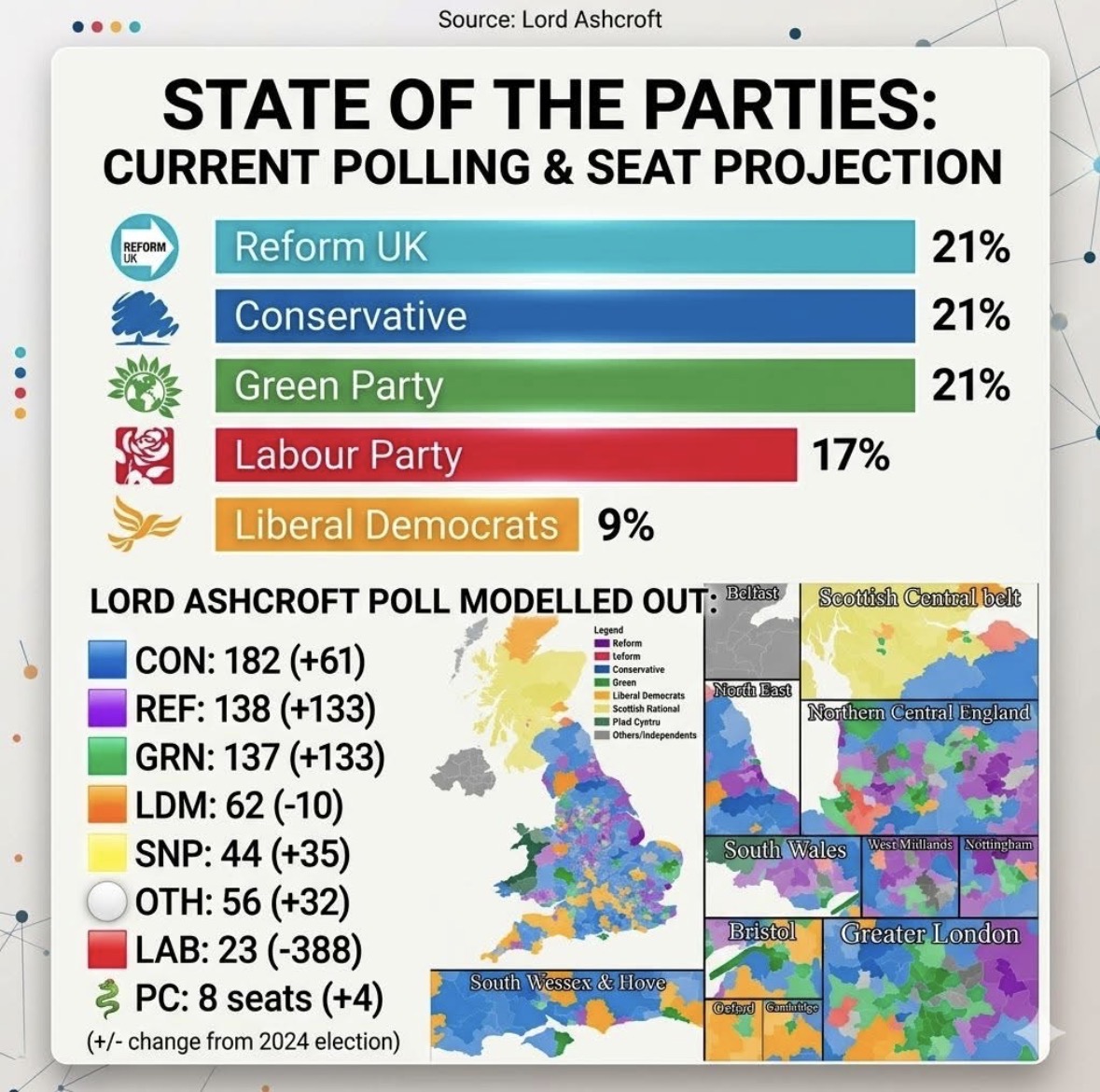
In what is being described as a “tectonic shift” in UK politics, a three-way tie has emerged at the top of voting intentions. Reform UK, the Green Party, and the Conservative Party are all sitting level at a remarkable 21 per cent each.
For the first time in history, the “Big Two” are no longer the ones setting the pace. Yes, there have been times in the recent past, when what we might call a challenger party has briefly forced its way up the polls, the SDP in 1983, the Lib Dems in 2010 with “Clegg mania” and UKIP in 2014, but this tends to be short-term and at the expense of one, not both of the Big Two.
The most significant headline from the Ashcroft data is the unprecedented rise of the Green Party. Under the leadership of Zack Polanski, the Greens have achieved what was once thought impossible: joint first place in a major national poll.
Polanski’s platform has struck a chord with a public weary of Starmer’s centrist pragmatism that for those still struggling with the cost of living crisis feels more like stagnation. The Greens have moved beyond being a single-issue environmental pressure group, pivoting toward an economic radicalism not seen in the UK since the 1980s. Their flagship policies of a wealth tax and a mandatory £15-an-hour minimum wage, seems to be galvanising both younger voters and former Labour supporters who feel living standards have stalled.
While the Green surge continues, the populist right appears to be treading water. Reform UK, led by the perennial disruptor Nigel Farage, has, according to this poll, seen its outright lead evaporate. Dropping to 21 per cent from previous highs of 25 per cent in late 2025, (N.B. other polls still give Reform a lead).
It has been suggested that several factors have contributed to this cooling of Reform’s momentum. Some commentators have suggested the party’s stance on the Iran War, represented a misstep by the leadership, while others have suggested that the party still doesn’t have a full policy offering to sell to voters, or that comments made by some of their candidates have caused embarrassment.
Whatever the reason, Reform has a stern test this May. Should they underperform, it will be suggested that the party has reached its upper limits in support, but this has been said before and disproved.
Turning to Big Two, for the Labour Party, the Ashcroft poll is nothing short of an existential threat. Slumping to 17 per cent, marks a historic low for a sitting government just two years into a landslide mandate.
Sir Keir Starmer’s Government, which was supposed to bring an end to the “Tory psycho drama” and restore competence, has failed. Rocked by a series of scandals such as the appointment of Peter Mandelson, industrial unrest, tax rises and a sluggish economy, the PM has the lowest popularity ratings of any sitting Prime Minister, yes, even lower than Liz Truss.
The Conservatives by comparison, have stabilised their polling rating, even seeing a modest increase to 21 per cent, but this is still within the margin of error, under its new leadership. Benefiting from the collapse of the Labour vote the Conservatives are still trying to rebuild their battered brand, trying to appeal to their former voters who are spooked by the Greens’ wealth tax proposals and saying they have learned from the mistakes of the past. However, they remain a shadow of their former selves, locked in a battle for survival against the very insurgents they once dismissed and ridiculed.
Looking north of the border, the polling suggests that misery for Labour isn’t confined to Westminster. In Scotland, the situation is dire. The data suggest that Labour has fallen behind the SNP once again. Projections for the next election show the SNP maintaining its dominance with 47 seats, leaving Labour with just 31.
This resurgence of the SNP indicates that the “Labour surge” in Scotland was a temporary loan rather than a permanent shift. As the Holyrood elections approach, the SNP is successfully framing the Westminster government’s struggles as proof that Scotland’s interests are being ignored by a failing Union.
What this all means for the elections in May is something of a bloodbath for the two traditional main parties, with the Greens, Reform and nationalist parties the beneficiaries.
But, does 2026 mark a fundamental shift away from the two-party system, or merely mid-term discontent?
This question is still being debated.
While we are in unprecedented waters of having two challenger parties riding high in the polls, support for the five national parties, according to this and other polls, remains close, meaning a movement of a handful of percentage points could catapult Labour back to the top spot or see them drop to fifth place – as it would impact the other parties. And with international events impacting our domestic agenda like never before, one thing looks certain: the volatility in the polls is likely to continue, and those suggesting otherwise are just guessing.