

The Napoleonic Wars were a collection of significant wars that lasted from 1803 to 1815 and, along with the French Revolution, altered the world. France, led by the revolutionary general Napoleon Bonaparte, challenged a fluctuating group of European countries.
At the core of the coalition was Great Britain. For over a decade, Britain survived as a world power. The impact of the years of war was significant for everyone from the government in London to the poorest farmer in the countryside. Wartime shifted national power and changed the daily lives of its people in ways that still matter today.
The Rise of a Global Superpower
Before the war, Britain was a powerful nation. After the war, Britain was the uncontested superpower for the next century. The defeat of Napoleon not only secured victory in the war. It cleared the way for the British Empire to establish its control over the balance of power in the 1800s.
Unchallenged Naval Dominance
Britain’s strongest weapon was its navy. The Royal Navy, led by admirals such as the famous Lord Nelson, who won the epic battle of Trafalgar in 1805, vanquished the French navy at sea. No other nation could contemplate challenging British ships at sea. This control of the seas had two benefits:
- It provided security against invasion. Napoleon’s ships could not cross the single gap of the English Channel if his soldiers could march across Europe.
- It enabled Britain to control world trade.
Britain’s trade ships could carry and supply goods, and they could block enemy ports, shutting down the French economy.
A Growing Empire
The war was happening in Europe, Britain was also able to expand its empire across the globe. Many French colonies and allied colonies were captured by British forces. British territory was marked in red on the map, with strategic naval bases added to its empire and important resources like Malta, the Cape of Good Hope (of South Africa), and parts of the Caribbean.
The Workshop of the World
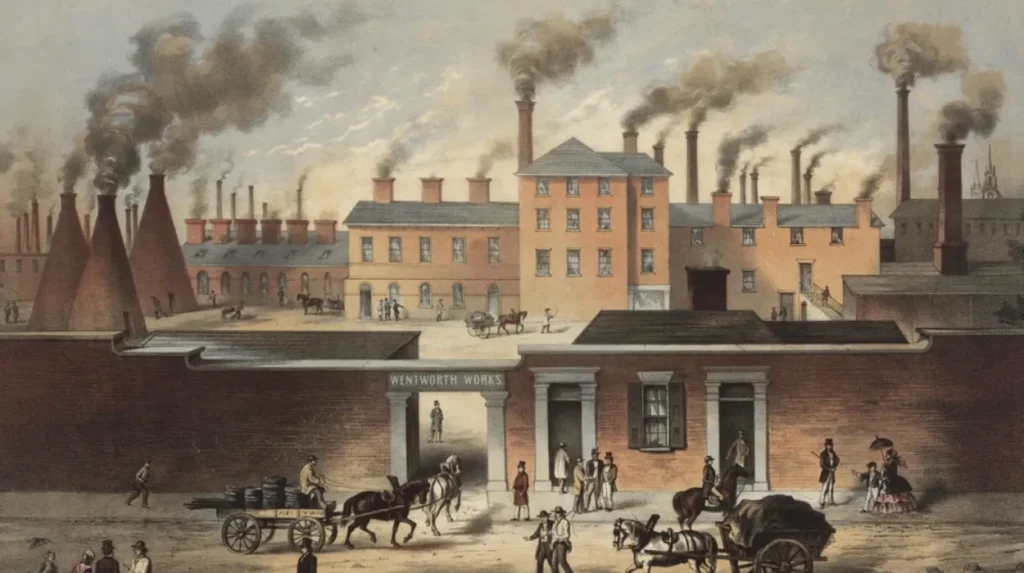
The war massively increased British industry. To supply the army and navy, factories had to produce bulky amounts of uniforms, boots, weapons, and ammunition. This demand created new inventions and more efficient ways to produce, most importantly in the textile and iron industries.
The war and innovation established the conditions for economic and industrial development that would lead to the Industrial Revolution. By the end of the war, Britain was able to squeeze large gains in manufacturing, leading to it receiving the nickname “the workshop of the world.”
The Heavy Price: The War’s Impact on the Life and Employment of British People
The development of increasing power has another aspect. The human costs of the war caused immense loss, reaching almost every family in the nation.
The Burden of Taxes and Debt
War is very expensive. The British government paid excessive taxes. There were taxes on all sorts of things, from the number of windows a house had to necessities like salt, sugar, and soap. This caused great strain on average households.
The government borrowed astronomically large amounts of money too, placing Britain in national debt. It took over a hundred years to pay off. This financial pressure would influence British economic policy for generations.
Hardship and Hunger on the Home Front
One of Napoleon’s goals was to hurt Britain economically through a policy termed the “Continental System.” This was an edict forbidding European nations from trading with Britain. In return, Britain blockaded European ports.
The trade war had a disastrous impact on farmers’s and workers’s livelihoods and an impact on everyone. With grain imports from Europe cut off, the price of bread, the staple food for most people, rose dramatically. This led to hunger and great suffering for the poor. Poor harvest conditions added to the problem, causing riots in many towns and cities.
Social Unrest and Seeds of Reform
The end of the war in 1815 was not the peace and prosperity many had been praying for, but instead, the beginning of a serious economic depression. Hundreds of thousands of demobilized soldiers and sailors returned home to find too few jobs.
To make matters worse, the landowner-led government passed the Corn Laws in 1815. The Corn Laws taxed the imported grain to protect British farms profits, keeping the price of bread artificially high, enriching the landowners, starving the poor.
This injustice prompted anger and protest. The post-war years witnessed mass protests such as the Peterloo Massacre in 1819, when cavalry charged into a peaceful crowd who were calling for political reform. The government initially responded with repressive laws, but the genie was out of the bottle.
The war had created a new political consciousness among the working and middle classes, sowing the seeds for the great reform movements of the 19th century.
A Divided Legacy: Progress and Pain
The legacy of the Napoleonic Wars upon Britain was one of two sides.
For the state and empire of Britain, it was a wild success. It secured naval domination, population growth of the empire, and initiated the industrial age. It began a long period of global British superiority known as the Pax Britannica.
For millions of ordinary Britons, it was a time of extreme hardship, increased taxation, scarcities of food, and political repression. The distance between rich and poor had become extreme.
A Forged Nation
How did the Napoleonic Wars affect Britain’s power and people? The answer is deeply complex. The wars shaped modern Britain. They created a global superpower that would dominate the nineteenth century and built an empire where the sun never set. Their industrial and military advantages were self-evident.
But this power came from its people sacrificing. The ongoing conflict exposed deep-seated social issues and inflicted economic pain that grew into a prolonged struggle for fairness and from social imbalance to political representation.
The memory of post-war challenges resulted in the Great Reform Act of 1832 that would pave the way for discussion of centuries of meaningful change in the British political system.
The wars, specifically the Napoleonic Wars, made Britain much stronger on the world stage; they also made Britain confront its challenges at home. It was a turning point for the country that helped determine the nation’s destiny, for the good and the bad, for the next one hundred years.
