

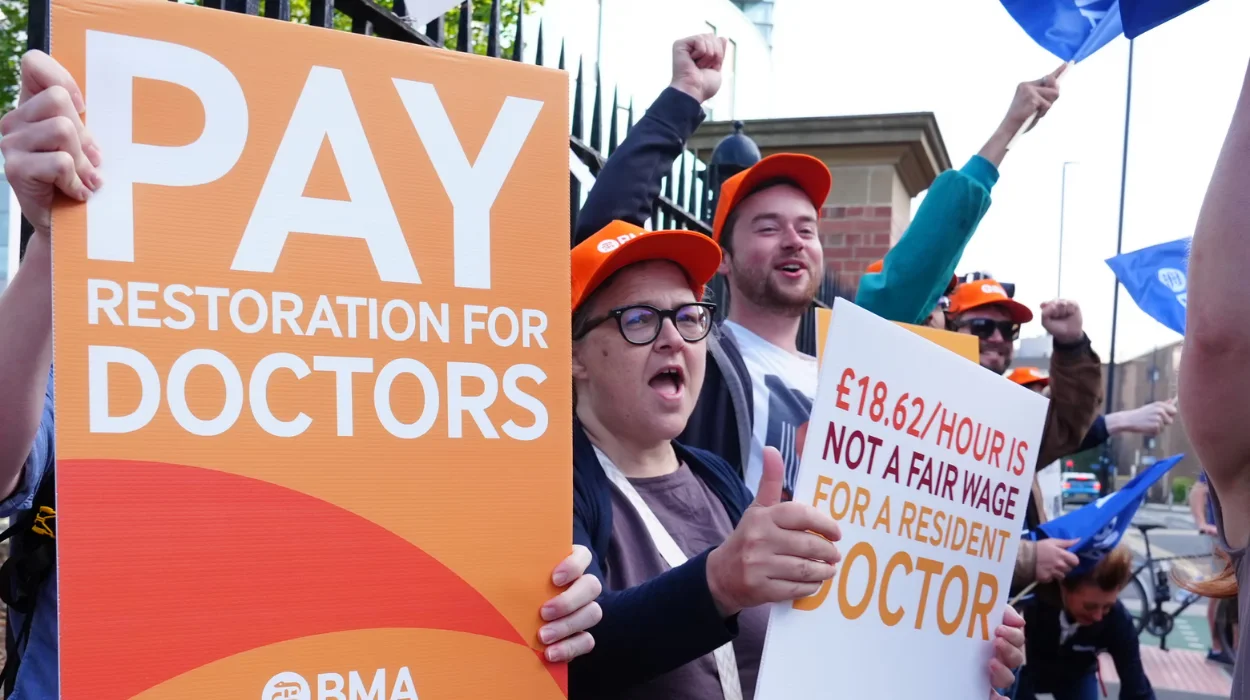
UK (Parliament Politics Magazine) – Resident doctors vote 83% to strike for five days after rejecting the government’s pay and jobs offer, increasing pressure on the NHS during the winter crisis.
As reported by Denis Campbell of The Guardian, resident doctors in England will go ahead with their planned strike on 17 December after rejecting the government’s latest offer to end the long-running pay and staffing dispute.
Health Secretary Wes Streeting proposed the deal last week, offering more training places for junior doctors in their chosen specialties, while leaving their pay unchanged for this year.
What did the BMA survey reveal about resident doctors’ strike plans?
After a survey conducted by the British Medical Association, resident doctors, formerly known as junior doctors, have voted to begin a five-day strike on Wednesday.
According to the BMA survey, 83% of resident doctors rejected the government’s offer, while 17% supported it, with a 65% turnout. In total, 35,107 of the 55,000 resident doctors took part.
Describing the government’s offer as “too little, too late,” the union said the industrial action will go ahead, starting at 7 am Wednesday and ending at 7 am the following Monday.
The strike is expected to add pressure on hospitals, which are already struggling with the early onset of the NHS winter crisis, driven by a virulent “super flu.” This will be the 14th strike since the dispute began in March 2023.
What did Dr Jack Fletcher say about the resident doctors’ strike and the Government’s offer?
Dr Jack Fletcher, the head of the BMA’s resident doctors committee, said,
“Our members have considered the government’s offer, and their resounding response should leave the health secretary in no doubt about how badly he has just fumbled his opportunity to end industrial action. Tens of thousands of frontline doctors have come together to say ‘no’ to what is clearly too little, too late.”
He said,
“There are no new jobs in this offer. He has simply cannibalised those jobs which already existed for the sake of ‘new’ jobs on paper. Neither was there anything on what Mr Streeting has said is a journey to restoring our pay – that has clearly hit the buffers.”
The BMA chair reiterated that resident doctors remain determined to achieve their long-term goal of full pay restoration, despite declining public support.
Mr Fletcher stated,
“This week’s strike is still entirely avoidable – the health secretary should now work with us in the short time we have left to come up with a credible offer to end this jobs crisis and avert the real terms pay cuts he is pushing in 2026. We’re willing to work to find a solution if he is.”
He accused Mr Streeting of
“scaremongering the public into thinking that the NHS will not be able to look after them and their loved ones.”
Mr Fletcher described the Health Secretary’s actions as “cruel and calculated,” saying Streeting
“fails to engage with us outside strikes and then presents an offer he knows is inadequate, expecting us to accept it within 24 hours.”
How did Wes Streeting respond to the BMA vote on Christmas strikes?
Commenting on the BMA’s vote, Wes Streeting said,
“The BMA has chosen Christmas strikes to inflict damage on the NHS at the moment of maximum danger, refusing the postpone them to January to help patients and other NHS staff cope over Christmas.
There is no need for these strikes to go ahead this week, and it reveals the BMA’s shocking disregard for patient safety and for other NHS staff. These strikes are self-indulgent, irresponsible and dangerous.”
“The government’s offer would have halved competition for jobs and put more money in resident doctors’ pockets, but the BMA has again rejected it because it doesn’t meet their ask of a further 26% pay rise.
Resident doctors have already had a 28.9% pay rise – there is no justification for striking just because this fantasy demand has not been met,”
the Health Secretary added.
What did Keir Starmer say about resident doctors’ planned strikes?
Prime Minister Sir Keir Starmer called it “frankly beyond belief” that resident doctors would strike during the NHS’s critical period, risking tensions with staff.
He said,
“I am a Labour prime minister, who believes in workers’ right to strike. But let’s be clear when it comes to the strikes planned by resident doctors next week. They should not happen. They are reckless.”
The prime minister stated,
“Right now, resident doctors’ colleagues will be cancelling operations, cancelling their Christmas leave and preparing for this coming storm. The idea that strikes could still take place in this context is frankly beyond belief.”
Mr Starmer added,
“The ‘super flu’ epidemic now sweeping the country is the NHS’s most precarious moment since the pandemic,” he said. “Last week, an average of 2,660 hospital beds each day were occupied by flu patients – up 55% on the week before and much higher than this time last year. And the epidemic is still growing.”
When are resident doctors set to go on strike?
Resident doctors in England, represented by the British Medical Association (BMA), are set to begin a five-day strike on Wednesday, December 17, 2025. It will end on Monday, December 22, 2025, at 7:00 AM.
The BMA confirmed on Monday that its members overwhelmingly rejected a government offer that addressed training posts and expenses but did not include additional pay.
How do the public view resident doctors going on strike?
A YouGov poll released on Friday, December 12, 2025, shows that public support for the upcoming resident doctors’ strike is low.
The poll finds around 33% (a third) of the public either “strongly support” or “somewhat support” the industrial action. It reveals roughly 58% of people “somewhat oppose” or “strongly oppose” the strike. This polling comes as the NHS faces record levels of flu cases.
What is the average pay of UK doctors, and what are resident doctors demanding?
Doctors’ salaries in the UK vary significantly based on grade and experience, following a 5.4% pay uplift implemented in April 2025. The doctors’ key demands include a further 26% pay rise, phased over several years.
The BMA argues that real-terms pay has fallen by roughly 20% since 2008 when adjusted for inflation. They also want a commitment to creating new specialist training posts rather than “cannibalizing” existing ones.
The basic annual salary of doctors as of April 1, 2025, is:
- Foundation Year 1 (FY1): £38,831 per year
- Foundation Year 2 (FY2): £44,439 per year
- Specialist Training (ST1–ST2): £52,656 per year
- Specialist Training (ST6–ST8): £73,992 per year
- Salaried GP: £76,038 – £114,743 per year
- Specialty Doctor: £61,542 – £99,216 per year
- Consultant: £109,725 – £145,478 per year