

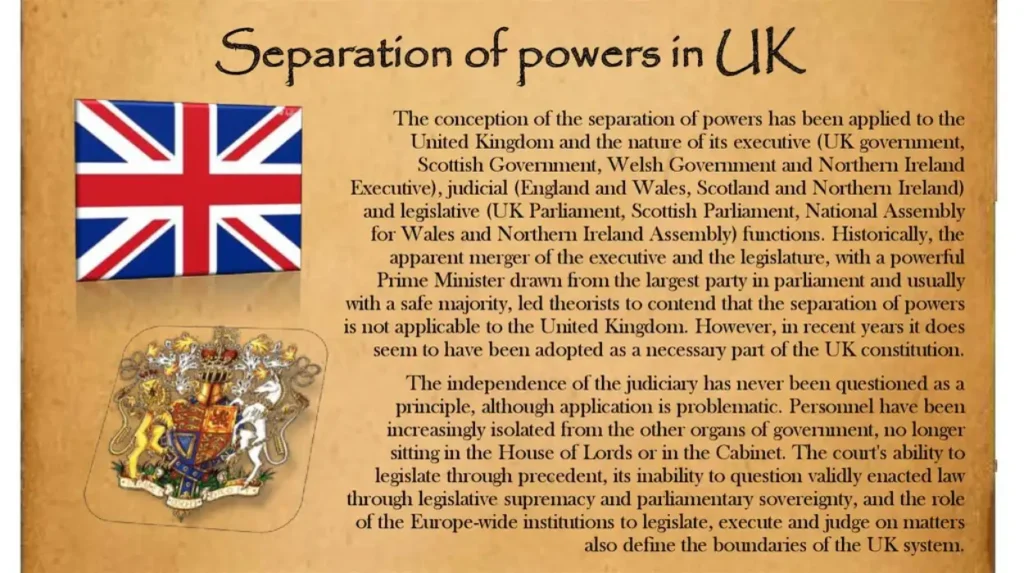
Separation of powers is associated with modern democracies, implying that political power should be separated between three branches: the legislature, executive, and judiciary. The branches of state should operate independently of one another; the potential of misusing power is reduced. In the United Kingdom, the position is somewhat different. The British Constitution does not create a clear separation of powers. The British Constitution establishes a loose arrangement. The government shares power, and the three branches intermingle.
What Is the Separation of Powers?
The concept of separation of powers was developed in the 18th century by the French philosopher Montesquieu. He claimed that liberty is best preserved when no single branch of government has total power. The Three Branches Defined
- Legislature: Makes laws (in the UK this is Parliament).
- Executive: Carries out laws (in the UK, this is the Government led by the prime minister and cabinet).
- Judiciary: Interprets laws and ensures justice (in the UK, this is the system of courts).
These branches should be independent of one another. In practice, particularly in Britain, the boundaries between the branches are blurred.
Parliament and the Executive: A Close Connection
One of the most obvious indications that the separation of powers is not rigid in the British Constitution is the way that Parliament and the Government are connected.
Ministers in Parliament
UK ministers, including the prime minister, are members of Parliament. The Canadian Constitution does not have a rigid separation of powers. There is overlap between the legislature and executive, which would not be allowed in a rigid separation system.
The Fusion of Powers
The UK operates under what many scholars refer to as a “fusion of powers,” meaning that the executive is drawn from the legislature and is directly accountable to it. This creates a thread of connection between the two branches.
The Judiciary: More Independence
The judiciary in Great Britain has gradually achieved greater independence than the legislature or the executive. The courts do not make legislation, as Parliament does. The courts interpret legislation, adjudicate cases, and ensure that governmental actions are done in accordance with the law.
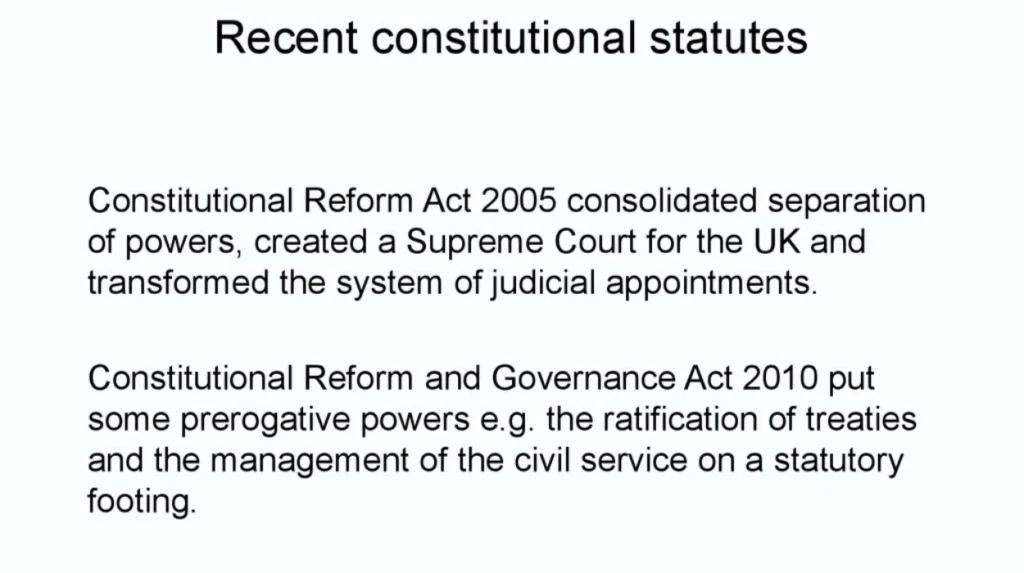
The Constitutional Reform Act 2005
One major factor in achieving independence for the judiciary occurred with the Constitutional Reform Act 2005, which led to the creation of the UK Supreme Court in 2009, which has a completely separate and distinct existence from the House of Lords, and eliminated the role of Lord Chancellor, who held positions in all three branches. This reform highlights the fact that Britain does not have full separation of powers; it is moving in certain areas closer to separating powers.
Checks and Balances Rather Than Strict Separation
The British Constitution relies more on checks and balances than on strict separation.
- Parliamentary Control: The executive branch is held accountable to Parliament in a variety of ways, including Prime Minister’s Questions, debates in MPs, and select committees.
- Judicial Review: The courts can review the decisions of the government to ensure the legality of actions. For example, during the Miller litigation on Brexit, the judiciary curtailed the power of the executive branch by requiring parliament to approve certain decisions.
- Role of the Monarch: The monarch, mostly a symbolic role today, also represents a further check since all laws still formally require royal assent, although royal assent is always given.
The Differences of Separation of Powers Between the United States
To appreciate the uniqueness of the British Constitution, it helps to compare it to the American Constitution. In the United States, the president cannot sit in Congress, and judges are entirely separate from both. Separation of powers is explicitly set out in the Constitution, and it is strictly adhered to. In Britain, the Prime Minister acts as head of government and is a member of Parliament. Judges are more independent than before, but Parliament is still sovereign. The British model allows for more flexibility and is less rigid.
Is the separation of powers real in the British Constitution?
The answer is both yes and no. Yes, because the judiciary has been made more independent, and there are systems of checks and balances between branches of government.
No, because the executive and legislature are still very closely connected. Overall, the best form would be a fusion of powers with important checks, rather than a strict separation.
Advantages of Britain’s Flexible System
Though the lack of rigid separation may be seen as a negative point, there are advantages as well.
- Strong Accountability: The executive is in Parliament, and the ministers answer directly to elected officials. This means that in comparison to some other systems, there is more accountability.
- Flexible Governance: An uncodified constitution allows Britain to react to changing circumstances without having to change the constitution all the time.
- Rapid Decision-Making: The fusion of Parliament and the Government can make passing laws quicker than in systems where the branches of government are completely separate.
Disadvantages of Limited Separation
There are also disadvantages.
- Potential for Executive Domination: When one party is dominant, they will have significant power over Parliament and Parliament’s ability to scrutinize them, meaning there is little perceived accountability.
- Limitations on Common Law: The judiciary remains independent. Unlike the courts of the USA, which may strike down acts of Parliament, the courts can’t strike down legislation, which limits the judicial powers as a check on power.
- Blurred Lines: The crossover of branches can mean that it is sometimes unclear where accountability lies.
Examples of Separation in Practice
To examine what separation of powers within the British Constitution looks like, it is helpful to consider examples.
- Parliamentary Accountability: The “Partygate” scandal that occurred during Boris Johnson’s government provided an example of the power of Parliament to interrogate and investigate the executive.
- Judicial Review of Government Decisions: In the 2019 prorogation of Parliament case, the UK Supreme Court found that the government’s decision was unlawful in the role of the courts in reviewing and checking governmental action.
These examples show that the separation is not absolute, there are working checks present.
