

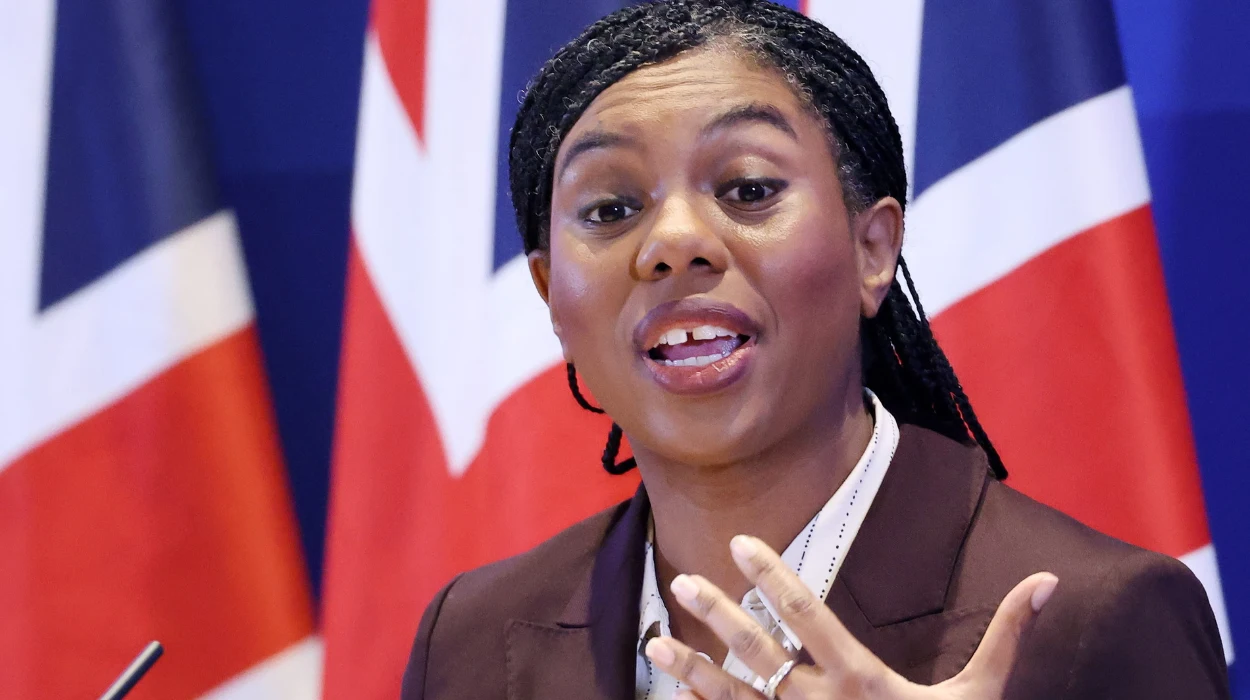
UK (Parliament Politics Magazine) – Conservative leader Kemi Badenoch plans a review of UK benefits, limiting support for low-level mental and physical conditions to reduce spending.
As reported by The Guardian, the Conservative Party has launched a policy review to reduce the cost and scope of the benefits system, with Kemi Badenoch warning that the rise of
“low-level mental conditions”
is making it unsustainable.
What did Kemi Badenoch say about reforming UK benefits and welfare?
Kemi Badenoch suggested the review may introduce time limits on certain benefits, considering both when support begins and how long it should last. She also recommended scrapping relative poverty as a measure of deprivation, arguing it ignores improvements in people’s circumstances when the economy grows.
At a London event, Ms Badenoch said she and three frontbench colleagues will next year examine
“the most challenging and complex aspects of work and welfare in the country”
under the party’s
“campaign to get Britain working again.”
The Tory leader said the review would involve medical and employment experts “to get it right,” but stressed that the growing number of physical and mental health benefit claims was unaffordable. She highlighted that
“low-level mental health issues,”
such as ADHD, were a major concern. Ms Badenoch added,
“A lot of people don’t know the scale of the problem. A lot of people don’t know how bad it is. Quite simply, our sickness benefit system was not designed to handle the age of diagnosis which we now live in.”
The Conservative leader signalled that the party would reduce the range of conditions eligible for benefits, saying,
“We are going to review which conditions the states treats as disabilities when it comes to benefits.”
She added,
“All of us will have physical and mental challenges at some point in our lives, but in an age in which one in four people now self-report as disabled, it’s clear that we are now going to have to draw a line on what health issues the state can support.”
Ms Badenoch said the reforms were necessary to protect the UK from economic shocks, citing Brexit, Covid, and the financial crisis. She indicated the government may stop relying on relative poverty, where deprivation is defined as earning less than 60% of the median income.
The Tory leader added,
“That is not a measure of poverty at all. It is a bad measure, because in a booming economy, as incomes rise, more people can be classed as being in poverty, even though their real income is rising.”
Ms Badenoch continued,
“We need something better. I long said that Britain is at risk of becoming a welfare state with an economy attached.”
During her address and follow-up questions, Ms Badenoch said the increase in benefit spending was partly due to choice and system abuse, claiming many refuse work
“because they think that those jobs are beneath them.”
She rejected the notion that comments on the “age of diagnosis” and the “budget for benefits street” were intended to stigmatise people, replying,
“I think that politicians should be careful with language all the time, but I don’t think there’s anything wrong in what I said.”
The Tory leader added,
“We spend a lot of time trying so hard not to upset people, or say anything that might ruffle any feathers, that we end up creating a system that is unworkable. I won’t apologise for the language I use. I’m actually very careful with my language, but I use language that’s going to cut through.”
The leader of the opposition said,
“Labour will claim that they raise taxes to eradicate child poverty. We Conservatives need to take on this argument that raising taxes on working people is the best way to eradicate poverty.”
She continued,
“It is not. Labour believe that the way to end poverty is give money to people in poverty, and give them more money until they’re not in poverty anymore. This has never worked. The best way to get children out of poverty is for their parents to have jobs, and for those jobs to pay well.”
In an interview, when asked about whether poverty in any form concerns her and if the government should act, the Conservative leader said it does, recalling her own experience of working while attending college. She said,
“I remember a time when I didn’t have much money at all, I had to work at the same time as I was going to college. I was on the minimum wage, fending for myself. So I know what it’s like, and I know that there are many people in worse off situations.”
How did Kemi Badenoch respond to flu mask recommendations?
Earlier today, an NHS spokesperson said the UK should wear masks when unwell, amid concerns over the circulating flu strain. When questioned about mask mandates, the Tory leader said she remained “slightly traumatized” by the COVID-era mask requirements. Ms Badenoch argued for “common sense” in the discussion, saying masks
“can hinder social interaction and cohesion,”
and expressed concern over a mandate.
She added,
“I don’t think the government should be mandating anything. Let’s have some common sense. I think people can make up their own minds. If you are really sick, it should be in bed – it should not be on public transport, I think that’s more of a problem.”
The leader of the opposition continued,
“But the truth is, many people are contagious before they realize that they’re even ill. So I’m not sure that it would work.”
How did Labour react to Kemi Badenoch’s welfare plans?
The Labour Party quickly responded to Kemi Badenoch’s speech, saying she challenged the core of Labour’s policy approach.
A party spokesperson said,
“The Tories’ message on welfare is: we broke it, now put us back in charge. Kemi Badenoch is delusional and is treating the public like fools. Under the Conservatives, the benefits bill rocketed by £114bn and nearly a million kids were plunged into poverty.”
They added,
“Now they want to pretend it didn’t happen. There is a simple choice at hand: lifting half a million children out of poverty with Labour, or plunging kids back into that misery under Tory plans. This Labour government is reforming the welfare and the skills system to get people back into the work and out of the doom loop of joblessness which spiralled out of control under the Tories.
That’s the only way we’ll create a fairer future where everyone has the chance to get on in life and succeed.”
How many people receive support from the UK welfare system, and who is eligible for it?
Around 24 million people in Great Britain receive at least one welfare benefit. This includes 13.2 million people of State Pension age, 10 million working-age adults, and 800,000 children under 16.
The most claimed benefits are the State Pension (13.1 million people) and Universal Credit (7.9 million claimants as of June 2025).
Eligibility varies by benefit, supporting pensioners, low-income or disabled working-age people, carers, and parents needing child-raising support.
