
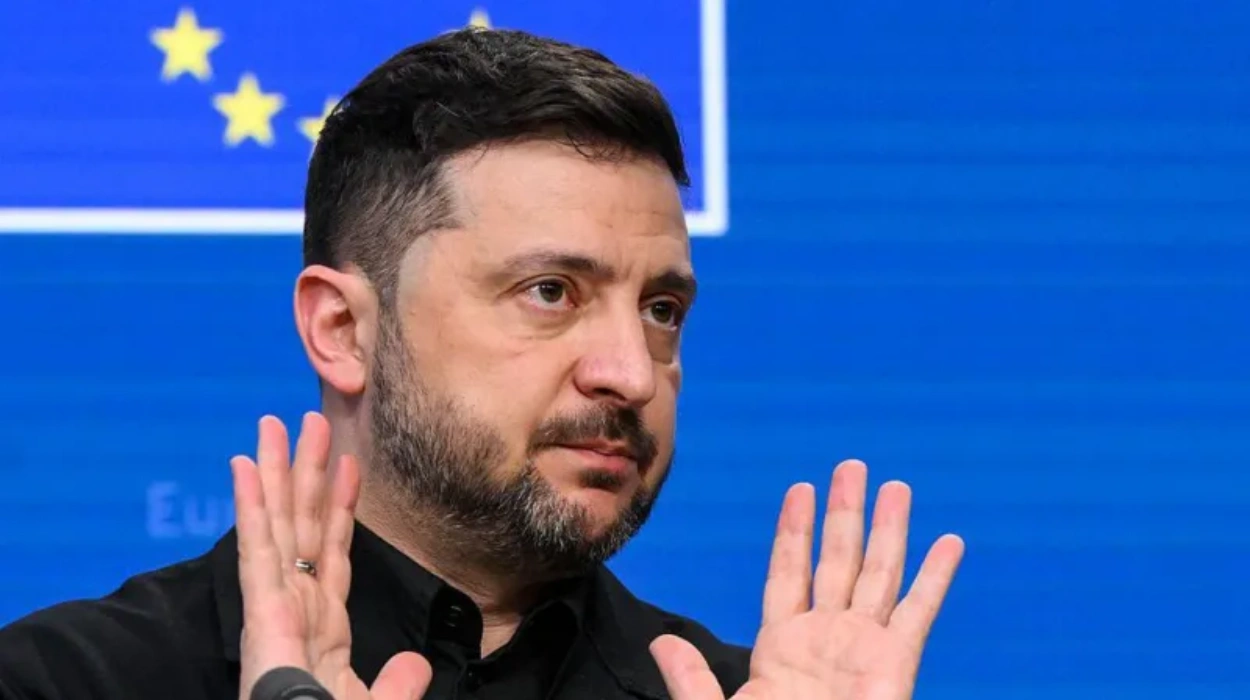
UK (Parliament Politics Magazine) – Volodymyr Zelensky urges EU leaders at summit to release frozen Russian funds, seeking multi-billion euro loan to support Ukraine’s military and economy.
Zelensky stated that without an infusion by spring, Ukraine “will have to reduce production of drones” because the country is just a few months away from running out of money.
The Belgium-based company Euroclear owns the majority of Russia’s €210 billion (£185 billion; $245 billion) worth of assets in the EU. Belgium and a few other member nations have expressed their opposition to the money being used as a “reparations loan” up to this point.
Polish Prime Minister Donald Tusk stated that EU leaders have to “rise to this occasion” despite Russia’s warning not to utilize its funds.
Russia has sued Euroclear in a Moscow court to recover its money, and the summit in Brussels coincides with a critical juncture in the conflict.
Ursula von der Leyen, the head of the European Commission, promised that “we will not leave the summit without a solution” after Zelensky declared that Ukraine will undoubtedly face a 45–50 billion euro deficit next year. An official from the European government said they were
“cautiously optimistic, not overly optimistic”
that a deal would be reached.
All eyes are on Belgian Prime Minister Bart De Wever, who said to the Belgian parliament on Thursday that
“then we’ll jump into the abyss together with the rest of the Europeans and hope the parachute holds us”
if everything was resolved and shared by the rest of the EU.
A solution to end the conflict, which started with Russia’s full-scale invasion of Ukraine in February 2022, is now closer than ever, according to US President Donald Trump.
A White House official told the AFP news agency that US and Russian officials will meet in Miami this weekend to continue discussions on a peace proposal. Trump envoys Steve Witkoff and Jared Kushner are expected to meet with Kremlin envoy Kirill Dmitriev in Miami.
President Zelensky, who is in Brussels, stated that Kyiv needs the funds, either to maintain its army in the event that the conflict persisted or to use them just for rehabilitation. Ukrainian officials are also traveling to the US.
The Kremlin has emphasized that ideas for a multinational force for Ukraine led by Europe and backed by the United States would not be acceptable, but Russia has not yet reacted to the most recent peace overtures.
On Wednesday, President Vladimir Putin expressed his views on Europe by claiming that the continent was in a condition of “total degradation” and that “European piglets”, a disparaging term for Ukraine’s European allies, were seeking to profit from Russia’s downfall.
Out of the €210 billion in Russian assets in Europe, the European Commission, the EU’s executive branch, has suggested lending Kyiv roughly €90 billion (£79 billion) over the next two years.
That amounts to around two-thirds of the estimated €137 billion Kyiv would require in 2026 and 2027.
What are the legal obstacles to using frozen Russian assets?
Firmed Russian means, totaling around €300 billion substantially held in EU authorities like Belgium, face significant legal hurdles to direct seizure or use as collateral for loans to Ukraine.
State- possessed means, including those of Russia’s Central Bank, enjoy autonomous impunity under transnational law, barring enforcement conduct like confiscation without Russia’s concurrence; courts in the US and EU have upheld this, rejecting simple transfer for restitutions.
In the US, IEEPA lacks vesting authority to transfer title, per Supreme Court precedent and legislative history; EU nations grapple with property rights under mortal rights conventions( e.g., ECHR Article 1 Protocol 1), taking due process and just compensation pitfalls.
