


Meanwhile, on the streets of Lebanese capital, many people — some skeptical about what the authorities will do and when — were taking the clean-up operation following Tuesday's blast and violent protests Saturday into their own hands.Lebanon was already in dire economic straits before the explosion wiped out Beirut's port area and damaged buildings across the city. At least 158 people were killed and dozens remain missing. More than 6,000 people were injured.As grief turned to anger, tens of thousands of demonstrators poured into central Beirut on Saturday calling for "revenge" against the ruling class of politicians widely held responsible for the explosion. Speaking by video conference on Sunday, Macron told world leaders, including US President Donald Trump, that "the objective is to pool our resources to meet the needs of the population of Beirut."However, the French President made clear that reforms were also needed."The explosion of August 4 was like a thunderbolt. It's time to wake up and take action," he said. "The Lebanese authorities now have to put in place the political and economic reforms which are being called for by the Lebanese people which is the only thing which will allow the international community to act efficiently side-by-side with Lebanon in its reconstruction."Macron also thanked Trump and 15 other heads of state for getting involved. The French President added that Israel had also expressed a desire to provide aid.
Seeking to rebuild
After a traumatic week, many of Beirut's citizens flooded outside on Sunday to clean, sweep and help begin the devastated city's recovery."This action, the act of collective mobilization and cleaning, proved that Lebanon is for all, the Lebanese people are the government, they, we are handling this better than the government, look around," said Andrew Trad, 25.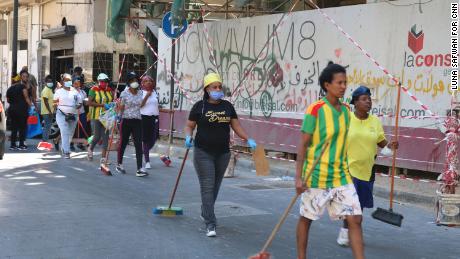 A group of Ethiopian men and women were heading from the Gemmayze neighborhood to downtown to help with the clean-up. Two of them, Zeina and Ameli, stopped to sweep up glass and rubble from the street on their way. "We are doing this because we love this country, it's been our home for years, it's our responsibility to help the Lebanese too," they said.Berj Dakesian, 70, told CNN he was born and raised in Beirut and wanted to help the city recover.
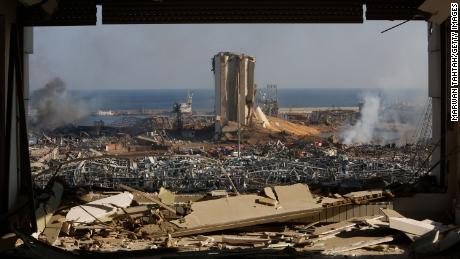 "I witnessed many wars in Lebanon, but I don't think that I will ever forget the sound and the scene of this explosion in Beirut. My house and my son's house in the same building are destroyed, we cleaned what we can clean but now we are trying to help our community here too," Dakesian said. Meanwhile, restaurant chain owner Sherif Doumit said he was concerned not just for his business but for the economic security of all his employees."Even if we want to restore and build, how can we build on moving sand? It's unstable, the whole country, I am just grateful that no one got seriously hurt from our staff and customers," he said."This government is making it impossible for the Lebanese to survive or to even be resilient, it's hit after hit. Even if they do resign, what's the point in that? These politicians are merely puppets in the hands of those in higher ranks, moving them around and dictating their actions and decisions."
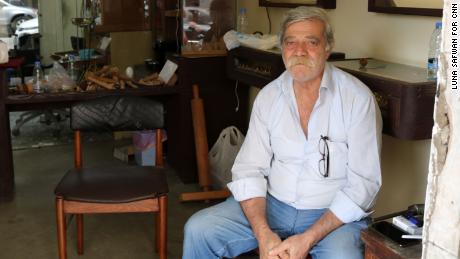 Mounzaer Hayek, who is Syrian-Lebanese, said he has lived in the country for 40 years, building up his small jewelry business. "Now it's all gone. I just want someone to make up for me, no matter what the amount, we need to try and stand on our feet again," said Hayek, 67. "I was in the shop with my son, Lian, when it happened — I think this glass and wood door saved me. I sustained small injuries, but our business might not survive."Others were in the downtown area on Sunday looking for vital supplies. Christine Tawil, who's Syrian, said she had come from Burj Hammoud, northeast of the city, to find aid and food for herself, her parents and two brothers. "Our whole house was damaged," she said. "I now worry that because we are Syrians, our loss won't be prioritized. This explosion was the last horror that Syrians who are taking shelter in Lebanon needed."And Maria Mouawad, 30, said she had walked from the city's Basta neighborhood to find donations of milk, sugar and other essentials."My house is damaged but we are still sleeping inside of it, we don't have any other solutions," she said. "I hate this government, it's still taking away things from us even though we have nothing, we really have nothing."
Mock gallows
Saturday's demonstrations, dubbed "Judgment Day" protests, stretched to surrounding neighborhoods and the city's main motorway, in the biggest outpouring of discontent since a nationwide uprising last October. Protesters occupied the foreign ministry, the environment ministry and the economy ministry as they called for the ruling elite's downfall. The Banking Association, which protesters blame for the country's worsening banking crisis, was also taken over by demonstrators and set ablaze.Parts of the demonstrations remained peaceful, while other parts were predominantly filled with angry protesters who faced off with security forces. Police fired tear gas and rubber bullets as protesters hurled stones and fireworks.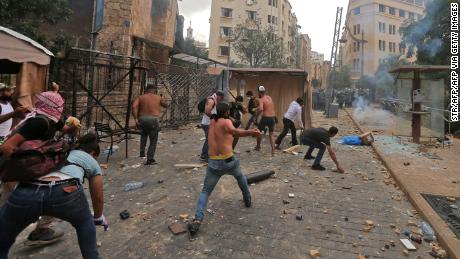 In a Twitter statement on Sunday, the Lebanese Internal Security Forces (ISF) denied using live fire and rubber bullets during the protests which left more than 200 people injured, according to the Red Cross.Unverified pictures and videos circulating on social media showed plainclothes men firing shotguns and pistols. However, the security forces' statement said that one person filmed shooting in the direction of protesters in the videos was not a member of the ISF. CNN cannot independently verify the authenticity of theRead More – Source