

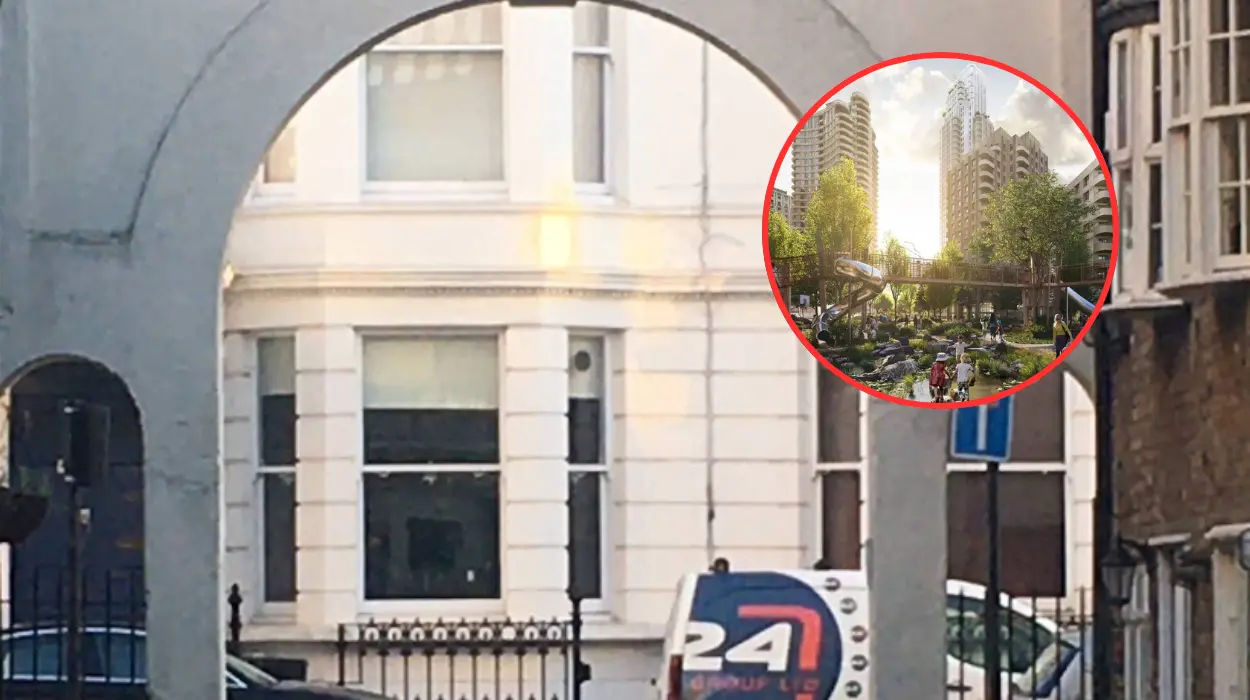
Hammersmith and Fulham (Parliament Politics Magazine) – A Hammersmith and Fulham council has approved the first of two applications to build homes at Earl’s Court, with developers calling it a “new district.”
Hammersmith and Fulham councillors approved a portion of the proposal for their borough at a Planning and Development Committee meeting last night (November 26). It will offer approximately 2,500 dwellings, accounting for almost half of the whole project, as part of a massive redevelopment of the dilapidated land.
The second application is with the neighboring Kensington and Chelsea Council. A decision on that aspect of the proposal is likely in December.
According to Rob Heasman, Chief Executive of the Earl’s Court Development Company (ECDC), the designs
“are truly reflective of Earls Court’s heritage as a place that dared – to showcase, entertain, and celebrate the spectacular”.
The planned £10 billion scheme aims to create a new 4,000-home suburb as well as 2.5 million square feet of workplace, 12,000 jobs, and cultural institutions through two applications.
The 40- acre brownfield point, which was formerly home to the Earl’s Court Exhibition Centres, has been substantially underused since the structures were disassembled in 2015 and 2017.
Former plans for the land, led by CAPCO and approved by Kensington and Chelsea and Hammersmith and Fulham councils in 2013, failed, and the point was vended to real estate investment group Delancey and Dutch pension fund director APG for£ 425 million in 2019.
The latest applications were made on behalf of the ECDC, a joint venture between Delancey, APG, and Places for London, Transport for London’s (TfL).
According to a council report, the operation is hybrid , which means it includes both comprehensive proffers and outlines. The precise aspects include the construction of four 42- story structures that will house 456 houses and 696 pupil apartments, as well as a variety of food, libation, and retail installations.
Outline ideas for up to 2,044 dwellings, senior housing, and other facilities, ranging from communal spaces to a cinema and a live music venue, were also sought approval.
An aggregate of 35% of the homes will be designated as affordable, which is lower than the 50% set by Hammersmith and Fulham’s Original Plan.
If approved, the work will be completed in several phases, with additional applications needed to flesh out the outline proposals. The program is expected to be completed by early 2043.
Because of the project’s magnitude, with Hammersmith and Fulham’s report alone spanning 451 pages, and the fact that it traverses two boroughs, the Mayor of London, Sir Sadiq Khan, can call it in for a final judgment if he so likes.
According to the council report, 376 representations were sent in response to the plans, with 74 in opposition, 33 neutral, and 269 in support. The complaints focused on the proposals’ height and density.
Officers, with assistance from ECDC, also spoke at length about the scheme’s environmental aspects, including the planting of over 1,000 trees, and how it will help the council’s Upstream London industrial strategy.
Cllr Alex Karmel questioned the officers’ approach to heritage assets and the potential impact, describing the decision to include and exclude specific sites as “strange”. He was told that officers have scoped out several of the assets mentioned by Cllr Karmel because they did not appear to be damaged by the program.
When presented to a vote, the measure passed unanimously. Cllr Nikos Souslous, Committee Chair, concluded by stating that members’ questions did “justice” to the application’s details and praising ECDC’s efforts on the designs.
Following the meeting Mr Heasman said:
“This marks a major milestone, following years of active listening and engagement with local communities and the development of designs that are truly reflective of Earls Court’s heritage as a place that dared – to showcase, to entertain and celebrate the spectacular.
Earl’s Court will be a new district in West London. A long-underused, centrally located, site with exceptional connectivity to deliver new homes, jobs and public space at scale – a strategic part of London’s growth agenda. We have worked closely with [Council Leader] Stephen Cowan and his team to embed the ambitions of Upstream London into the vision for Earl’s Court as a model of innovative urban renewal.
We now look forward to the plans being considered by the Royal Borough of Kensington and Chelsea Planning Committee and working with public and private sector partners to move into delivering the first phase of this project.”
How will the scheme affect local council tax and public services?
No specific details emerge on direct changes to original council duty rates from the Earl’s Court redevelopment scheme in Hammersmith & Fulham or Kensington & Chelsea. The design, approved unanimously on November 27, 2025, includes 4,000 homes( 35 affordable) and workspaces projected to produce 12,000 jobs, potentially boosting the council duty base through new parcels and residents without immediate rate hikes.
Increased profit from advanced property values and population could laterally support duty stability, as seen in analogous large- scale London developments. The scheme promises enhanced public services via new structure, including a large demesne, artistic venues like a cinema and music space, and better transport links to Earl’s Court station.
These additions address community needs amid resident enterprises over viscosity and overshadowing, with 269 probative commentary overbalancing 74 expostulations.
