

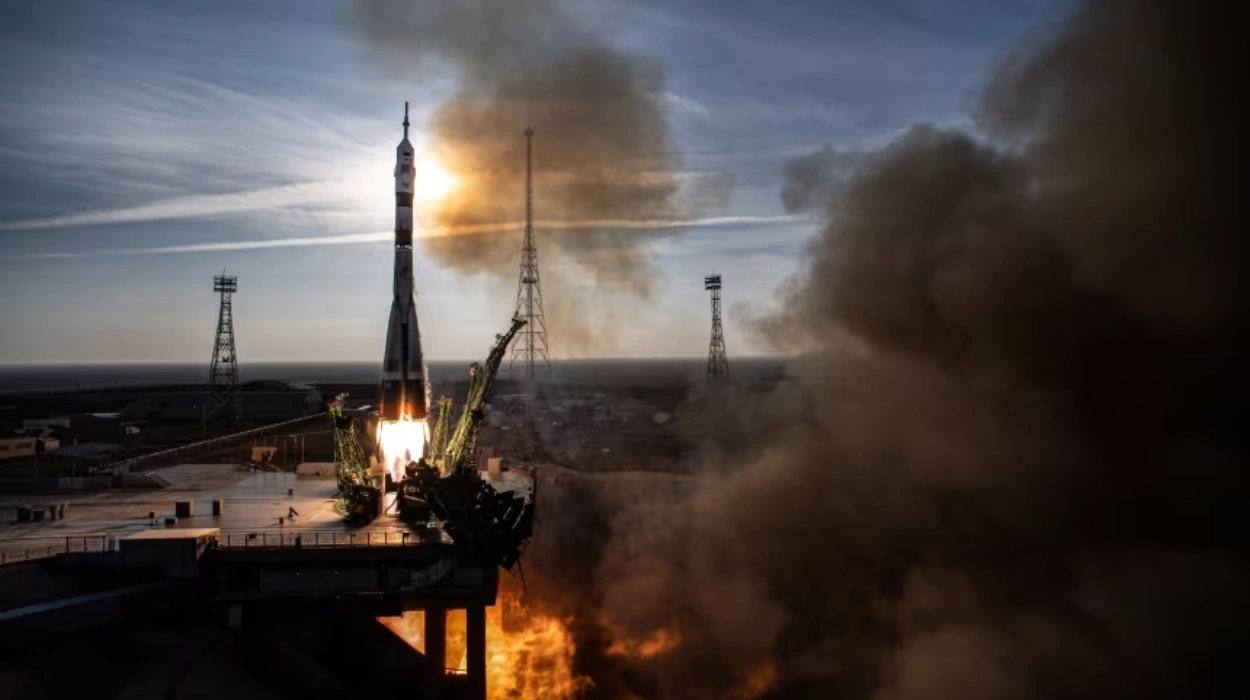
Russia (Parliament Politics Magazine) – Russia’s only launch pad for crewed missions, located at Baikonur Cosmodrome in Kazakhstan, suffered significant damage during the recent Soyuz MS-28 rocket launch to the International Space Station (ISS). Roscosmos confirmed the damage to key launch pad infrastructure, raising concerns about delays in future crewed spaceflights from the site.
Damage Occurred During Successful Soyuz MS-28 Launch
The Soyuz MS-28 spacecraft successfully blasted off carrying two Russian cosmonauts and one NASA astronaut to the ISS on November 27, 2025, as reported by CNN and Reuters. However, post-launch inspections revealed that the movable servicing cabin, a critical component providing crew access to the rocket, collapsed into the exhaust trench beneath the launch pad at the moment of lift-off.
Footage released by Roscosmos showed part of the launch structure collapsing during liftoff at Baikonur Cosmodrome, with the service bay apparently dislodged by the force of rocket boosters. Officials have yet to fully specify the extent or timeline for repairs but confirmed specialists are assessing the damage, noting that spare components are available for the restoration.
Impact on Russia’s Manned Spaceflight Capability
This incident effectively renders Russia’s sole launch pad for crewed Soyuz missions inoperative until repairs are complete. Analysts warn that the damage could cause a suspension of Russia’s ability to launch humans into space for weeks or potentially months. According to Telegram user and space analyst Georgy Trishkin, the worst-case scenario might severely impact rotation missions and cargo flights to the ISS, which typically run roughly every six months.
Russian commentator Vitaliy Egorov remarked that Russia has effectively lost human spaceflight capability pending urgent repairs or the revitalisation of an alternative launch pad, a situation unprecedented since the dawn of their space programme in 1961.
Details of the Service Bay Collapse
The movable service bay, designed to give crew members access to the rocket on the pad before launch, collapsed during ignition into the flame trench. Some unconfirmed speculation suggests that locking pins meant to keep it secured may not have been properly engaged, causing the structure to be drawn into the exhaust stream during liftoff. Though this remains unverified, the damage is classified as substantial, with large twisted remains visible inside the trench.
Roscosmos has pledged to repair the damage “in the near future,” highlighting that spare parts are in stock. However, independent assessments estimate that repairs could take several months or longer, putting future crewed missions to the ISS at risk for an extended period.
Future Missions and Uncertainty for the ISS Programme
Russia’s forthcoming mission involving the Progress MS-33 cargo flight to the ISS, scheduled for December 21, 2025, may not be affected immediately. However, the damage complicates the logistics for launching continuing crew rotations to the ISS. This setback adds tension to an already complex geopolitical and operational environment surrounding the multinational space station.
Roscosmos emphasised safety and stated the astronauts aboard the ISS are healthy following the successful docking of Soyuz MS-28. The agency meanwhile continues inspection and assessment, balancing swift repairs with ensuring mission safety.