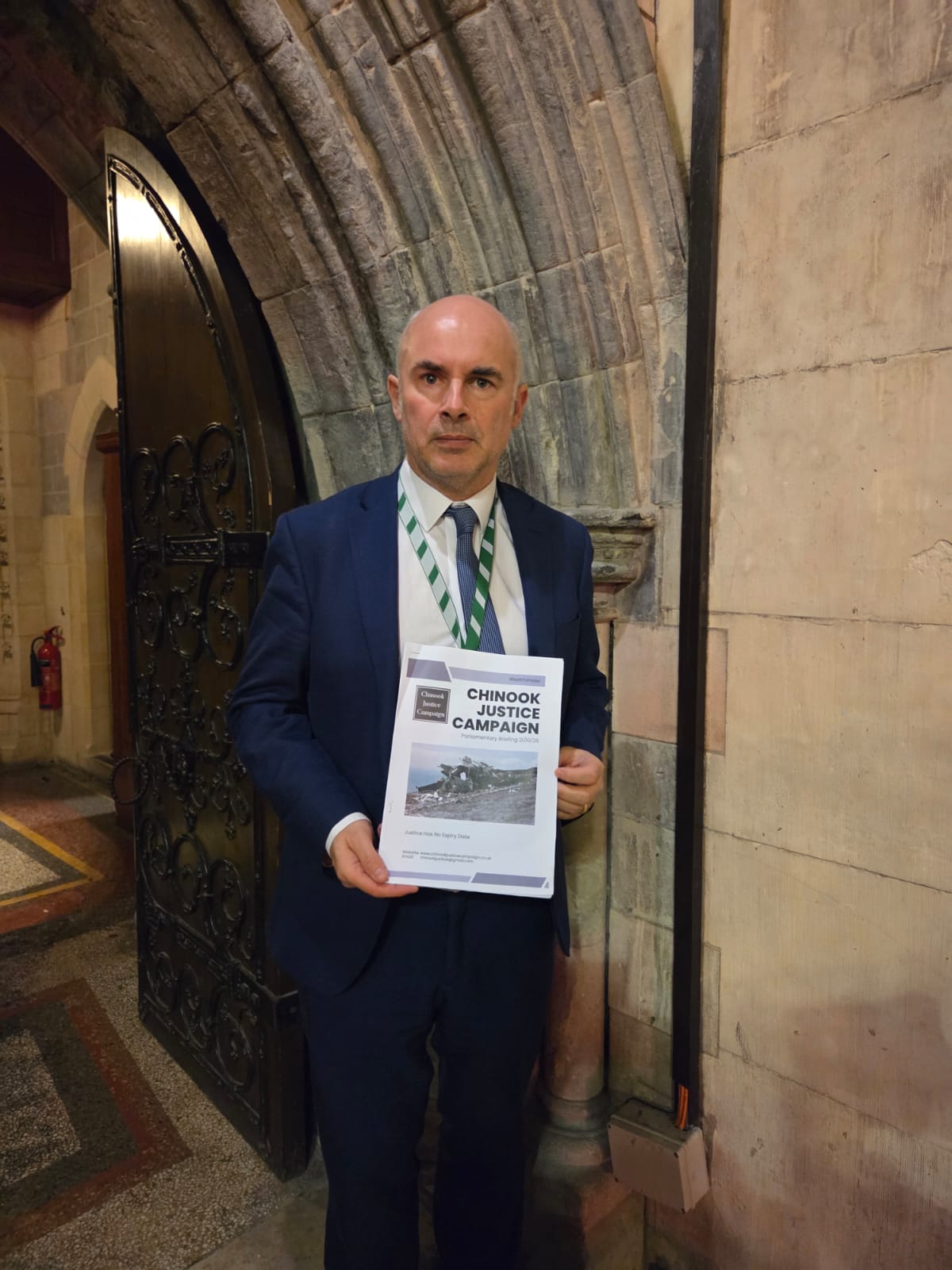
On Wednesday 26th November, during a Westminster Hall debate, I raised an issue that has remained unresolved for more than three decades — the crash of RAF Chinook ZD576 on 2 June 1994 and the continuing campaign for a full, judge-led public inquiry.
The crash claimed the lives of 29 individuals, including senior RAF officers, MI5 personnel, Royal Ulster Constabulary Special Branch officers, a senior civil servant and the four RAF aircrew. These were highly skilled individuals serving in some of the most sensitive and dangerous areas of national security. They were also husbands, fathers, brothers and sons. Their families deserved truth in 1994 — and still do today.
For those families, the tragedy did not end with the crash. It began there.
From the outset, the investigation process was marked by contradiction, omission and doubt. Documentation was missing or redacted, critical technical information was not disclosed or fully considered, and early conclusions were reached without certainty. The most damaging example remains the original verdict of gross negligence against the pilots — a conclusion later overturned after years of effort by their families and supporters.
That reversal was not a procedural footnote — it was a warning sign. It demonstrated that the state had been willing to assign blame in the absence of conclusive evidence. If such a grave and consequential judgement could be reached and then undone, how can the wider investigative process ever be considered complete?
Some of the most serious technical concerns surrounding the Chinook Mk2 — particularly its FADEC digital engine control system — had been raised long before the crash. Airworthiness assessments and operational readiness reviews repeatedly identified serious shortcomings. Test pilots, engineers and software specialists warned that the aircraft was not behaving predictably, and in some cases formal test bodies were unwilling to certify it as safe for unrestricted service. Despite those warnings, the Chinook Mk2 was placed into operational use, and those concerns do not appear to have been fully incorporated into decision-making.
Many crucial documents relating to the Chinook crash remain sealed for up to 100 years. That alone raises serious questions. When lives are lost in service to the nation, the truth should not be locked behind closed files or delayed for another generation. These papers need to be unsealed so that answers can be found, lessons can be learned, and confidence in the institutions of the state can be restored.
This call for transparency is not new — and it is no longer only coming from bereaved families or elected representatives. The Chief Constable of the Police Service of Northern Ireland has already stated publicly that a lack of government transparency over the Chinook disaster is “adding to the suffering” of those left behind. When the head of policing in Northern Ireland recognises that secrecy is compounding grief, it should serve as a stark warning that this issue cannot be allowed to drift further.
This is no longer simply about the technical failure of an aircraft — it is now about whether government is willing to allow full and fair scrutiny of its decisions. And, increasingly, it is about whether public trust can survive the perception that accountability can be postponed indefinitely.
The families affected have shown extraordinary dignity. They have also shown extraordinary persistence. Many have had to become experts in aviation engineering, military procedure and state accountability simply to engage with the process on equal terms. That burden should never have been theirs.
A nation that sends men and women into dangerous service carries a solemn obligation: if those individuals are killed in the line of duty, the state must do everything in its power to find full, factual answers — and to do so transparently. Anything less risks damaging trust between those who serve and those who command.
Some argue that a public inquiry is no longer necessary. Others suggest that too much time has passed, or that national security considerations prohibit further examination. Those arguments do not withstand scrutiny.
Time does not reduce responsibility — it increases it. Key witnesses remain alive. Documentation remains accessible. And where sensitive material exists, it can be heard in closed session, as countless inquiries before have proved.
As for cost: justice has a cost — but injustice has a far greater one.
A public inquiry is not about assigning blame. It is about establishing truth. It is not about revisiting the past for its own sake — it is about learning from it to ensure the same mistakes are never repeated.
The Chinook ZD576 tragedy remains one of the most serious unresolved aviation and governmental failures in modern British history. It is now a test of whether the United Kingdom will choose accountability over avoidance — transparency over secrecy — truth over convenience.
The families have waited long enough. Those who lost their lives deserve more than silence, doubt and sealed files.
Justice delayed must not become justice denied.
The time for a full, judge-led public inquiry is now.
The Time for Truth – Why the Chinook ZD576 Victims Deserve a Judge-Led Inquiry