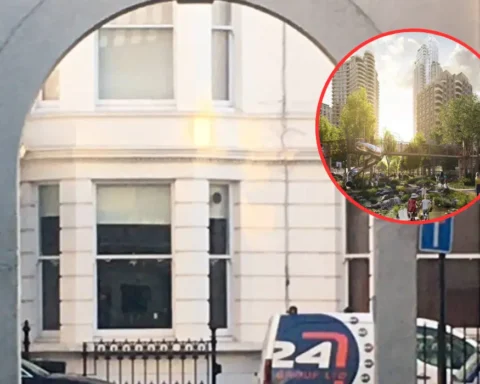
Hammersmith and Fulham (Parliament Politics Magazine) – Chelsea’s hopes for a new stadium at Earls Court face renewed uncertainty after Hammersmith and Fulham Council issued a decision that delays the project.
The Hammersmith and Fulham council approved a rival £10bn redevelopment plan for the site last week, which green-lights a proposal led by the Earls Court Development Company (ECDC) to create a mixed-use district on the former Earls Court Exhibition Centre land.
ECDC characterizes the project as a 44-acre masterplan, containing roughly 4,000 new dwellings, retail and hospitality facilities, and offices designed to produce an estimated 12,000 employment.
The design, however, has no provision for a football stadium, with the ECDC continually declaring it is not open to hosting a major sports arena within its plans.
Chelsea have also been studying destroying and reconstructing their present stadium, Stamford Bridge, although the club’s owners Todd Boehly and Clearlake Capital are said to still view Earls Court as appealing, despite the resistance.
With Stamford Bridge’s 40,000 capacity, the London club are falling behind their capital rivals in terms of matchday revenue, with Arsenal, Tottenham Hotspur and West Ham United all enjoying much larger grounds.
The most practical result seems to be a complete reconstruction of Stamford Bridge. Chelsea increased their footmark in 2023 by acquiring 1.9 acres of bordering land, but a rebuild would bear dismembering the present ground and playing home matches nearly, with Wembley the likeliest temporary home.
The Earls Court property is located within the Royal Borough of Kensington & Chelsea, where council members will cast separate ballots. December 9 is allowed
to be the foremost probable date. Any concurrence by both councils would also be examined by the Mayor of London, meaning this original decision signals simply the first stage of a prolonged planning process.
Chelsea have been then before the club gained full planning concurrence for a repaired 60,000- seat colosseum on the Stamford Bridge point in 2017 under Roman Abramovich, only for the design to be abandoned the ensuing time.
Chelsea had examined a plan to turn Battersea Power Station into a 60,000- seat colosseum in 2012, but their request for the point was eventually rejected in favour of a domestic- led redevelopment.
How will the Earls Court decision affect local housing and jobs?
Hammersmith and Fulham Council’s blessing of the £10bn Earls Court development will deliver new homes on the 44- acre brownfield point, including 35 affordable casing (supposed maximum feasible, below the 50 original target).
The design creates 12,000 onsite jobs via 2.5 m sq ft of climate invention workspace, plus 23,500 civil places and£ 3bn periodic UK profitable impact. concentrated on startups, creatives, and chains with zero- carbon energy, it supports London’s growth plan. Retail, hospitality, and artistic venues( cinema, live music) add employment, revitalizing a vacant point since 2017.
269 public responses favored the plan for connectivity( three Tube stations) and 20 acres of green space; 74 expostulate to palace heights (42 stories), viscosity, and heritage impacts. Led by Earls Court Development Company( Delancey, APG, TfL’s Places for London), it awaits Kensington & Chelsea approval.