

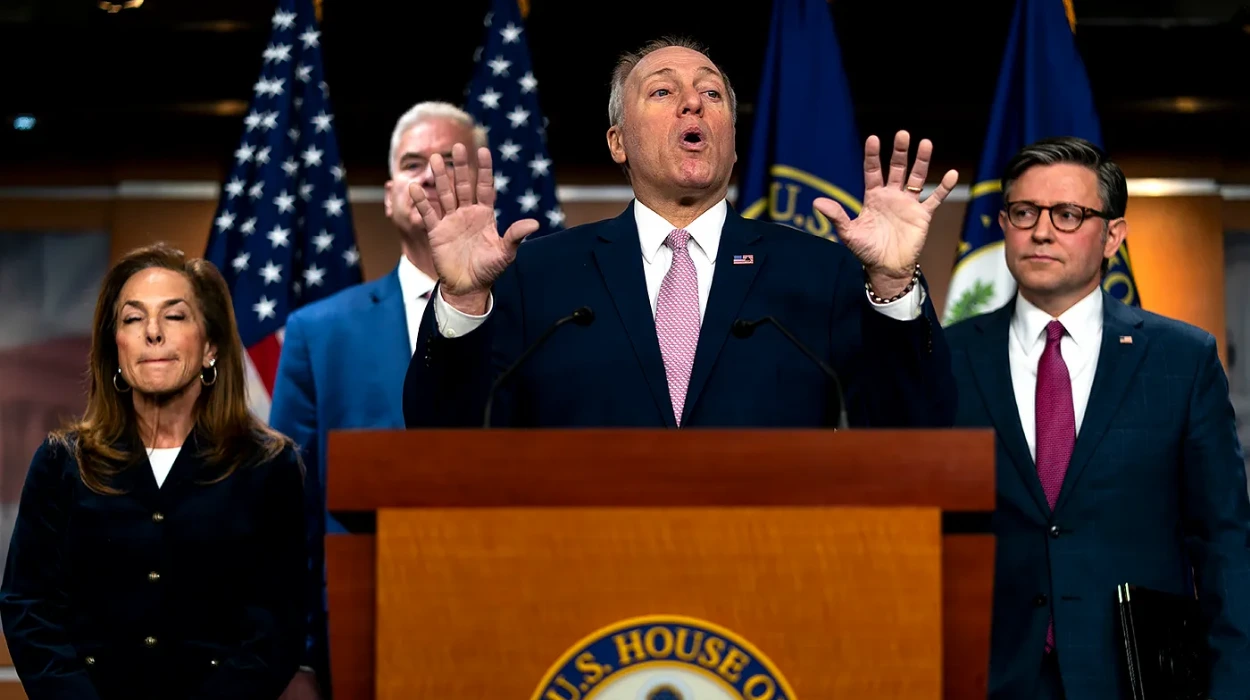
USA (Parliament Politics Magazine) – House GOP centrists have struck a deal with Democrats to force a vote on Obamacare subsidies, weakening Speaker Mike Johnson’s control.
Following weeks of intense internal conflict between GOP leaders, moderates, and hardliners that failed to result in a Republican solution for the Obamacare deadline at the end of the month, Johnson was dealt a surprising blow. Four moderate Republicans have agreed to give the leader of the House Democratic caucus a significant floor victory in a protest that is uncommon even in this contentious and chaotic House.
These centrists, led by Representatives Brian Fitzpatrick and Mike Lawler, are now subtly pressuring Johnson to alter his approach on the expanded Affordable Care Act subsidies that are about to expire, or else Democrats will be able to win that significant victory on the floor in January.
Fitzpatrick had pushed his own compromise proposal, which included significant modifications and extended the subsidies for two years rather than the Democrats’ three, but party leaders continually prevented him from getting a floor vote.
“The only thing worse than a clean extension with no anti-fraud and no income caps is a cliff. So obviously left with a Hobson’s choice,”
he told reporters, speaking about the Democratic bill, which includes none of the reforms that centrists of both parties have endorsed.
On Wednesday, the House is scheduled to vote on a different, more limited health care package from the GOP leadership that ignores the expiring subsidies, virtually ensuring that the funds will expire and raise premiums for tens of millions of Americans the next year. Additionally, a bipartisan group of senators is pursuing their own health care arrangement in parallel.
According to a person familiar in the deliberations, several GOP moderates cautioned Johnson during a heated meeting on the House floor on Wednesday that he must now permit a vote on the centrists’ own compromise plan to handle the subsidies. If he doesn’t, Johnson will have to deal with the humiliating possibility that the GOP-led House would approve House Minority Leader Hakeem Jeffries’ plan, which is hated by most Republicans, during the first week of January.
“What we’re trying to do is to force the conversation. We have to have a conversation on something. There should be an extension of the ACA tax credits for some period of time,”
Pennsylvania Rep. Ryan Mackenzie, who was part of that huddle with Johnson.
Mackenzie was one of the four GOP centrists who agreed to a discharge petition from the opposing party, a move known in Congress as the “nuclear option.” Rep. Rob Bresnahan of Pennsylvania, Lawler, and Fitzpatrick all quickly joined the Democratic effort on Wednesday morning.
“This town acts on leverage, well that’s what I’ve learned in the last three years. And for some reactions there’s a reaction to it,”
LaLota told CNN, adding that he would sign onto the Democratic bill if there are no other options.
The Democratic stance, which they claim does nothing to control the program’s skyrocketing costs, will not win over all centrists. However, many agree that Johnson could have prevented the spectacle by permitting a vote on a compromise package, as moderates had called for for weeks.
“If he would have brought up the Fitzpatrick or Kiggans bill, this probably would never have happened,”
Rep. Don Bacon of Nebraska told CNN, adding that he personally won’t vote for the Democratic measure.
After initially ignoring CNN’s queries regarding the centrists’ uprising, Johnson later defended his leadership by telling reporters that the House’s narrow margin was to blame for the upheaval.
“I have not lost control of the House,”
Johnson said, adding:
“We have the smallest majority in US history. These are not normal times.”
According to several people involved with the talks, even Democratic leaders were taken aback by the centrists’ move, as they had been secretly encouraging members to collaborate with Republicans on a compromise bill in recent days. Many thought that in a GOP-led Congress, their request for three extra years of Obamacare subsidies was, at best, unlikely.
Many House Republicans, who have been nervously observing the weeks-long conflict between centrists and leadership ahead of the deadline, were also irritated by it.
GOP Representative Eric Burlison said,
“They’re stabbing the rest of the party in the back,”
claiming that the moderates’ backing of the Democratic proposal is “a betrayal to the rest of us Republicans” and that House Republicans took a “bold stand” in proposing their own health care plan.
The Republican from Missouri called for a “wholesale reform of the Obamacare system” and cautioned that his colleagues are being “short sighted” about the electoral ramifications because consumers will still have to pay more.
Oklahoma’s senior representative Frank Lucas contended that his conference “does everything the hardest possible way.” We cause each other the most internal suffering.
GOP leaders don’t have much time to decide what to do next. Additionally, a number of Republican lawmakers stated that Johnson’s decision is still unclear.
Mackenzie claimed they were informed that GOP leaders needed to consult with the rest of the conference when they were questioned about putting a compromise plan up for a vote.
Jeffries now has the 218 signatures required to ensure a vote under discharge petition rules after agreeing to Democrats’ procedural move to compel a floor vote on their planned three-year extension of increased Affordable Care Act tax subsidies. However, those same regulations prohibit forcing that floor vote until the first week of January.
The strategy of their colleagues has been condemned as flawed by the centrists who have joined Democrats. But instead of letting the increased subsidies expire at year’s end, the usually leadership-aligned centrists made the desperate decision to oppose Johnson and join Democrats’ push.
Instead of waiting until January, when the subsidies will have already expired, a chorus of Democrats and several Republicans are now urging Johnson to bring the vote to the floor this week.
Shortly after obtaining the 218 signatures required to compel a vote on his proposal, Jeffries told reporters on Wednesday,
“Mike Johnson should not recess the House of Representatives until we vote on this straightforward extension.”
What timeline must Leader Jeffries follow to bring the discharge to the floor?
House Minority Leader Hakeem Jeffries must stay until the alternate legislative day in January 2026 to call for the discharge solicitation vote on the bottom, per House Rule XV rules taking seven days from full prosecution( reached December 17, 2025).
Once 218 autographs are vindicated, the solicitation is presented and published in the Congressional Record. No bottom action occurs until the specified interval ends, generally early Januarypost-recess, forcing debate and vote without Rules Committee input bypassing Speaker Johnson’s control.
Jeffries could accelerate via amicable concurrence or Johnson’s disclaimer, but GOP leadership blocks this. The vote likely lands mid-January, aligning with open registration deadlines amid decoration hike warnings.
