

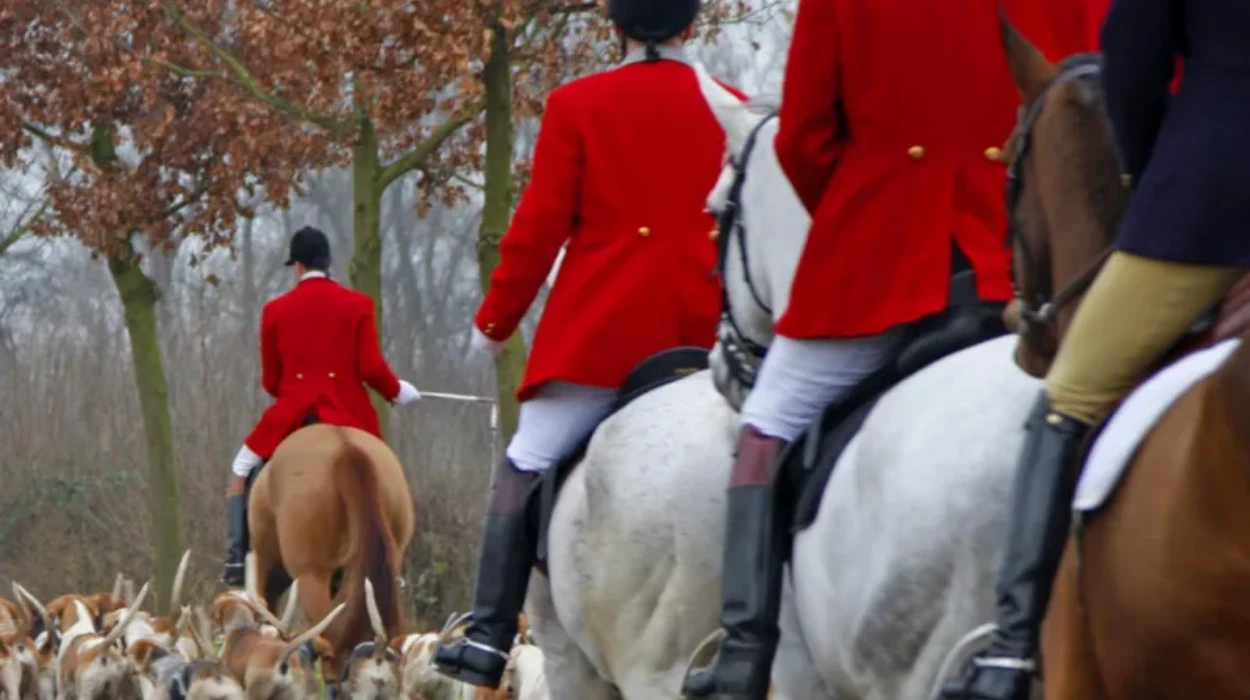
UK (Parliament Politics Magazine) – Trail hunting will be banned in England and Wales under a new animal welfare strategy, citing misuse to hunt wild animals, with a consultation planned for next year.
As reported by Fiona Nimoni of the BBC, the government is set to ban trail hunting in England and Wales under an animal welfare strategy to be released on Monday.
How did trail hunting remain legal despite the 2004 hunting ban?
Trail hunting uses an animal scent trail for dogs to follow, allowing mounted hunters to accompany the pack without directly hunting a live animal.
Ministers argued the practice acts as a “smokescreen” for illegal hunting, citing this as the reason for their decision to introduce a ban.
In parts of the UK, hunting with hounds has a long history, but restrictions were introduced under the 2004 Hunting Act. The legislation banned the use of dogs to hunt wild mammals such as foxes, hares, deer, and mink across England and Wales.
The practice of trail hunting involves dragging a rag for hounds to follow, aiming to replicate the traditional hunt while avoiding the killing of live animals.
The League Against Cruel Sports said in April that nearly 1,600 incidents occurred during the last hunting season, including 397 cases of foxes being chased nationwide.
How did hound associations and farmers respond to the proposed trail hunting ban?
The Countryside Alliance’s CEO, Tim Bonner, called the review of trail hunting “completely unnecessary.”
He said,
“It is unbelievable that the government wants to waste more parliamentary time on hunting. This issue was settled 20 years ago as far as Labour was concerned but it does not seem to be able to leave it alone.”
Mr Bonner also commented on the Labour Party’s ties with rural voters, saying.
“People across the countryside will be shocked that after Labour’s attack on family farms and its neglect of rural communities it thinks banning trail hunting and snares used for fox control are a political priority.”
According to the British Hound Sports Association, trail hunting plays a crucial role in rural communities, providing both economic benefits and support for mental and physical health.
One farmer said,
“I would be shunned if I publicly rejected hunting,”
adding that banning trail hunting
“reinforces the narrative they [Labour] don’t care and are imposing urban values on people they don’t understand.”
What did Baroness Hayman say about the trail hunting ban?
Baroness Hayman, the minister for animal welfare, said the government is set to start work on enforcing the new measures.
She said,
“In our manifesto we said we would ban trail hunting, and that’s exactly what we’ll do. There are concerns that trail hunting is being used a smokescreen for the hunting of wild animals, and that’s not acceptable.”
Ms Hayman added,
“We are working out the best approach to take the ban forward and will run a consultation to seek views in the new year.”
How will new animal welfare laws change hare shooting in England?
Under proposed reforms to animal welfare law, shooting hares in England will be prohibited for much of the year.
Currently, shooting hares during their breeding season is legal, with pregnant hares left to bleed out and many leverets left orphaned.
The nature minister, Mary Creagh, said,
“Brown hares are a cherished part of our countryside, an iconic British species, and it’s simply wrong that so many are shot during breeding season. I am determined to stop the decline of this wonderful animal.”
The upcoming animal welfare package is expected to boost the morale of Labour MPs and voters after months of party disputes, rising living costs, and weak polling results.
Recent surveys indicated that 79% of the public wanted stricter laws on foxhunting to prevent harm, while Labour sources said 85% believed there is a moral duty to protect animal welfare.
How did George Eustice respond to the new hare shooting ban?
George Eustice, former Conservative environment secretary, tried to enforce a hare close season during his tenure but faced opposition from Number 10.
He said,
“The first principle of conservation is to protect species during their breeding season, so it is excellent news that the government will now create a modern close season on the shooting of hares. Every year, approximately 200,000 hares are killed in organised, commercial shoots during February and March and this has a devastating impact on the orphaned leverets, which are left to starve to death.”
Mr Eustice added,
“Even the Victorians recognised the need for a close season but the 1892 act was based on a ban on sales, so no longer works. The current government deserves credit for finally getting this important change done.”
What is the 2004 Hunting Act?
- The Hunting Act 2004 bans hunting wild mammals like foxes, deer, and hares with dogs.
- The law includes exemptions for activities such as stalking, flushing out for livestock protection, and retrieving shot animals.
- Rats and rabbits can still legally be hunted with dogs under the Act.
- The Act defines five specific criminal offences, including hunting with a dog and participating in hare coursing.
- Convictions under the Act are heard in magistrates’ courts, with fines as the maximum penalty.
- Enforcement is challenging, with controversies over “trail hunting” and proving intent to hunt live animals.
