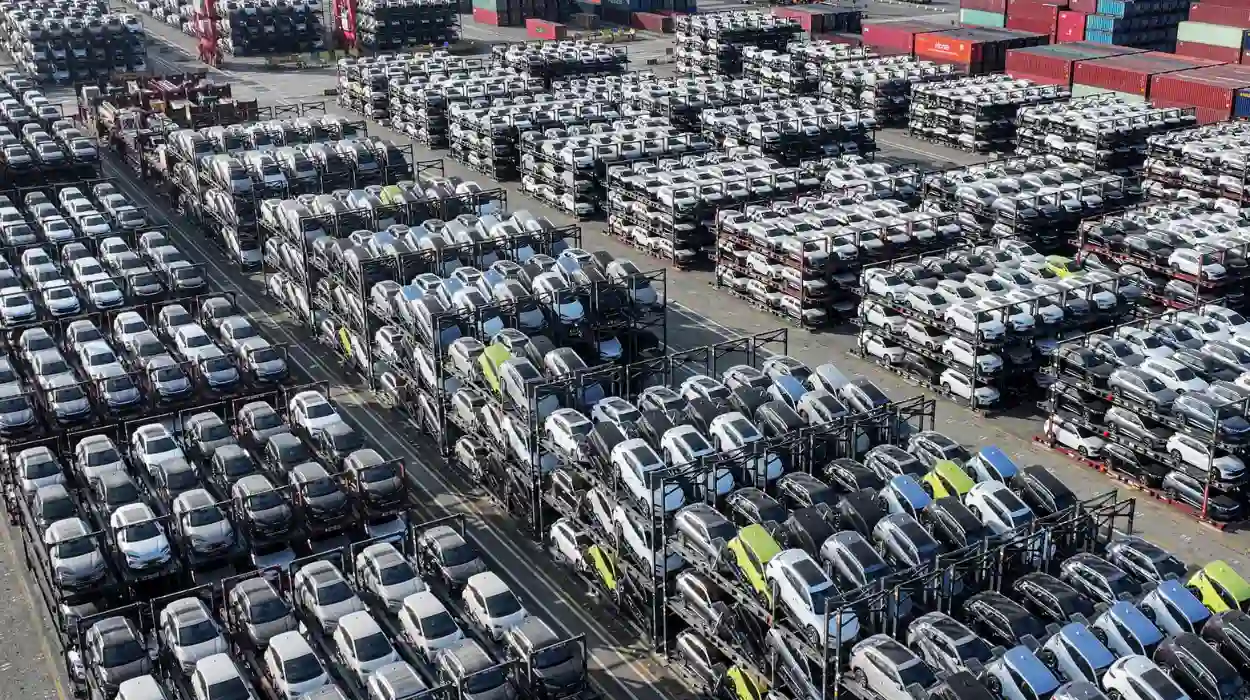
UK (Parliament Politics Magazine) – Chinese brands MG, BYD, and Chery are projected to sell 10% of UK new cars in 2025, driven by increasing demand for EVs and hybrid vehicles.
As reported by Jasper Jolly of The Guardian, Chinese automakers are set to account for one in ten new UK vehicles in 2025, a notable rise from last year as European sales expand.
How are Chinese car brands capturing 10% of the UK market in 2025?
Analyst Matthias Schmidt reports that MG, BYD, and Chery are projected to exceed 200,000 UK car sales in 2025, potentially accounting for one in ten new vehicles.
Schmidt noted that Chinese car brands make up nearly 10% of new vehicle sales in Spain and Norway, with the Western European average at 6%.
He stated that the UK offers a significant opportunity for Chinese automakers, given its market size and absence of strong domestic mass-market competitors. Rover stopped operating in the early 2000s, Vauxhall belongs to the Stellantis group, and MG vehicles are produced in China by state-owned SAIC.
Schmidt added,
“With no genuine domestic volume brands for UK consumers to choose from, UK consumers crucially can no longer participate in what is known as patriotic purchasing.”
He continued,
“In Germany and France, half of each country’s new-car market is effectively in the control of domestic brands. While in China, we now also see that two-thirds of the market is accounted for by domestic brands.”
Tu Le, the founder of Sino Auto Insights, a consultancy, said,
“The Chinese are tackling the EU region by region since there are pockets of support in some areas and pockets of opposition in others.”
Beijing has become a global leader in electric vehicles, supported by extensive government subsidies, control over lithium battery supply chains, and lower labor costs. The rise in Chinese vehicle sales has sparked concern in the EU, particularly in Germany and France, where officials fear millions of automotive jobs could be lost.
Norway leads global EV adoption, supported by generous subsidies, while in Spain and the UK, many Chinese cars are petrol-electric hybrids.
The UK and Norway have not followed the EU in imposing tariffs on Chinese cars, allowing Chinese EVs to enter their markets freely.
The Society of Motor Manufacturers and Traders reported that Chinese automakers sold 187,800 cars in the UK during the first 11 months, doubling last year’s total.
Japanese automakers appear to be losing ground in the UK, with Nissan and Toyota each shedding nearly a percentage point of market share. Sales of Honda and Suzuki also fell in the UK, while Mitsubishi has exited the market entirely.
Last year, the EU imposed tariffs ranging from 17% to 38% on Chinese electric vehicles to create a fairer market. The rules, however, target only electric cars, leaving Chinese firms room to increase market share by undercutting European rivals with hybrid sales.
According to Schmidt, less than 40% of all Chinese car models sold in Western Europe during the third quarter of 2025 were fully battery-electric models. The EU tariff structure has allowed Chinese automakers to undercut European rivals while boosting sales of higher-emission hybrid vehicles.
The EU has relaxed its EV rules, allowing a tenth of vehicles sold after 2035 to continue using petrol or diesel engines instead of enforcing a total ban. Automakers across Europe pushed for the revisions, arguing that continued petrol and diesel sales are needed to finance electric vehicle production.
Some industry insiders warn that Europe’s delayed EV transition may allow Chinese carmakers to pull ahead. Schmidt predicts Chinese carmakers could capture nearly 10% of the European market by 2028–2030, with their global battery car share peaking at 13%.
Which Chinese car brands are selling the most in the UK?
Chinese-owned MG led UK sales with over 75,000 vehicles, while fast-growing BYD sold 43,000 cars, beating brands like MINI and Tesla.
The Chery group achieved strong growth via new Jaecoo and Omoda brands. Jaecoo’s 7 model helped the brand sell over 24,000 cars and enter the top-ten chart.
The three leading Chinese brands, MG, BYD, and Chery, captured nearly 90% of UK sales among Chinese automakers in a key 2025 quarter.
Why did Mitsubishi pull out of the market?
Mitsubishi faced record losses in Europe as low sales and high costs to meet strict emissions and safety rules hit the company hard.
Under a global plan to cut costs by 20%, Mitsubishi exited Europe to focus on more profitable markets in Southeast Asia and Australia, where it holds over 6% market share.