


London, January 2026 — global stock markets opened the mid-year trading period with notable stability as investors balanced optimism around corporate earnings with caution ahead of key policy and economic signals. Trading activity across London reflected a measured tone, with participants maintaining exposure while remaining alert to shifts in monetary direction and geopolitical risk.
The early-summer mood suggests confidence without complacency, as investors seek confirmation that growth momentum can persist in a higher-rate environment.
A Market Defined by Balance Rather Than Euphoria
The defining feature of current trading conditions is balance. Rather than chasing aggressive rallies, participants across global stock markets are prioritizing durability and consistency. Equity benchmarks remain near elevated levels, yet volatility indicators suggest that fear-driven positioning has eased.
This equilibrium reflects lessons learned from recent cycles, where sudden repricing punished overconfidence and rewarded patience.
London’s Financial Ecosystem at the Center
London continues to play a pivotal role in shaping international equity sentiment. As one of the world’s primary financial hubs, the city offers deep liquidity, transparent regulation, and global connectivity. These qualities have allowed global stock markets to absorb uncertainty more efficiently, particularly during periods of policy transition.
Market professionals in the city emphasize risk management, capital preservation, and incremental gains rather than speculative excess.
United States Equities Provide Directional Cues
US markets remain a key reference point for investors worldwide. Strong earnings, resilient consumer demand, and technological innovation have underpinned confidence. Movements in American indices often set the tone for global stock markets, influencing sentiment well beyond domestic borders.
However, analysts caution that valuation sensitivity has increased, making future gains more dependent on earnings quality than liquidity alone.

European Shares Navigate Structural Challenges
European equities have shown quiet strength despite structural headwinds. Energy price stabilization, easing supply chain pressures, and moderate growth have supported investor confidence. Within global stock markets, Europe is increasingly viewed as a region of selective opportunity rather than broad momentum.
Investors are focusing on companies with pricing power, export exposure, and balance-sheet resilience.
Asia Reflects Regional Diversity
Asian equity performance has been more mixed, reflecting regional diversity rather than uniform trends. Some markets benefit from domestic stimulus and demographic momentum, while others face currency pressure and export sensitivity. Even so, global stock markets in Asia continue to attract long-term capital due to growth potential and improving governance standards.
Investors are increasingly differentiating between markets rather than treating the region as a single block.
Monetary Policy Expectations Shape Strategy
Central bank communication remains a dominant influence. Investors are parsing language carefully, looking beyond headline decisions to assess future intent. For participants in global stock markets, clarity on the duration of restrictive policy is as important as the policy level itself.
Uncertainty has not vanished, but it has become more manageable as policymakers emphasize flexibility.
Economic Data Encourages Measured Optimism
Recent economic indicators present a picture of moderation rather than contraction. Employment remains stable, inflation is trending lower, and consumer spending shows resilience. These signals have reinforced confidence in global stock markets, supporting the view that economies can adjust without severe disruption.
Markets are responding proportionally to data surprises, avoiding the exaggerated reactions seen in earlier periods.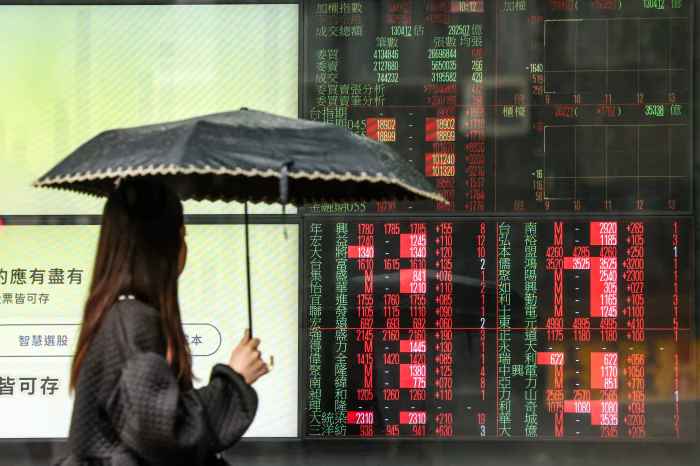
Corporate Earnings Reinforce Market Confidence
Earnings reports continue to validate current valuations. Many companies have demonstrated pricing discipline, cost control, and adaptability. This performance has strengthened trust in global stock markets, particularly among institutional investors focused on long-term returns.
Earnings quality, rather than revenue growth alone, has become the primary metric of confidence.
Sector Leadership Highlights Investor Priorities
Leadership within equity markets reflects changing priorities. Technology, healthcare, and infrastructure-linked sectors have attracted consistent interest, while highly leveraged industries face closer scrutiny. This selectivity within global stock markets illustrates a preference for sustainability over rapid expansion.
Rotation remains gradual, reducing the risk of abrupt dislocation.
Market Insight
One senior equity strategist said,
“What we are seeing is not fear or exuberance, but a disciplined reassessment of value and risk across regions and sectors.”
Currency Stability Supports Capital Flows
Stabilization in currency markets has reduced friction for international investors. When exchange rates fluctuate less sharply, global stock markets tend to benefit from improved cross-border participation. This dynamic has supported emerging economies while reinforcing confidence in developed markets.
Currency calm has become an unsung contributor to equity resilience.

Liquidity Conditions Remain Supportive
Liquidity remains ample across major financial systems, cushioning markets against shocks. Central banks have avoided abrupt withdrawals of support, allowing global stock markets to function smoothly even during periods of uncertainty.
This liquidity backdrop has limited forced selling and supported orderly price discovery.
Geopolitical Risks Remain Contained
Geopolitical developments continue to influence sentiment, but their impact has been measured. Investors appear more accustomed to operating amid persistent uncertainty. As a result, global stock markets have incorporated geopolitical risk into baseline expectations rather than treating it as an extraordinary shock.
This adaptation has reduced reactive trading behavior.
Emerging Markets Show Differentiation
Emerging market equities are no longer moving in lockstep. Countries with strong institutions, manageable debt, and credible policy frameworks are attracting capital, while others lag. This differentiation within global stock markets highlights a maturing investor approach that rewards fundamentals.
Selective exposure has replaced blanket optimism.
Technology and Transparency Improve Market Function
Advances in trading systems, disclosure standards, and regulatory oversight have enhanced market efficiency. Improved transparency has strengthened trust in global stock markets, encouraging broader participation from institutional and retail investors alike.
These structural improvements contribute to long-term stability rather than short-term gains.
Investor Psychology Reflects Experience
Investor behavior today reflects accumulated experience. Rather than reacting impulsively, participants are weighing probabilities and outcomes. This psychological shift has contributed to steadier conditions across global stock markets, reducing the likelihood of panic-driven moves.
Experience has become an asset in itself.
Outlook for the Second Half of the Year
Looking ahead, the outlook remains cautiously constructive. While risks persist, the foundation supporting global stock markets appears more robust than in previous cycles. Policy clarity, earnings visibility, and liquidity conditions will remain key determinants of direction.
Investors are preparing for adjustment rather than disruption.
Why This Period Matters for Long-Term Strategy
The current phase may prove influential for long-term investment strategy. It demonstrates how markets can adapt to tighter conditions without severe stress. For global stock markets, this adaptability reinforces confidence in equities as a core component of diversified portfolios.
The emphasis has shifted from speed to sustainability.
A Broader Perspective on Market Evolution
Beyond daily movements, today’s environment reflects broader evolution in financial behavior. Risk is being priced more carefully, capital allocated more selectively, and expectations managed more realistically. These changes suggest that global stock markets are entering a more mature phase of development.
This maturity may help buffer future shocks.