

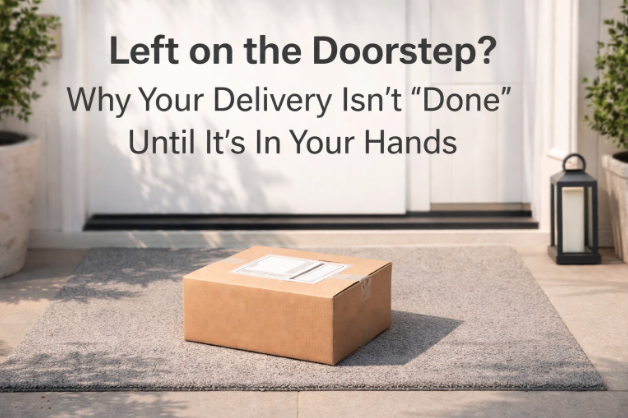
Left on the Doorstep? Why Your Delivery Isn’t ‘Done’ Until It’s In Your Hands and companies like Temu need to know this
We’ve all been there. You’re tracking a parcel, excitedly watching it inch closer to your home, and then: ping: “Your package has been delivered.” You rush to the door. Nothing. You check behind the bins, under the mat, in the hedge. Still nothing.
The delivery driver snapped a photo of your parcel perched on your doorstep three hours ago. Now it’s gone. Vanished into thin air: or more likely, into someone else’s hands.
Here’s the thing: that delivery wasn’t actually complete. Not legally, anyway. And that’s something every online shopper and online retailer in the UK needs to understand.
The Doorstep Delivery Problem
Online shopping has exploded. Whether you’re ordering from Amazon, Temu, or any of the countless retailers competing for your clicks, the expectation is simple: you pay, they deliver.
But “delivery” has become a bit of a loose term. Couriers are under immense pressure to hit targets, which means parcels increasingly end up dumped on doorsteps, shoved behind wheelie bins, or left with neighbours you’ve never met: all without your permission.
Porch piracy is now a widespread problem across the UK. Packages are stolen, damaged, delivered to wrong addresses, or simply abandoned in bizarre locations. The tension between what couriers consider “delivered” and what customers reasonably expect has created a grey area that benefits no one: except perhaps the thieves.
But here’s what many people, and as I experienced recently, even some big companies don’t realise: UK law is actually pretty clear on this. And it’s on the consumer’s side.
What the Consumer Rights Act 2015 Actually Says
The Consumer Rights Act 2015 is your best friend when it comes to online shopping disputes. It’s the piece of legislation that sets out your rights when you buy goods or services from a trader. And it has some very specific things to say about delivery.
Two sections are particularly relevant here: Section 29 and Section 49.
Let’s break them down.
Section 29: Risk Stays with the Trader
This is the big one. Section 29 of the Consumer Rights Act 2015 deals with when risk passes from the trader to the consumer. In plain English: who’s responsible if something goes wrong with your goods?
The law states that goods remain at the trader’s risk until they come into the physical possession of:
• The consumer, or
• A person identified by the consumer to take possession of the goods
Read that again. Physical possession. Not “left on doorstep.” Not “thrown over fence.” Not “placed in a location the driver deemed safe.”
The goods must be in someone’s actual hands. That someone must be either you or a person you’ve specifically nominated: like a neighbour you’ve named, a family member, or a receptionist at your workplace.
If a courier leaves your parcel on the doorstep without your explicit instruction and it disappears, the risk hasn’t transferred to you. It’s still on the trader. Legally, your delivery hasn’t been completed.
Section 49: Reasonable Care and Skill
Section 49 adds another layer of protection. It states that every contract to supply a service is to be treated as including a term that the trader must perform the service with reasonable care and skill.
What does this mean for deliveries? The service: getting your goods from the warehouse to you: must be carried out properly. Dumping a parcel in an unsecured location without consent doesn’t exactly scream “reasonable care and skill.”
If a retailer or their courier fails to deliver your goods safely into the right hands, they’ve arguably breached this term. And that gives you grounds to demand they put things right.
What This Means for You
So let’s put this into practical terms. What does all this legal jargon actually mean when your #Temu haul goes missing?
1. The retailer is responsible, not you.
If your parcel was left somewhere without your permission and it’s gone, that’s the retailer’s problem. They contracted to deliver goods to you, and they haven’t done that. You’re entitled to a refund or a replacement.
2. “Safe place” instructions matter.
If you’ve explicitly told the courier to leave parcels in a specific location: say, behind your garden shed: then you’ve assumed some of the risk. But if you haven’t given those instructions, the default position is that delivery requires a person to receive it.
3. Photo evidence isn’t proof of delivery.
Couriers love to snap photos of parcels on doorsteps as “proof” of delivery. But a photo of an unattended package doesn’t prove you received it. It proves they left it somewhere. There’s a significant difference.
4. Neighbours only count if you’ve authorised them.
Some couriers leave parcels with neighbours as standard practice. But unless you’ve specifically nominated that neighbour, the delivery isn’t technically complete. If the neighbour loses the parcel or denies receiving it, that’s still on the trader.
What to Do If Your Parcel Goes Missing
And here I will talk about a recent case I experienced, when a #Temu order was abandoned on my doorstep and was stolen.
If you find yourself staring at a “delivered” notification with no parcel in sight, here’s your action plan:
Contact the retailer first. Don’t bother chasing the courier: your contract is with the retailer, not the delivery company. It’s their job to sort it out. I did this, but #Temu, denied it was their problem, rejecting a complaint, and providing a photo of the parcel being left abandoned on a doorstep with a description. Weirdly in the description from #Temu it suggested the parcel had been left in an “enclosed porch” despite the picture not showing that. In an email exchange, a customer service rep from #Temu said: “We have reviewed the delivery details for your order once again and can confirm that the package was successfully delivered to your address”. They went on to blame the “enclosed porch” on the courier.
State your rights clearly. Reference the Consumer Rights Act 2015 if needed. Explain that under Section 29, the goods remained at their risk because they never came into your physical possession. Again I did this with #Temu, but they remained unmoved.
Request a refund or replacement. You’re entitled to one. The retailer can’t fob you off with “the courier says it was delivered.” #Temu tried this with me rejecting two separate requests.
Escalate if necessary. If the retailer refuses to help, you can escalate to your payment provider for a chargeback, speak to Citizens Advice or your local trading standards. Write to your local paper, or a national one. Sometimes they have journalists who write about consumer affairs and who can take up your case. Keep records. Screenshots of tracking information, delivery notifications, and any correspondence with the retailer will strengthen your case.
The Bigger Picture
Perhaps the most galling part is the sheer amount of time and effort that you have to put into trying to prove your case, when the law is clear. As #Temu showed their customer services seem unaware of the law, certainly the one I was in contact with, a point I put to their press office. Expecting a fulsome reply, I was shocked to receive a “no comment” reply. I challenged this, as there are a million ways most companies can address such an issue, but the no comment reply stands.
And although I eventually received a refund, had I not been moved to write about this issue, I doubt this would have happened.
So, the next time a retailer tries to tell you that your missing parcel is “not their problem,” you’ll know better. Section 29 and Section 49 of the Consumer Rights Act 2015 are your tools. Use them.
Delivery is only complete when a package is in the physical possession of a person. That’s the law. And no amount of doorstep photos or “safe place” excuses changes that fact.
Your delivery isn’t done until it’s actually in your hands.