

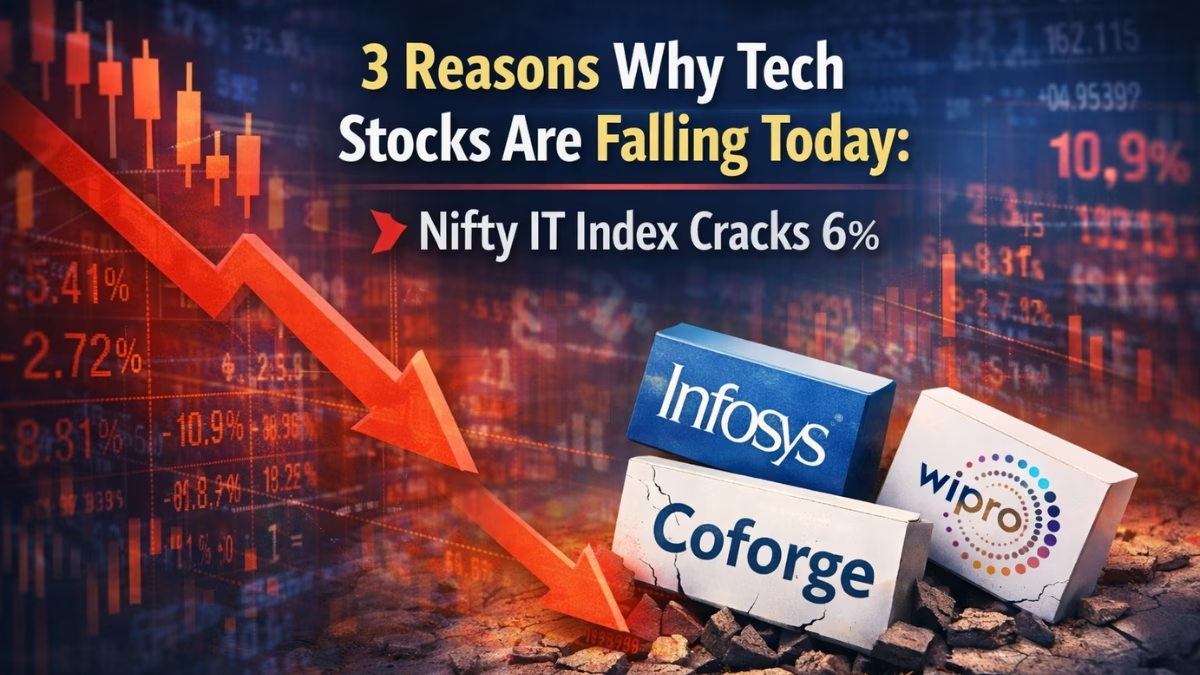
San Francisco, February 4, 2026 — According to Parliament News, Global Software Stocks moved lower across major international markets as investors reacted to accelerating advances in artificial intelligence that are reshaping the foundations of the global software industry. The reassessment unfolding in 2026 reflects growing concern that long-established valuation frameworks may no longer capture the pace or scale of AI-driven disruption.
Equity markets in North America, Europe, and Asia showed synchronized weakness across software-heavy indices, signaling a structural repricing rather than a localized or short-term correction.
Anthropic’s Message Resonates Across Global Markets
The latest wave of investor scrutiny has been closely tied to signals emerging from San Francisco-based artificial intelligence research firms, most notably Anthropic. Industry participants have focused on the company’s public discussions highlighting how quickly advanced AI systems are moving beyond narrow applications into broader reasoning, automation, and content generation.
These developments have intensified debate about whether existing enterprise platforms can defend their economic relevance in an environment where AI can replicate or replace core software functions at scale.
One technology strategist based in Silicon Valley said,
“Artificial intelligence is no longer supporting software products. It is becoming the product itself.”

Why AI Is Triggering a Valuation Reset
For more than a decade, software companies benefited from predictable subscription revenue, high operating margins, and strong customer lock-in. Those assumptions are now being tested as AI compresses innovation cycles and lowers switching costs.
Modern AI systems can integrate data, generate outputs, and adapt in real time, reducing reliance on multiple standalone software tools. As a result, Global Software Stocks are facing renewed pressure as investors question long-term pricing power and customer retention.
This shift does not suggest that demand for software is disappearing, but rather that the definition of value within the sector is changing rapidly.
Market Reaction Reflects Global Synchronization
Technology indices across the United States, the European Union, and Asia-Pacific markets reflected similar patterns of decline. Analysts described the move as disciplined, with institutional investors rotating capital toward AI-native platforms and infrastructure providers rather than exiting technology exposure entirely.
In this environment, Global Software Stocks are increasingly benchmarked against emerging AI-first competitors instead of traditional industry peers, marking a significant shift in market psychology.
Enterprise Customers Accelerate the Shift
Corporate buyers are playing a decisive role in accelerating transformation across the software ecosystem. Enterprises are prioritizing platforms that embed artificial intelligence directly into workflows, enabling automation, predictive analytics, and faster decision-making.
A senior enterprise software advisor noted,
“Customers now expect intelligence to be built into the system from day one, not added later as an upgrade.”
This change in buyer expectations is intensifying competitive pressure on Global Software Stocks that have relied on incremental innovation rather than foundational redesign.
Competitive Pressure Intensifies Across the Sector
Lower development barriers enabled by AI have increased competition across the global software landscape. Startups can now deploy sophisticated tools with fewer resources, challenging established firms on speed and adaptability.
This dynamic is eroding long-standing advantages tied to scale and brand recognition. Investors are increasingly evaluating companies based on execution speed, AI integration depth, and data access rather than legacy market share.
Capital Markets Adjust to a New Innovation Cycle
Capital allocation trends further illustrate the shift underway. Venture capital and institutional funding are flowing toward AI-native platforms, cloud infrastructure providers, and data-centric companies that enable large-scale model training and deployment.
These trends reinforce caution toward Global Software Stocks perceived as slow to adapt, as capital markets prioritize agility over incumbency.
Volatility Reflects Uncertainty, Not Collapse
Despite recent declines, market analysts caution against interpreting the adjustment as a collapse of the software sector. Demand for digital tools continues to expand across industries such as healthcare, finance, manufacturing, and logistics.
However, the pace of AI adoption is compressing timelines for strategic execution. Companies unable to respond quickly may face gradual erosion rather than sudden failure, a risk that investors are now actively pricing.
Global Investors Rebalance Expectations
Portfolio managers are increasingly differentiating between software firms positioned to benefit from AI and those vulnerable to displacement. This selective approach suggests that volatility may persist as markets refine expectations.
One global asset manager observed,
“This is not a technology selloff, it is a reassessment of who controls the future of software value creation.”
Transition Phase Defines Early 2026
The first months of 2026 are emerging as a defining transition period for the software industry. Artificial intelligence is no longer viewed as a future trend but as a present force reshaping competitive dynamics, pricing strategies, and customer relationships.
For Global Software Stocks, the challenge lies in demonstrating credible paths to AI-driven growth while navigating rising development costs and regulatory scrutiny.
Regulatory Scrutiny Expands Alongside AI Adoption
As artificial intelligence becomes more deeply embedded in commercial software, regulatory attention is increasing across major jurisdictions. Policymakers in the United States and the European Union are examining how AI systems handle data, generate outputs, and influence automated decision-making in sensitive sectors.
For Global Software Stocks, regulatory compliance is emerging as a parallel challenge to technological disruption. Firms operating across borders must now navigate fragmented regulatory frameworks while continuing to innovate at speed, adding complexity to long-term planning.
Enterprise Procurement Patterns Are Rapidly Changing
Large enterprises are no longer evaluating software solely on feature sets or vendor reputation. Procurement teams are increasingly focused on adaptability, automation depth, and measurable productivity gains delivered through AI.
This shift has shortened purchasing cycles and reduced tolerance for rigid platforms. As enterprise expectations evolve, Global Software Stocks are being forced to redesign offerings to remain competitive in a landscape where flexibility is paramount.
Margin Pressure Becomes a Central Investor Concern
While revenue growth remains visible across parts of the technology sector, margins are facing new pressure. AI integration requires significant upfront investment in infrastructure, data, and talent, even as pricing power becomes less certain.
Investors are now closely examining cost structures, particularly for firms that must balance legacy platforms with next-generation AI development. This margin sensitivity is becoming a defining factor in how Global Software Stocks are valued.
Competition Intensifies From AI-Native Entrants
The rise of AI-native companies has altered the competitive balance of the software market. These firms, unburdened by legacy systems, can iterate faster and deploy adaptive solutions more quickly than established competitors.
As barriers to entry fall, Global Software Stocks face a more crowded marketplace where innovation cycles are shorter and customer loyalty is harder to sustain.

Capital Allocation Reflects Long-Term Strategic Shifts
Investment flows provide further evidence of structural change. Venture capital funding continues to favor AI infrastructure, model development, and data-centric platforms, while public market investors are becoming more selective.
This reallocation suggests that markets are not abandoning software exposure, but redefining where long-term value is likely to emerge. In this environment, Global Software Stocks must demonstrate strategic clarity to retain investor confidence.
How Earlier Technology Shifts Reshaped the Software Industry
The software industry has undergone major transformations before. The shift from on-premise systems to cloud-based delivery initially disrupted revenue models and valuations. Similarly, the transition to subscription pricing reshaped customer relationships and cash flow predictability.
Artificial intelligence represents a deeper inflection point. Unlike earlier transitions, AI does not simply change how software is delivered, it changes what software does. For Global Software Stocks, this historical context underscores the scale of the challenge and the opportunity now unfolding.
Global Market Synchronization Signals Structural Change
The repricing observed in early 2026 has not been confined to any single exchange or region. Software-heavy indices across North America, Europe, and Asia have moved in broadly similar patterns, reflecting shared investor concerns.
This synchronization suggests that Global Software Stocks are responding to a common global narrative rather than isolated corporate developments.
Short-Term Volatility Masks Long-Term Divergence
Market volatility has increased as earnings expectations adjust to AI-driven realities. However, analysts caution that short-term price movements may obscure longer-term divergence within the sector.
Companies that successfully integrate AI into core offerings are expected to consolidate market share, while slower adopters may experience gradual erosion. This divergence is likely to become more pronounced for Global Software Stocks as 2026 progresses.
Strategic Execution Becomes the Decisive Factor
As AI lowers switching costs and accelerates competition, execution speed is emerging as the most critical differentiator. Firms that can align innovation, compliance, and monetization are better positioned to navigate the transition.
For Global Software Stocks, the margin for strategic missteps is narrowing, with investors increasingly intolerant of delayed or unclear transformation plans.
Workforce Transformation Adds Another Dimension
AI adoption is also reshaping workforce dynamics within software companies. Demand for AI engineers, data scientists, and ethics specialists is rising, while traditional development roles are evolving.
Managing this transition effectively is becoming another factor influencing investor confidence in Global Software Stocks, particularly as labor costs and talent competition intensify.
A Defining Phase for the Software Industry
The developments unfolding in 2026 indicate that the global software industry is entering a defining phase. Artificial intelligence is no longer a peripheral innovation but a central force shaping competition, valuation, and customer expectations.
Market participants increasingly view this period as a turning point for Global Software Stocks, where adaptability and execution will determine long-term relevance.
Reflects a Structural Market Shift
The current adjustment in valuations reflects a broader recognition that the economics of software are changing. Investors are recalibrating assumptions, enterprises are redefining value, and artificial intelligence is accelerating every dimension of disruption.
As markets continue to adjust, Global Software Stocks that successfully embed AI at their core may emerge stronger, while those that hesitate risk gradual decline in an increasingly intelligence-driven global economy.