

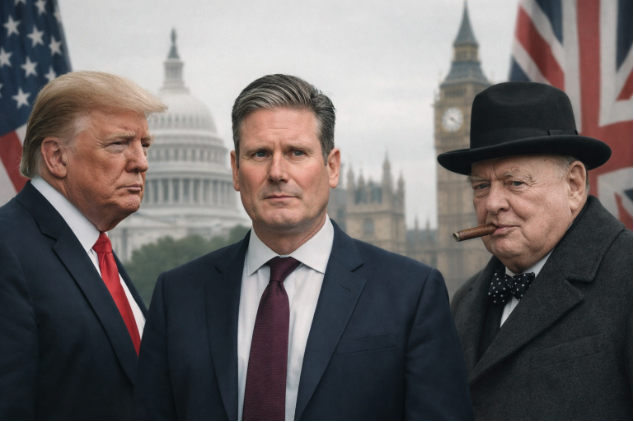
The phrase “Special Relationship” has always been a bit like a long-married couple’s pet name: affectionate to some, slightly nauseating to others, and frequently used to paper over the cracks of a deeply lopsided dynamic. But as of March 2026, the cracks aren’t just showing; they’ve become a full-blown architectural crisis.
In the hallowed halls of Westminster and the gilded corridors of Mar-a-Lago, the diplomatic mercury has plummeted to record lows. The catalyst for this latest frostbite? A characteristically blunt assessment from President Donald Trump, who recently declared that Sir Keir Starmer is “no Winston Churchill.” In the world of british politics, where Churchill is less a historical figure and more a secular saint, those are fighting words.
It’s a jab intended to do more than just bruise an ego; it signals a perilous state for transatlantic cooperation at a time when the Middle East is a tinderbox, Russia’s invasion of Ukraine continues and the geopolitical map is being redrawn by drone strikes and sovereign disputes.
The timing of Trump’s critique is as calculated as it is caustic. It follows a period of intense friction over how to handle the expanding conflict involving the US, Israel, and Iran. While the White House has been pushing for a robust, “all-in” military response following the strikes that eliminated Iranian leadership, Downing Street has been practising a brand of “strategic caution” that Washington views as dithering.
The tension reached a breaking point when the UK initially declined to let American aircraft use British bases for the first wave of offensive strikes on Tehran. Starmer’s caution was triggered by question marks over the legality of the US-led attacks and domestic UK politic, with many on the left of his party, plus the Lib Dems and Greens calling the war illegal and demanding British forces play no part.
The PM’s telling Parliament that he does not believe in “regime change from the skies,” reportedly left the Oval Office fuming. For Trump, who views military alliances through the lens of a loyalty test, this wasn’t just a policy disagreement; it was a betrayal of the very foundation of the special relationship.
This sense of abandonment was compounded by the chaos surrounding the UK’s RAF base in Cyprus. After reports of a strong explosion near RAF Akrotiri: a vital node for Western intelligence and logistics: the reality of the conflict’s expansion hit home. The base was reportedly targeted by pro-Iranian proxies, a move that forced the Prime Minister to eventually pivot on his stance regarding the use of UK airbases. While Starmer eventually sanctioned “limited, defensive strikes” from these bases after Iran retaliated against US allies, the damage to his reputation in Washington was already done. To Trump, the delay was evidence of a weak and duplicitous leader who lacks the resolve of a wartime premier.
Beyond the smoke of the Middle East, the “Churchill” comment also draws from the simmering resentment over the Chagos Islands. Starmer’s decision to cede sovereignty of the archipelago to Mauritius: while retaining the US-UK airbase at Diego Garcia on a long-term lease: has been described by Trump as “stupid”, although he initially seemed supportive.
The President’s frustration, may also more than aesthetics. The initial refusal to allow US forces permission to use UK air bases, made military operations “less convenient,” requiring extra flying hours and fewer sorties. In Trump’s worldview, a “Churchill-esque” leader would never have entertained the idea of surrendering an inch of territory that holds such strategic importance. By contrast, Starmer views the deal as a necessary step to settle a long-standing colonial dispute and secure the base’s future through legal certainty. It is a classic clash between the populist demand for “strength” and what could be described as the technocratic pursuit of “stability.”
The result of this friction is a President who is no longer shy about looking elsewhere for his European “best friend.” In a move that has sent shivers through the Foreign Office, Trump has publicly stated that he now has “stronger partners in Europe,” specifically praising France and Germany. For decades, the UK has marketed itself to the world as the “bridge” between the US and Europe. If the US decides it no longer needs the bridge, the UK risks becoming a very lonely island in the North Atlantic.
This shift in affection isn’t just about personal chemistry; it’s about the perceived utility of the alliance. When Starmer questions the use of British bases for offensive operations, he is, in the eyes of the current US administration, making the UK a “difficult” partner. Trump’s preference for Macron or Scholz, leaders who he believes are being more “transactional” and “realistic” in the current climate: is a direct snub to the idea that the UK holds a permanent, privileged seat at the American table.
Inside the UK, the “perilous state” of the relationship has become a potent weapon for Starmer’s domestic opponents. During recent sessions of PMQs, the Prime Minister has found himself fighting on two fronts. On one side, left-wing critics demand he distance the UK even further from US military adventurism; on the other, figures like Kemi Badenoch and Nigel Farage have seized on Trump’s comments to paint Starmer as a weakling who has alienated our most important security ally.
Starmer, who has stood his ground so far, walking a political tightrope between appeasing the left of his own Party and the White House, continues to insist that his primary duty is to judge “what is in Britain’s national interest,” but the political cost of being labelled “no Churchill” by the leader of the free world and being seen to lose influence with the President places the Sir Keir under immense pressure to make further concession to Washington.
Should concessions occur, expect those on both the left and right to launch renewed attacks on the embattled PM’s “perceived weakness” and “poor judgement” ahead of what could be make-or-break elections in May.