
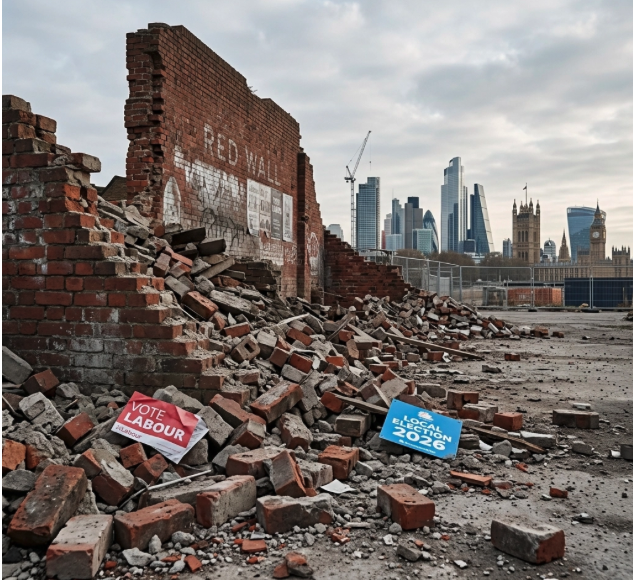
As results from the 2026 local elections trickle in from across England, the political map is being redrawn in front of our eyes as Reform wins hundreds of council seats as Labour’s Red Wall crumbles.
As Professor Sir John Curtice, one of the UK’s leading psephologists, told The Times: “We’re going to see records tumble. We are living in unprecedented circumstances. The opinion polls suggest that the traditional Conservative-Labour duopoly is facing its biggest challenge since its advent in the 1920s.”
And for Keir Starmer and the Labour Party, the overnight declarations have been nothing short of a nightmare in their traditional heartlands. The “Red Wall,” which had shown signs of returning to the fold in 2024, has been reduced to rubble: not by a Conservative resurgence, but by a Turquoise wave that has seen Reform UK transform from a protest movement into a party of municipal government.
One of the most startling result of the night came from Newcastle-under-Lyme, where Nigel Farage’s party took outright control of the council, sending shockwaves through the regional party offices. But the bleeding didn’t stop there. In Wigan, a town synonymous with Labour history, the party saw everyone of the seats it was contesting vanish, a staggering 22 in total. Tameside followed suit with 16 losses out of 17, and the symbolic fortress of Hartlepool has effectively been dismantled.
Nigel Farage, appearing before a jubilant crowd of supporters, was quick to frame the results as a “truly historic shift” in the British landscape. Using his characteristic flair for the dramatic, he told reporters that “there is no more left-right” in the old sense of the words. Farage later turned to a sporting metaphor to describe his party’s momentum: “If we cleared Becher’s Brook and landed well, we go on to win the Grand National. What is very clear to me is that our voters will stick with us now all the way through.”
This breakthrough suggests that the Mandelson scandal, a sluggish economy and the ongoing fatigue regarding the cost-of-living crisis have created a vacuum that Labour’s “moral compass” narrative.
For many voters in the North and Midlands, the choice was no longer between two shades of the Westminster establishment, but a rejection of it entirely. As one voter told a focus group, conducted by More in Common, “We had the Conservatives who were consistently shit, whereas Labour are shit but faster.”
However, politics loves a paradox, and while the Conservatives suffered some loses in the shires and northern towns, they managed to pull off some wins in the capital, in what one Conservative claimed was a “London Revival”, they successfully winning seats Westminster and Wandsworth from Labour.
These flagship London boroughs, which Labour had seized with such fanfare in 2022, have swung back to the blue column. Analysts suggest that a combination of local fatigue with aggressive traffic schemes and a backlash against national taxation policies may have driven affluent urban voters back to the Conservative fold.
By the time the sun was fully up, the pressure on 10 Downing Street had become palpable. Inside the Labour camp, the mood is reportedly funereal. Rumours have already begun to circulate that senior figures, including Ed Miliband, are quietly urging the Prime Minister to consider a departure timetable to avoid a total collapse before the next general election.
Keir Starmer, appearing bruised but resolute, has so far refused to entertain talk of a resignation. In a statement that will likely be dissected for weeks to come, the Prime Minister addressed the nation directly:
“I take responsibility for Labour’s election results in England. They are very tough, and there’s no sugarcoating it. We’ve lost brilliant Labour representatives across the country… that hurts, and it should hurt, and I take responsibility. Days like this don’t weaken my resolve to deliver the change that I promised. I’m not going to walk away and plunge the country into chaos.”
Despite the brave face, the internal math for Starmer is getting increasingly difficult. The loss of council leaders and hundreds of veteran activists in the North means the party’s ground game is severely compromised.
As we look toward the weekend, the drama is far from over. While the English councils have provided the initial shock, the counts for the Senedd in Wales and the Scottish Parliament are only just beginning. Early indications suggest that the same “fracturing” Curtice observed in England is crossing the borders, with nationalist parties and smaller insurgents poaching votes from the “big two.”
What these results confirm is that the duopoly that has defined UK politics for nearly a century is under its greatest-ever strain. Whether it is the rise of Reform on the right or the persistent nibbling of the Greens on the left, the voters are no longer behaving in predictable blocks.
The bloodbath of May 2026 will be remembered not just for the seats lost, but possibly for the moment the electorate decided that the old rules no longer applied. For the Prime Minister, the task of “steadying the ship” just seems like mission impossible, but there is unlikely to be an immediate coup against him. Figures from both the left and right of the Party have cautioned against this. Appearing on LBC, former Shadow Chancellor John McDonnell poured cold water on a rush to replace Sir Keir, saying Labour should “mustn’t lose our heads and panic”, although he added that there needs to be a rethink of policy and the direction of the Government.
Early results confirm poor night for Labour as Reform smashes Red Wall

7 mins read
Latest from UK News
BLAINA, BLAENAU GWENT, June 23 (Parliament Politics Magazine) – Gwent Police have launched a murder investigation
BELFAST, June 23 (Parliament Politics Magazine) – Tuesday marks the tenth anniversary of the referendum vote
LONDON, June 23 (Parliament Politics Magazine) – The British government announced plans on Tuesday to implement

LONDON, June 23 (Parliament Politics Magazine) – The United Kingdom government is considering new regulations that
NEWRY, Northern Ireland, June 22 (Parliament Politics Magazine) – A jury at Newry Crown Court found