
Today the Prime Minister, Sir Keir Starmer must deliver the speech of his life as calls for him to resign grow after Labour’s disastrous elections last week.
The backdrop to this “reset” is nothing short of a mutiny. Over 40 Labour MPs have reportedly joined a chorus calling for his resignation. The mood in the Parliamentary Labour Party (PLP) has shifted from quiet grumbling to an open scramble for the exits. Josh Simons, a key voice in the growing dissent, didn’t mince words about the Prime Minister’s standing, stating that Sir Keir had “lost the country”.
Leading the charge is former Minister Catherine West MP, who has emerged as a potential “stalking horse” challenger. West has placed a very public ticking clock on Starmer’s premiership, tying his survival directly to the performance he gave this morning.
Adding to the pressure is Deputy Prime Minister Angela Rayner. While she remains publicly at Starmer’s side, the internal messaging is far more pointed. Rayner is reportedly demanding a significant move to the left to reconnect with the party’s traditional base, viewing this moment as the final opportunity to save the government. Her assessment was blunt: “What we are doing isn’t working, and it needs to change. This may be our last chance.”
In the midst of the chaos, the internal shadow-boxing for the succession has become almost cinematic: quite literally. Reports suggest Wes Streeting is already “ready to be next PM,” a sentiment he has reportedly conveyed to Starmer himself. The Health Secretary’s movements are being tracked with the intensity of a thriller, leading to some rather creative defences from his allies.
Long-time Sir Keir loyalist, Science Secretary Peter Kyle attempted to pour cold water on the rumours of a coup or threat to the Prime Minister.
While Streeting waits in the wings, another shadow looms large over the Commons, Andy Burnham. The popular Mayor of Greater Manchester is increasingly viewed as the “King in the North” who could bridge the gap between the metropolitan leadership and the disillusioned northern heartlands. Plans are reportedly being drawn up for his return to Parliament, a move that would immediately reshape the internal power dynamics of the party.
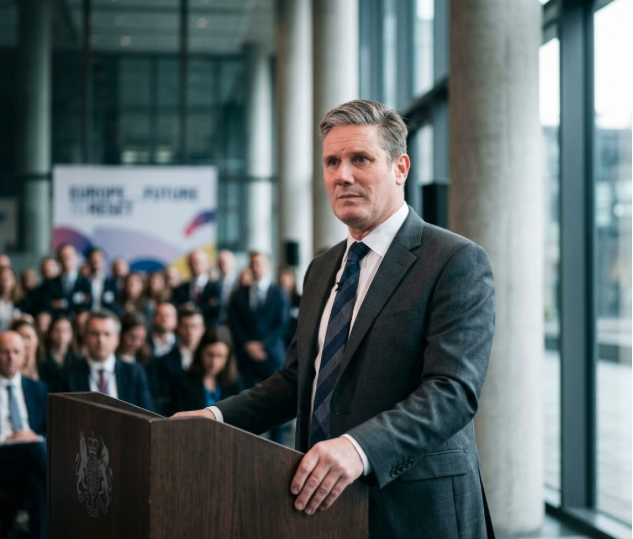
Starmer’s response to this pincer movement was a speech that attempted to leapfrog the internal bickering by proposing a radical shift in national direction. Admitting that the cautious approach of the last two years has failed to ignite the country’s imagination, he signaled a move to place Britain at the “heart of Europe” once more.
“To meet the challenges that our country faces incremental change won’t cut it,” Starmer declared. “On growth, defence, Europe, energy – we need a bigger response than we anticipated in 2024 because these are not ordinary times.”
This rhetoric marks a significant departure from the “steady as she goes” mantra that has defined his tenure. By leaning into Europe and energy independence, he is attempting to carve out a new “big state” narrative that might satisfy Rayner’s demand for a move to the left while offering a pro-growth agenda to appease the centrists.
Despite the grand visions of European integration, Starmer had to address the immediate pain of the election results. He was forced to acknowledge the deep bruising the party has taken across its former strongholds.
“I take responsibility for Labour’s election results in England,” he admitted. “They are very tough, and there’s no sugarcoating it. We’ve lost brilliant Labour representatives across the country… that hurts, and it should hurt, and I take responsibility. Days like this don’t weaken my resolve to deliver the change that I promised. I’m not going to walk away and plunge the country into chaos.”
The question now is whether the PLP: and Catherine West in particular: thinks this speech “grabbed the nation” enough to warrant putting the daggers away. For a Prime Minister who has frequently been accused of facing backlash for his messaging, the stakes couldn’t be higher. This was a speech designed to show he isn’t just a manager, but a leader capable of radical resets.
Is this the beginning of a bold new chapter that puts Britain back at the heart of Europe, or is it merely the final, desperate act of a premiership that has run out of road? The coming days in the tea rooms of Westminster will provide the answer. Although, as one commentator pointed out, borrowing a key phrase on the UK’s relationship from former Prime Minister Sir John Major, who led his party to a massive defeat in 1997 was not a good look.
One thing is certain: the time for incremental change is officially over, either a bold new plan if unveiled or the mutiny against Sir Keir looks set to grow.
Starmer’s high-stakes reset speech

6 mins read
Latest from UK News
BANGOR, June 26 (Parliament Politics Magazine) – On The Square Emporium, an auction house located in
LONDON, June 26 (Parliament Politics Magazine) – Great Britain is set to see the development of
RIYADH, June 26 (Parliament Politics Magazine) – The Ministry of Foreign Affairs has announced a new
LONDON, June 26 (Parliament Politics Magazine) – The United Kingdom provisionally shattered its all-time June temperature
LONDON, June 26 (Parliament Politics Magazine) – King Charles III and Queen Camilla will not move