
Today, Prime Minister Sir Keir Starmer will publish the government’s long-delayed Defence Investment Plan (DIP), framing the multi-billion pound settlement as a once in a generation move to modernise the British military.
However, the unveiling has been overshadowed by high-level resignations and intense scrutiny over a funding gap that service chiefs warn could leave the nation’s security at risk.
The plan, which arrives nearly a year later than originally promised, represents one of Starmer’s final major acts before he is expected to hand over the premiership to Andy Burnham next month.
The publication follows a period of significant turmoil within the Ministry of Defence (MoD). Writing for The Times, Steven Swinford, Larisa Brown, and Charlie Parker noted that “Sir Keir Starmer will unveil an additional £15 billion for defence on Tuesday amid significant concerns about how long-term projects intended to transform the armed forces will be funded.”
While the government has pitched the settlement as a “game-changing” injection of capital, critics argue the total amount falls nearly £13 billion short of what military leaders said was the absolute minimum to fully implement the recommendations of the 2025 Strategic Defence Review.
The central tension of the DIP lies in the discrepancy between the MoD’s requirements and the Treasury’s constraints. While the government has secured a settlement estimated between £14.5 billion and £15 billion over the next four years, service chiefs had consistently argued that a cash injection of £28 billion was necessary.
This friction led to the dramatic departures of John Healey as Defence Secretary and Al Carns as Armed Forces Minister, who resigned following the Prime Minister’s failure to overrule the Treasury and his putting forward of a deal seen as tens of billions of pounds short.
The Times also revealed that, despite the headline figures, the plan fails to provide a concrete timeline for reaching the key NATO spending target of 3 per cent of GDP. Instead, the government has provided a one-off £2 billion increase in day-to-day funding this year to help to cover the cost of operations and training, a move intended to placate senior officers who have warned that current activity levels are unsustainable.
Sir Richard Knighton, the head of the armed forces, cautioned earlier this month that the military would have to “dial back” our activities and our exercise and operational activity if the level of resource funding that’s available to us does not increase. Sources in the MoD are now concerned that Sir Richard might follow Healey and Carns and step down in protest at the low level of the settlement.
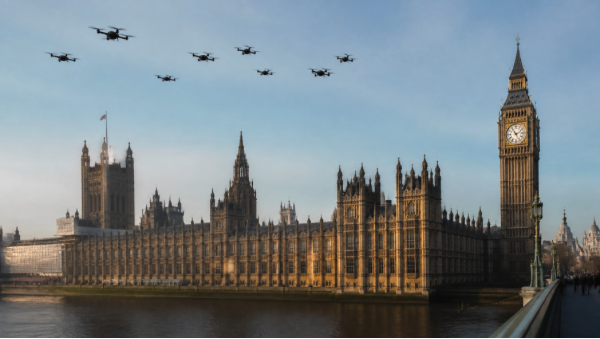
A primary pillar of the DIP is a massive shift toward autonomous technology. The government, with some fanfare, has committed £5 billion to a drone transformation programme designed to integrate uncrewed systems across land, sea, and air. However, the Daily Mail’s Mark Nicol pointed out that “only £1 billion of this is fresh investment, with a £4 billion drone programme having been announced last year.”
Critics have accused the government of “massaged figures and repackaged promises” rather than providing a genuine expansion of capability.
Despite these criticisms, the DIP outlines a significant shift in how the UK will manufacture and deploy warfighting robots. The plan aims to produce hundreds of thousands of drones over the next four years, with the capacity to scale to millions during active conflict. This strategy is heavily influenced by contemporary warfare in Ukraine.
New Defence Secretary Dan Jarvis, who took over following Healey’s resignation, remarked that the “character of warfare is rapidly changing,” adding that “in Ukraine and the Middle East, uncrewed systems are defining conflicts.”
Specific allocations for drones include £50 million for the Army to support infantry units. Simultaneously, the Royal Air Force is set to develop autonomous fighter jets and bring its “uncrewed electronic warfare drone system” into service this year. Much of this research will be centralised at what the MoD calls “Europe’s biggest drone testing centre” in Swindon, which serves as the hub for the government’s new autonomous technology task force.
The Royal Navy faces some of the most radical changes under the new investment plan. The government intends to transition the fleet into a “hybrid navy,” where crewed warships and submarines operate as “mother ships” for a vast array of autonomous platforms. A controversial element of this shift is the decision to build six new “budget warships,” also referred to as common combat vessels. These hybrid ships are intended to replace the UK’s fleet of Type 45 destroyers but has meant the scrapping of the Type 83 destroyer programme.
There is significant scepticism regarding the funding and delivery timeline for these ships. A senior defence source told The Times: “If you want to turn promises of money into defence contracts you need certainty. You need budget lines saying when we will hit 3 per cent. The Treasury is not willing to do that, and it has led to a lot of uncertainty about some of the big-ticket projects.”
The publication of the DIP comes just ahead of the NATO leaders’ summit in Turkey, where the UK will face pressure from allies to demonstrate its commitment to collective security. NATO Secretary General Mark Rutte recently met with Starmer at Downing Street, praising the Prime Minister for “everything you are doing to ramp up defence spending, to ramp up defence industrial production.” However, Rutte’s public flattery sits against a backdrop of increasing volatility in transatlantic relations.
The shadow of Donald Trump and his demand that NATO members increase their spending to 5% of GDP looms large over the current settlement. While the UK has pledged to eventually reach 3.5% of GDP by 2035, the lack of a clear intermediate timetable for the 3% target in today’s plan has drawn fire from the opposition.
Tory defence spokesman James Cartlidge described the plan as “too little, too late,” arguing that it was only being “rushed through because Keir Starmer is desperate for a legacy.” He further stated: “The plan is not worth the paper it is written on. The next prime minister needs to cut welfare and give our Armed Forces the funding they need.”
As Starmer prepares to exit Number 10, the DIP is seen by many as an attempt to lock in a defence legacy. However, there are questions about how much of the plan will survive the transition to a new administration.
Andy Burnham, who is positioning himself as a champion of localism and economic growth, may take the decision to increase defence spending as a way to drive investment and jobs in the sector, which employs tens of thousands of people outside of London, as Starmer’s DIP, represents a compromise between a Prime Minister seeking a legacy and Treasury penny-pinching.
Starmer unveils long-awaited Defence Investment Plan, but critics say it’s ‘too little, too late’

9 mins read
Latest from UK News
MANCHESTER, June 29 (Parliament Politics Magazine) – Andy Burnham has announced a radical strategy to reshape
CARDIFF, June 28 (Parliament Politics Magazine) – The political atmosphere in Cardiff has shifted dramatically following
LONDON, June 28 (Parliament Politics Magazine) – Prince Harry is reconsidering plans to bring his family

CHERTSEY, SURREY, June 27 (Parliament Politics Magazine) – A 31-year-old man has been charged with the
LONDON, June 27 (Parliament Politics Magazine) – Five individuals, including two teenagers, have died after drowning