

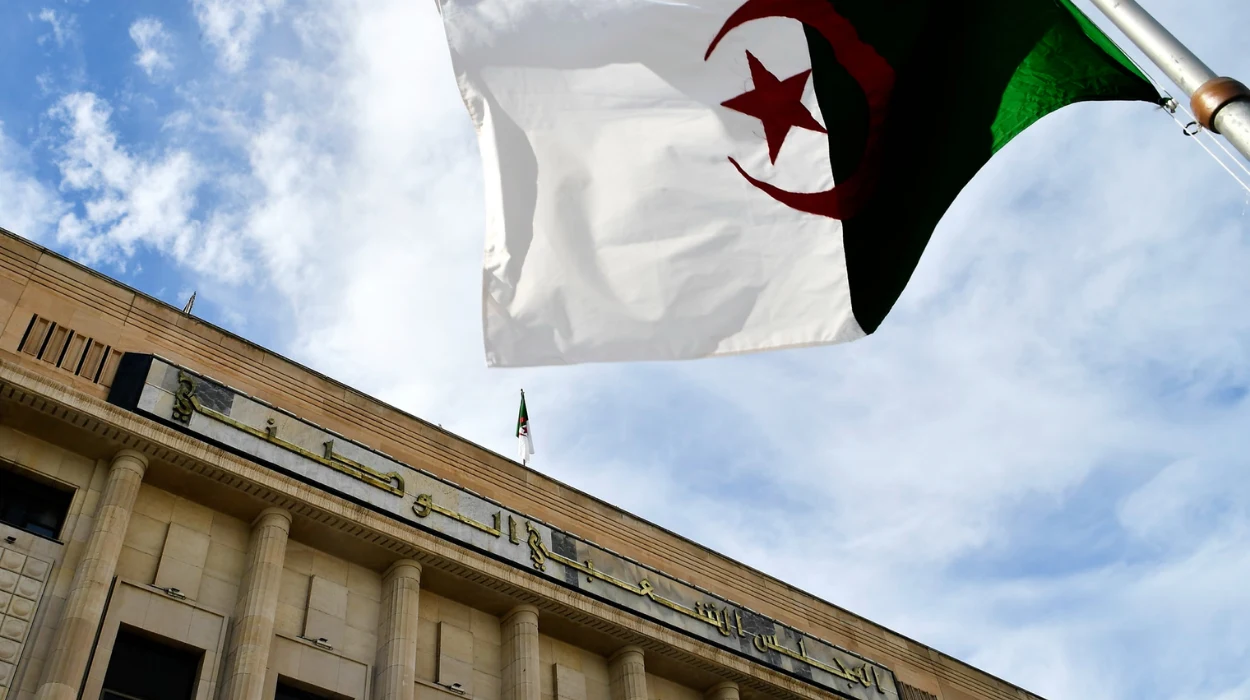
Algiers (Parliament Politics Magazine) – Algerian lawmakers approve a law criminalising French colonisation from 1830-1962, seeking reparations and signaling a politically significant break with France.
As reported by The Guardian, Algeria’s parliament has approved a bill declaring French colonial rule a criminal act, while calling for an official apology and reparations.
How did Algeria’s parliament react to the French colonial legacy with a new law?
During Wednesday’s parliamentary session, legislators wearing Algeria’s flag colours applauded and chanted “long live Algeria” in support of a bill holding France legally responsible for its colonial past and its consequences.
The two nations are engaged in a serious diplomatic dispute, with experts saying Algeria’s move is largely symbolic but carries significant political weight.
The parliament speaker, Ibrahim Boughali, stated that the legislation would send
“a clear message, both internally and externally, that Algeria’s national memory is neither erasable nor negotiable.”
The law outlines the “crimes of French colonisation,” including nuclear tests, extrajudicial killings, physical and psychological torture, and the organized plundering of resources.
It adds that,
“full and fair compensation for all material and moral damages caused by French colonisation is an inalienable right of the Algerian state and people.”
The period of French control over Algeria from 1830 to 1962 was marked by widespread killings and large-scale deportations, leading up to the violent war of independence between 1954 and 1962.
According to Algeria, around 1.5 million people died during the war, while French historians estimate the total death toll at 500,000, including 400,000 Algerians.
French President Emmanuel Macron has described Algeria’s colonisation as a “crime against humanity” but refrained from offering an apology.
Last week, when questioned about the vote, French Foreign Ministry spokesperson Pascal Confavreux said he would not comment on “political debates taking place in foreign countries.”
Hosni Kitouni, a researcher in colonial history at the University of Exeter in the UK, stated that
“legally, this law has no international scope and therefore is not binding for France”.
He added,
“Its political and symbolic significance is important: it marks a rupture in the relationship with France in terms of memory.”
Why are Algeria and France experiencing diplomatic tensions?
The relations between Paris and Algiers have been strained over France’s 132-year rule in Algeria, during which thousands of Algerians were killed, and a social hierarchy was established, privileging European settlers and their descendants.
France initially refused to relinquish Algeria, viewing it as part of its territory, and only left after the war of independence. The nation is remembered as the “country of a million martyrs” due to the heavy toll of lives lost.
In April, French Foreign Minister Jean-Noel Barrot said,
“We are reactivating as of today all the mechanisms of cooperation in all sectors. We are going back to normal and to repeat the words of President Tebboune: ‘The curtain is lifted.’”
How many people died in the Algerian War of Independence?
French historical studies suggest that around 250,000 Algerians (including civilians and fighters) were killed. Algeria officially states that 1.5 million people died.
Nearly 25,600 French soldiers were killed during the war, and 65,000 were wounded
Approximately 13,700 European civilians in Algeria were killed, wounded, or disappeared. After the war, at least 50,000 pro-French Muslim auxiliaries (Harkis) were massacred.
