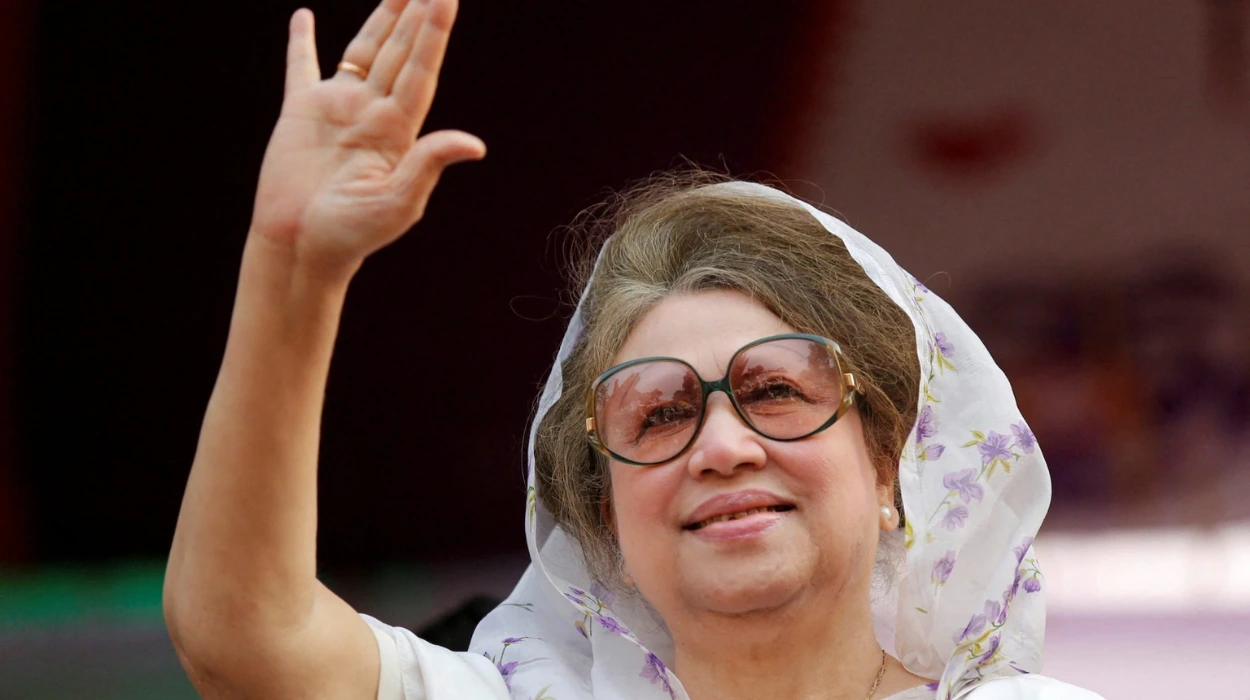
Dhaka (Parliament Politics Magazine) – Bangladesh’s first female Prime Minister, Khaleda Zia, passed away at 80, leaving a lasting impact on the country’s politics and leadership.
As reported by The Telegraph, the Bangladesh Nationalist Party announced on Tuesday that former Prime Minister Khaleda Zia has died at 80.
What did the BNP say about former Prime Minister Khaleda Zia’s passing?
The BNP said in a statement,
“The BNP chairperson and former prime minister, the national leader Begum Khaleda Zia, passed away today at 6:00 am (0000 GMT), just after the Fajr (dawn) prayer.”
It added,
“We pray for the forgiveness of her soul and request everyone to offer prayers for her departed soul.”
Ruhul Kabir Rizvi, the senior BNP leader, said,
“This is an irreparable loss for the nation.”
What was the impact of Khaleda Zia on Bangladesh’s politics?
Khaleda Zia, Bangladesh’s former first female prime minister, was expected to win next year’s elections despite health struggles and past imprisonment.
She confirmed in November that she would contest the February 2026 elections, marking the first vote since last year’s uprising against rival Sheikh Hasina.
The BNP is considered the front-runner, with Zia’s son Tarique Rahman, returning from years in exile, widely seen as a potential prime minister if they win.
Early in 2025, she traveled to London for medical treatment, staying there for four months before returning home, but her condition worsened in late November when she was hospitalized.
On Monday, 29 December, doctors said Zia’s condition was “extremely critical,” and she was on life support, with her age and poor health limiting treatment options.
Party officials in Dhaka submitted nomination papers for Zia across three constituencies, hours ahead of the upcoming elections.
Bangladesh’s interim leader, Muhammad Yunus, said the country “has lost a great guardian.”
He added,
“Through her uncompromising leadership, the nation was repeatedly freed from undemocratic conditions and inspired to regain liberty.”
Golam Kibria, a 29-year-old BNP supporter, said Zia
“chose prison over comfort and spent years jailed,”
calling her an “irreplaceable leader.”
Shy and family-oriented, Zia devoted herself to raising her sons until her husband, military leader and then-President Ziaur Rahman, was killed in a 1981 coup attempt.
In 1983, she became leader of the BNP, founded by her late husband, pledging to advance his goal of economic development and national progress.
She allied with Sheikh Hasina, daughter of Bangladesh’s founding father and Awami League leader, to lead a mass movement that ousted military ruler Hussain Muhammad Ershad in 1990.
The alliance ended quickly, with the women earning the title “Battling Begums,” an Urdu term for notable female leaders.
In 1991, Bangladesh held its first free election, ending with Zia defeating Hasina, gaining support from Jamaat-e-Islami.
Zia made history as Bangladesh’s first female prime minister, following Benazir Bhutto as the only other woman to lead a democratic Muslim-majority nation. She replaced the presidential system with a parliamentary one and introduced free primary education.
After losing to Hasina in 1996, Zia staged a surprising comeback in 2001. Her term was overshadowed by corruption claims and rising Islamist militancy.
In 2004, a grenade attack on a Hasina rally killed over 20 and injured 500, with Zia’s government and allies widely blamed.
During a 2004 rally, Hasina survived a grenade explosion that killed over 20 and injured hundreds, with Zia’s government and allies widely blamed.
In 2018, after Hasina returned to power, Rahman was sentenced to life in absentia, a verdict the BNP criticized as politically motivated.
Zia’s second term as prime minister ended in 2006 when an army-backed interim government took control, despite her efforts to curb Islamist extremism.
In 2007, after spending about a year in jail over alleged corruption and abuse of power, Zia and Hasina were released. Zia remained out of office, and her long-standing feud with Hasina continued to shape Bangladeshi politics, as the BNP boycotted the 2014 and 2024 elections.
In 2018, the court convicted Zia, Rahman, and aides of misappropriating $250,000 in foreign donations, a case Zia described as a political move to sideline her family.
Zia spent time in jail before being placed under house arrest in March 2020 due to declining health and was released in August 2024, while Hasina, 78, was sentenced to death in absentia and remains in hiding in India.
Commenting on Zia’s death, Hasina said,
“I pray for the eternal peace and forgiveness of Begum Khaleda Zia’s soul.”
How did global leaders react to Khaleda Zia’s passing?
Indian Prime Minister Narendra Modi expressed that Zia’s legacy would guide ties despite strained India-Bangladesh relations.
Pakistan’s Prime Minister Shehbaz Sharif called Zia a “committed friend” to Islamabad, while Yao Wen, China’s ambassador in Dhaka, expressed condolences.
Yao added,
“China will continue to maintain its longstanding and friendly ties with the BNP.”
When is Khaleda Zia’s funeral?
The funeral for former Prime Minister Khaleda Zia will be held on Wednesday, December 31, 2025, after the Zuhr (midday) prayer.
The prayers will take place at Manik Mia Avenue, adjacent to the South Plaza of the National Parliament in Dhaka. She will be buried beside her late husband, President Ziaur Rahman, at Chandrima Udyan (Zia Memorial Complex).