
Beijing (Parliament Politics Magazine) – China called on the US to meet nuclear disarmament duties after a Pentagon report highlighted Beijing’s expanding ICBM arsenal and lack of interest in arms talks.
As reported by Reuters, China called on the United States to honor nuclear disarmament obligations following a Pentagon draft report indicating Beijing may have deployed over 100 intercontinental ballistic missiles and avoided arms control talks.
What did Lin Jian say about US nuclear disarmament responsibilities?
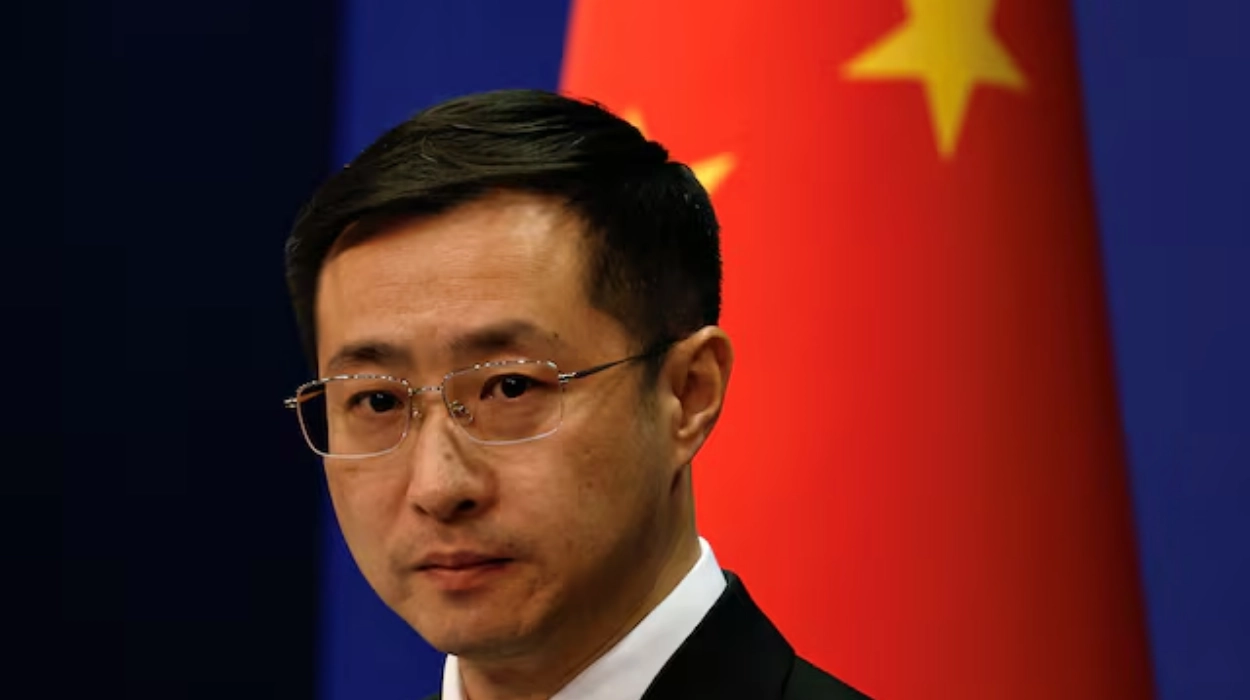
During a press conference in Beijing, Lin Jian, a Chinese foreign ministry spokesperson, said,
“As a super nuclear power with the largest nuclear arsenal, the most urgent task for the U.S. is to earnestly fulfil the special and priority responsibility for nuclear disarmament.”
America should
“substantially reduce its nuclear arsenal to create conditions for other nuclear-weapon states to join the nuclear disarmament process,”
Lin added.
US President Donald Trump indicated last month that he could be pursuing a plan to denuclearize with China and Russia.
According to a Chinese foreign ministry aide, he was unaware of the Pentagon report but added that similar “hypes” had come from the US in the past.
Lin said,
“It aims to find excuses for accelerating its own nuclear forces’ modernisation and actions disrupting global strategic stability.”
He stated,
“China firmly adheres to a no-first-use nuclear weapons policy and upholds a nuclear strategy of self-defence,”
adding that China
“does not engage in nuclear arms races with any country.”
What did the Pentagon report say about China’s nuclear arsenal?
A draft Pentagon report says China may have loaded over 100 ICBMs across three new silo fields and shows little interest in arms control talks.
The report said,
“We continue to see no appetite from Beijing for pursuing such measures or more comprehensive arms control discussions.”
According to the report, Beijing may have installed more than 100 solid-fueled DF-31 ICBMs in silo fields near Mongolia, the latest addition to its series, though earlier Pentagon reports noted the fields but not the missile count.
China’s embassy in Washington, D.C. said Beijing has
“maintained a defensive nuclear strategy, kept its nuclear forces at the minimum level required for national security, and abided by its commitment to a moratorium on nuclear testing.”
The draft Pentagon report provided no information on newly deployed missiles, and US officials said the report could be revised before submission to lawmakers.
According to the report, China’s nuclear arsenal was still in the low 600s in 2024, reflecting a slower production pace compared with earlier years.
The draft report added that Beijing’s nuclear arsenal is steadily growing and is projected to exceed 1,000 warheads, while China maintains a self-defense strategy and a no-first-use policy.
The detailed Pentagon report added that
“China expects to be able to fight and win a war on Taiwan by the end of 2027.”
According to the report, China is reportedly developing military plans to take Taiwan by “brute force,” including potential strikes 1,500-2,000 nautical miles from its shores.
It added,
“In sufficient volume, these strikes could seriously challenge and disrupt U.S. presence in or around a conflict in the Asia-Pacific region.”
The draft report said the purge may reduce short-term nuclear readiness but could lead to long-term improvements in PLA capabilities, noting that at least 26 senior and former officials in state-owned arms companies have been investigated or removed.
The report continued,
“Investigations have expanded from a 2023 focus on procurement of rockets and missiles industry to most of China’s defense industry, including China’s nuclear and shipbuilding industry.”
The Pentagon draft came shortly ahead of the 2010 New START treaty, the final U.S.-Russia nuclear arms accord, which limits both nations to 1,550 strategic warheads on 700 delivery systems.
President Trump has indicated that the US may resume nuclear testing; during his first term, he and former President Biden sought to involve China and Russia in talks to replace New START with a trilateral nuclear arms agreement.
Russian President Vladimir Putin and President Biden extended the deal for five years in February 2021, but its terms do not allow further extensions; experts warn its expiration could spark a trilateral nuclear arms race.
Daryl Kimball, an executive director of the Arms Control Association advocacy group,
“More nuclear weapons and an absence of diplomacy will not make anyone safer, neither China, Russia, or the United States.”
What is the New START treaty?
The New START treaty is a bilateral nuclear arms control deal between the US and Russia. It was signed in 2010, entered into force in 2011, and was extended in 2021 until its current expiration date of February 5, 2026.
The treaty’s core purpose is to enhance strategic stability and security by continuing the bilateral process of verifiable reductions to the world’s two largest nuclear arsenals.
The agreement is scheduled to expire on February 5, 2026, and there are no ongoing talks for a direct replacement. Russia has indicated a willingness to informally adhere to the central limits for a period after expiration, but the US has not committed to this.
