

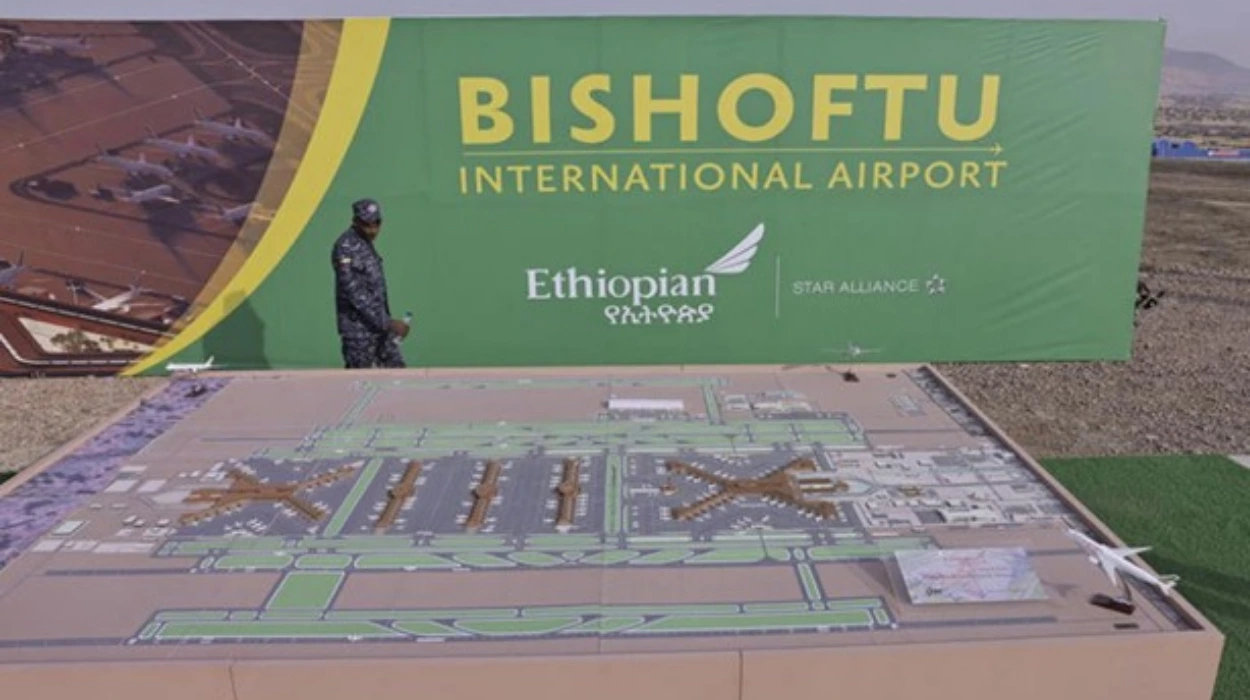
Addis Ababa (Parliament Politics Magazine) January 12, 2026 – Ethiopia launched construction of the $12.5 billion Bishoftu International Airport 45km southeast of Addis Ababa designed to handle 110 million passengers annually with capacity for 270 aircraft across four runways. Ethiopian Airlines will fund 30% of the project with Chinese lenders and African Development Bank covering the remainder through a $8.7 billion financing package. Prime Minister Abiy Ahmed attended the groundbreaking ceremony stating airport positions Ethiopia as Africa’s primary aviation hub serving 1.2 billion continental population.
The project addresses capacity constraints at Bole International Airport expected to reach saturation within two to three years amid rapid growth in travel and trade. Bishoftu features a terminal complex spanning 750,000 square metres plus cargo facilities processing 2.5 million tonnes annually. Phase I targets 60 million passenger capacity operational by 2030 with full completion 2035.
Bishoftu airport targets 110 million annual passenger throughput
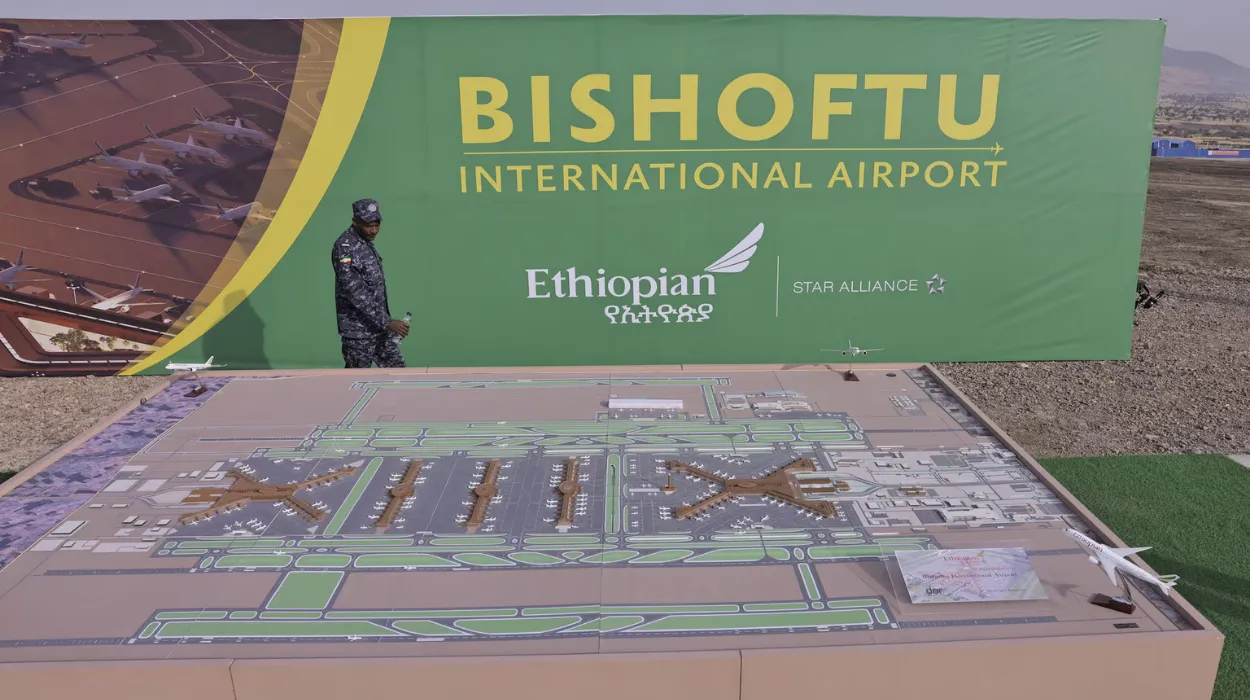
Bishoftu International Airport plans four parallel runways accommodating A380 Boeing 777X widebody operations simultaneously with 270 aircraft parking stands. Terminal buildings provide 150 gates and 200 boarding bridges serving peak hour movements exceeding 120 flights hourly. Cargo terminal capacity reaches 2.5 million tonnes annually establishing Ethiopia as continental logistics gateway.
Airport city development spans 5,000 hectares including commercial zones, hotels and convention centres generating 150,000 direct employment. Sustainability features include 500 megawatt solar power generation supplying 80% operational requirements achieving carbon neutral certification. Green terminal design incorporates rainwater harvesting wastewater recycling meeting 70% non-potable water demands.
NextMetropolis detailed project specifications. NextMetropolis said in X post,
“Ethiopia has begun construction on what is being billed as Africa’s largest airport, a $12.5 billion project led by Ethiopian Airlines that aims to reshape the continent’s aviation capacity by 2030. The state-owned carrier has officially broken ground on Bishoftu International Airport (BIA), a four-runway facility located about 45 km (28 miles) southeast of Addis Ababa.
According to government officials, the airport will be able to park 270 aircraft and handle up to 110 million passengers annually, more than four times the capacity of Ethiopia’s existing main airport, which is expected to reach its limits within two to three years. Ethiopian Airlines will fund roughly 30% of the project, with lenders financing the remainder.
The airline has already allocated $610 million for earthworks scheduled to be completed within a year, while main contractors are expected to start work in August 2026. The African Development Bank Group has committed $500 million and is leading efforts to raise $8.7 billion from other lenders.”
Ethiopia has begun construction on what is being billed as Africa’s largest airport, a $12.5 billion project led by Ethiopian Airlines that aims to reshape the continent’s aviation capacity by 2030. The state-owned carrier has officially broken ground on Bishoftu International… pic.twitter.com/zv54LG5mSv
— NextMetropolis (@NextMetropolis) January 12, 2026
Ethiopian airlines commits $3.75 billion equity financing share
National carrier allocated $610 million initial earthworks phase completion within 12 months mobilising heavy earthmoving equipment clearing 5,000 hectares site preparation. Ethiopian Airlines secures 30% equity stake $3.75 billion total investment maintaining operator concession 50 years commercial operations commencement. Revenue projections forecast $4.2 billion annual aeronautical charges $3.8 billion non-aeronautical generating 8% EBITDA margins.
Star Alliance hub status supports network expansion connecting 150 destinations 1,200 weekly flights delivering 25 million seats annual capacity. Fleet planning accommodates 120 widebody 85 narrowbody aircraft maintaining Skytrax 4-Star dispatch reliability 98.7% industry benchmark performance.
Chinese lenders provide $8.75 billion 70% project financing
China Aviation Capital Group leads $8.75 billion financing package structured 25-year tenor 3.8% fixed margin LIBOR benchmark with 15-year grace construction principal moratorium. African Development Bank committed $500 million leading $8.7 billion multilateral syndication targeting additional $1.2 billion green bonds environmental components. Financing structure achieves 1.6x debt service coverage ratios operations commencement supporting long-term viability.
Engineering procurement construction contract awarded China Civil Engineering Construction Corporation consortium turnkey delivery 2035 deadline. EPC cost breakdown allocates $6.2 billion infrastructure $3.8 billion equipment systems $2.5 billion airport city development phases.
Business Explainer highlighted project significance. Business Explainer said in X post,
“AFRICA’S BIGGEST AIRPORT TAKES SHAPE Ethiopia has started building a new $12.5-billion airport near Addis Ababa, a project expected to become Africa’s largest when it opens in 2030. The airport will be built in Bishoftu and designed by Ethiopian Airlines, with space for four runways, hundreds of aircraft and more than 100 million passengers a year.
The investment is driven by pressure at the country’s main airport, which is nearing capacity as travel and trade grow. Ethiopian Airlines will fund part of the project, with the rest coming from international lenders, including development banks.”
AFRICA’S BIGGEST AIRPORT TAKES SHAPE
Ethiopia has started building a new $12.5-billion airport near Addis Ababa, a project expected to become Africa’s largest when it opens in 2030.
The airport will be built in Bishoftu and designed by Ethiopian Airlines, with space for four… pic.twitter.com/wuKnjmtmX7
— Business Explainer (@businessXplain) January 12, 2026
Phase i construction achieves 60 million capacity 2030 operations
Initial phase completes two runways 2.8km terminal 90 gates processing 60 million passengers annually commencing operations 2030. Phase I connects 45 African 35 Asian European destinations supporting Airspace A Category I procedures simultaneous parallel operations. Passenger terminal provides 12 square metres per passenger international standard automated people mover linking 12 piers.
Phase II expansion adds second terminal runway extensions achieving 110 million capacity 2035 full commercialisation. Cargo facilities Phase I process 1.2 million tonnes expanding 2.5 million tonnes complete operations. Airport rail integration connects Addis Ababa Light Rail 18-minute journey frequency 10 minutes peak hours.
Bole international capacity saturation drives relocation strategy
Current hub processes 45 million passengers annually approaching saturation within two to three years rapid growth projections. Bishoftu relocation strategy preserves Bole operations domestic regional feeder traffic maintaining 25 million capacity post-relocation. Dual hub model optimises continental international traffic segregation improving operational efficiencies.
Runway utilisation optimisation achieves 120 peak hour movements and four parallel configurations simultaneous widebody operations. Advanced air traffic management systems support 98.7% on-time performance industry leading metrics Star Alliance network connectivity.
Airport city generates 150,000 employment commercial revenues
5,000 hectare development accommodates 2 million square metres commercial space 50,000 hotel rooms convention centre 100,000 delegates capacity. The free trade zone processes $15 billion annual exports serving 35 African markets and consolidated cargo operations. Business aviation FBO facilities support 5,000 annual movements of private jet operations.
Logistics cluster creates 75,000 direct 225,000 indirect jobs e-commerce fulfilment 2 million parcels daily processing capacity. Knowledge city universities research institutes train 50,000 aviation professionals annually supporting regional operations maintenance requirements.
Sustainability achieves carbon neutral airport operations
A 500 megawatt solar farm generates 1.2 billion kilowatt hours powering 80% facilities’ zero emissions target. Waste-to-energy plant processes 450,000 tonnes municipal waste producing 120 megawatts baseload power. Electric ground power units replace diesel APU 100% apron operations emissions elimination.
Rainwater harvesting system captures 2.8 billion litres supplying 70% non-potable irrigation landscaping requirements. Wastewater treatment plant processes 45 million litres daily 98% recycling rate sanitary cooling applications. LEED Platinum certification benchmarks 35% energy 40% water conservation reductions.
Chinese epc consortium mobilises 25,000 peak construction workforce
China Civil Engineering Construction Corporation leads consortium mobilising 25,000 workers peak phases 65% local hires skills transfer programmes. Runway construction utilises 12 million tonnes aggregate 450,000 tonnes asphalt achieving 4.4km parallel configuration. Terminal construction employs 5,200 precast concrete panels and 2.8 million square metres glass curtain walling.
Modular factory produces 85% terminal components 450km distance reducing transport emissions 72% site duration. Baggage handling system capacity 28,000 bags hourly 99.9% traceability automated sorting 250 destinations coding compliance.
Economic impact contributes $8 billion annual gdp multiplier
Airport operations generate $8 billion GDP contribution 4.2% national economy employment tourism trade multipliers. 150,000 direct jobs $18,000 average annual wages 225,000 indirect employment generation. Tourism multiplier creates $25 billion visitor spending 25 million arrivals 12-night average length stays.
Cargo operations process $45 billion annual exports of minerals and perishables manufacturing goods. Logistics efficiencies reduce Djibouti corridor transit times 28 hours $1.2 billion annual importer cost savings.
Intra-Africa aviation liberalisation supports low-cost operations
The airport facilitates YDCA liberalisation low-cost carriers 150-seat aircraft 75% load factors point-to-point routes. Bilateral agreements 85 African states enable code-share partnerships and fifth freedom rights operations. Express parcel operators DHL FedEx UPS establish hub operations 1.5 million tonnes annual throughput capacity.
Continental hub status serves 54 nations with a 1.2 billion population generating $25 billion tourism revenues and 25 million arrivals projections. Network expansion connects 220 destinations 1,600 weekly flights Airspace A Category I status compliance.
Renaissance dam economic corridor freight consolidation hub
GERD corridor integration facilitates $28 billion annual trade volume mineral exports industrial imports processing. Logistics park handles 5 million TEU containers Djibouti consolidation serving 35 African markets. Industrial parks development $150 billion investment generates 3 million manufacturing employment opportunities.
Special Economic Zone designation attracts MRO facilities $2 billion annual revenues 50 aircraft throughput capacity. Knowledge transfer programmes train 50,000 aviation professionals supporting regional operations requirements.
