


London (Parliament Politics Magazine) January 19, 2026 – Haas F1 Team has unveiled digital renders of its VF-26, becoming the first outfit to publicly display a 2026-spec Formula 1 car ahead of the sport’s most transformative regulation changes in decades. The American-owned team, which secured eighth place in the 2025 Constructors’ Championship with approximately 80 points including Oliver Bearman’s fourth-place finish in Mexico City, showcased a slimmer chassis, narrower front wing, and a livery dominated by white and red hues reflecting new title sponsor Toyota Gazoo Racing. The reveal signals intensive preparations for pre-season testing in Barcelona and Bahrain, culminating in the Australian Grand Prix opener on March 8.
VF-26 Design Innovations and Livery Evolution
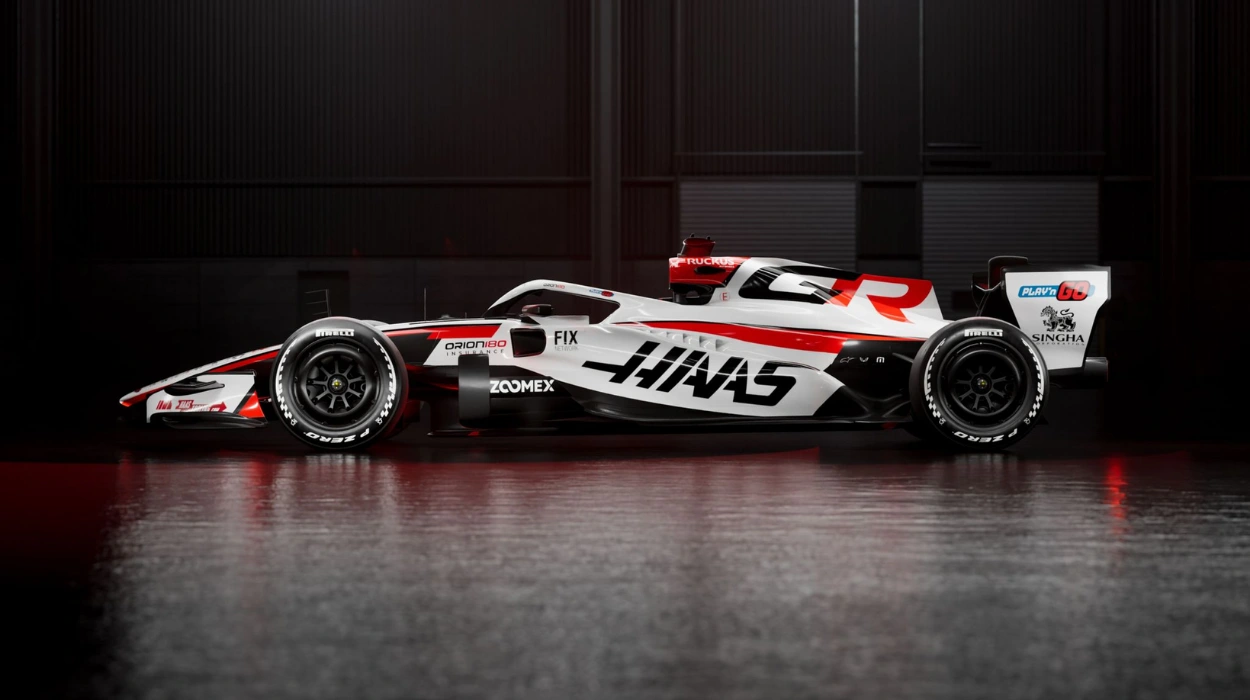
Haas released high-resolution digital renders of the VF-26 on Monday, marking the initial public unveiling of a car built to Formula 1’s radically revised 2026 technical specifications. The vehicle appears significantly smaller and narrower than its 2025 predecessor, adhering to rules that reduce overall weight by 30kg and introduce a fresh aerodynamic philosophy aimed at enhancing on-track agility and closer racing. Key visible modifications include a notably narrower front wing and a prominent fin atop the engine cover, features designed to curtail downforce and drag while integrating active aerodynamics to supplant the drag reduction system (DRS).
As reported by Andrew Benson of BBC Sport, these elements represent the most striking alterations on the Haas machine, setting it apart from prior generations. The renders offer a clearer view than recent efforts by other teams, such as Cadillac’s blurred shakedown images from Silverstone or Red Bull’s non-representative show car displayed in Detroit.
The accompanying livery overhaul replaces extensive black carbon exposures from 2025 with expansive white panels and bolder red accents, directly echoing Toyota’s corporate palette. This aesthetic shift underscores Haas’ deepened collaboration with Toyota Gazoo Racing, elevated to title sponsorship status for 2026. Chris Medland of RacingNews365 observed the prominent branding in an immediate reaction.
Chris Medland – @ChrisMedlandF1 said in X post,
“Haas has unveiled its 2026 car – the VF-26. Heavy TGR branding as its new title partner #F1”
Haas has unveiled its 2026 car – the VF-26. Heavy TGR branding as its new title partner #F1 pic.twitter.com/P6jekcYjo8
— Chris Medland (@ChrisMedlandF1) January 19, 2026
Technical observers noted continuities in Haas’ cooling approach alongside the fresh look. Aerodynamics expert Vanja H highlighted the side-pod airbox design in context of ongoing development trends.
Vanja H – @AeroTechVH said in X post,
“#F1 #F1Tech #F12026 Haas VF26 is revealed, love the livery and having predominant white is a welcome return since 2022 Haas continues to increase airbox cooling, something they started in 2024 and went against what Ferrari (PU supplier) does with their car”
Haas VF26 is revealed, love the livery and having predominant white is a welcome return since 2022
Haas continues to increase airbox cooling, something they started in 2024 and went against what Ferrari (PU supplier) does with their car pic.twitter.com/ZcMry2rny6
— Vanja H (@AeroTechVH) January 19, 2026
Sky Sports coverage emphasised how the VF-26’s front and rear wings diverge sharply from 2025 norms, contributing to the mandate for lighter, more nimble machinery. Team principal Ayao Komatsu described the early launch as “almost a bit surreal,” yet affirmed the excitement for a regulation-altered campaign.
Comprehensive 2026 Regulation Transformations
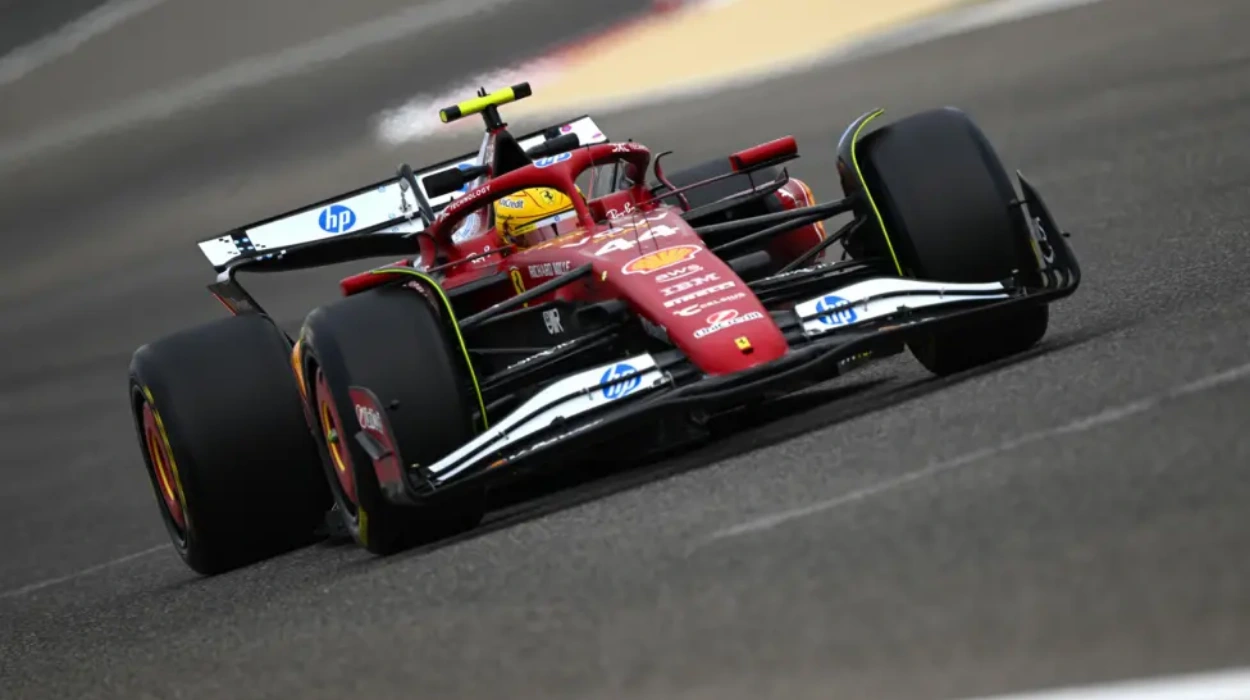
The 2026 ruleset constitutes Formula 1’s most sweeping redesign since the hybrid era dawned in 2014, overhauling chassis dimensions, aerodynamics, and power unit architectures. Chassis stipulations demand cars 30kg lighter at 768kg maximum, with reduced widths and lengths to foster manoeuvrability. Front wings narrow to 50cm from 75cm, rear wings to 60cm track with a lower-mounted element, all engineered for diminished downforce—targeted at 30% less—and drag, facilitating wheel-to-wheel combat via manual overrides and ‘overtake modes.’
Power units preserve the 1.6-litre V6 turbocharged hybrid core but elevate electrical output dramatically. The MGU-K battery motor surges nearly threefold to 350kw from 120kw, equalling the internal combustion engine’s 400kw for a 50% electrical contribution to total propulsion. MGU-H exhaust energy recovery disappears, replaced by enhanced braking recuperation doubled to 8.5 MJ per lap. All fuel must derive from sustainable sources—waste biomass or industrial synthetics—aligning with net-zero ambitions by 2030.
Andrew Benson of BBC Sport detailed how these shifts demand sophisticated energy deployment, with batteries cycling multiple times per lap amid heightened lap-long management. Komatsu echoed this to BBC, stating no team feels wholly equipped, with Haas facing amplified hurdles as F1’s leanest operation:
“The challenge is bigger for us.”
Power unit supplier alignments—Mercedes powering four teams including McLaren and Aston Martin, Ferrari three with Haas and Sauber, Red Bull-Ford duo, Audi for Sauber transition, Honda for Aston—could cluster performances, leaving aerodynamics as the differentiator.
Komatsu anticipated vast inter-team disparities, with early races potentially cementing a pecking order that evolves dynamically:
“What you see in race one and race two, I expect will be totally different when we come to the final races of the year.”
Haas’ 2025 Achievements and Line-Up Continuity
Haas concluded 2025 in eighth position among 10 constructors, tallying around 80 points—the second-best haul in the team’s decade-long history. Standout moments included Oliver Bearman’s rookie podium contention, capped by a career-high fourth in Mexico City, alongside consistent points from five consecutive races in the campaign’s latter stages. This edged out Williams, Alpine, and Sauber, injecting momentum despite resource constraints.
The driver pairing remains intact: 20-year-old British rookie Bearman alongside veteran Frenchman Esteban Ocon, both entering sophomore seasons. Bearman’s post-Mexico surge outscored Ocon, sparking discourse on his Ferrari pathway after the Scuderia loaned him via their academy. Sky Sports quoted Bearman reflecting on his “impressive rookie campaign,” particularly the back-end consistency.
Komatsu credited a “monumental effort” to Sky Sports for bridging the post-Abu Dhabi to January timeline, amassing track-relevant data despite scale disadvantages. Haas’ persistence yielded the highest non podium points relative to midfield rivals, positioning them credibly for regulation flux.
Team Leadership Insights on Preparation Challenges
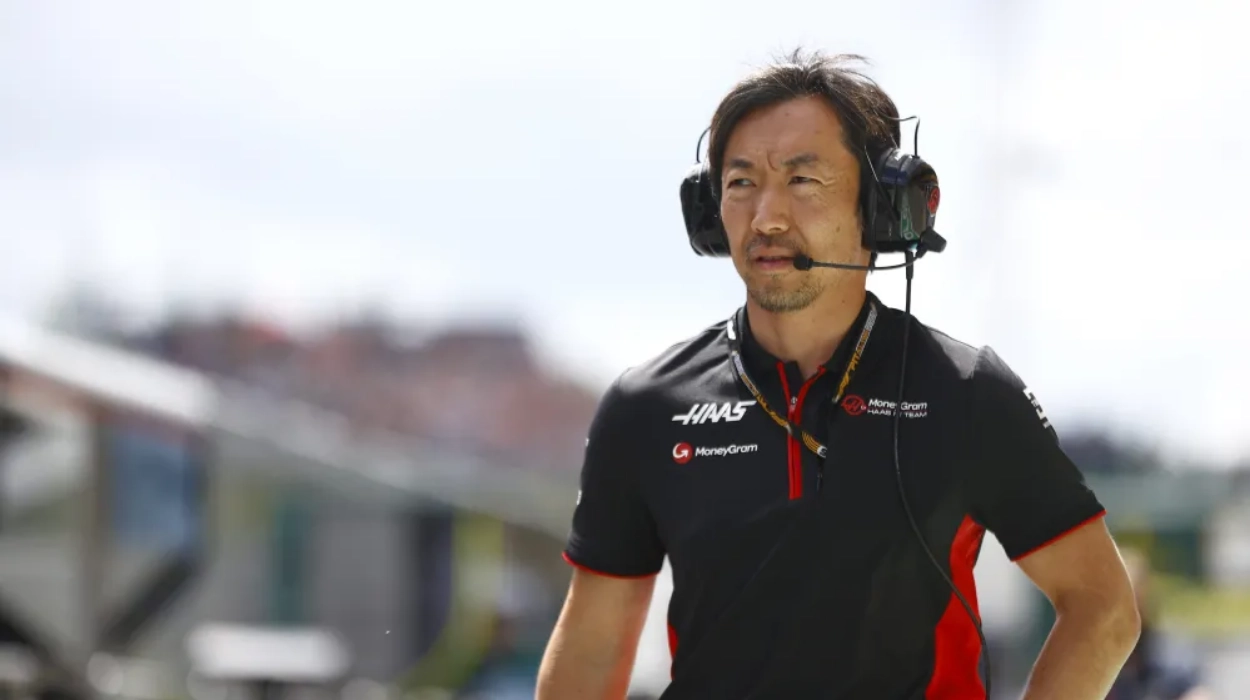
Ayao Komatsu outlined to BBC Sport the multifaceted demands, prioritising energy orchestration in initial Barcelona running:
“What the question will be for everyone is what’s possible for drivers to manage around a single lap and for a racing scenario over multiple laps.”
He stressed scenario modelling pre-testing, admitting collective uncertainty:
“I don’t know if we all understand the full extent of the challenge because we don’t know what we don’t know.”
Aerodynamic validation looms large, with Komatsu satisfied preliminarily but vigilant for rival innovations:
“If we’ve missed something, we need to get on it very quickly.”
The VF-26’s airbox emphasis, diverging from Ferrari’s supplier approach since 2024, exemplifies Haas’ bespoke path.
Esteban Ocon brings experience stability, complementing Bearman’s ascent. Komatsu views the duo as assets in navigating debut gremlins like reliability, which Bearman predicts will scramble early hierarchies.
Driver Reactions to Historic Regulation Shift
Oliver Bearman conveyed enthusiasm to BBC Sport for F1’s “biggest changes in the history,” deeming team preparations positive yet unbenchmarkable pre-Australia:
“We won’t know until qualifying.”
He flagged new-rule teething—errors, breakdowns—prolonging true order discernment.
To Sky Sports, Bearman dissected his evolution:
“I really upped my game… started to put down some really some results that I was really happy with.”
Circuit familiarity accrued from 24 2025 weekends equips him superiorly:
“Having one race weekend’s worth of experience… is going to put me in a much better place.”
Against veterans’ decade-plus laps, his foundational year positions Haas aggressively.
Komatsu reinforced to media the “homework phase” of simulations, underscoring Barcelona’s role in decoding lap dynamics under electrical volatility.
Intensive Pre-Season Testing Roadmap
A trio of evaluations calibrates 2026 machinery: a closed Barcelona shakedown January 26-30, barring media, precedes Bahrain’s public outings February 11-13 and 18-20. Bahrain mornings commence 10:00 local, maximising data amid mileage caps.
Online launches cascade through three weeks, post-Haas. Cadillac’s Silverstone debut Friday featured Valtteri Bottas and Sergio Perez piloting a finned prototype in obscured shots. Red Bull-Ford’s Thursday Detroit spectacle prioritised livery over substance.
These phases precede a fortnight’s refinement for Melbourne’s curtain-raiser: practice March 6, qualifying 7th, grand prix 8th across 24 rounds.
Broader Landscape: Launches, Suppliers, and Expectations
Haas pioneers substantive 2026 imagery, surpassing Cadillac’s evasions and show-car precedents from Red Bull, Racing Bulls. Supplier matrices—Mercedes quartet, Ferrari trio—may homogenise propulsion, amplifying chassis aero’s premium.
Komatsu forecasts four-race stabilisation then flux, propelled by rapid iterations. VF-26 and Cadillac similarities suggest convergence, yet diversity promises intrigue. Sustainable fuels and electric parity herald a greener, visceral F1 epoch, with Haas’ proactive reveal emblematic of midfield ambition.