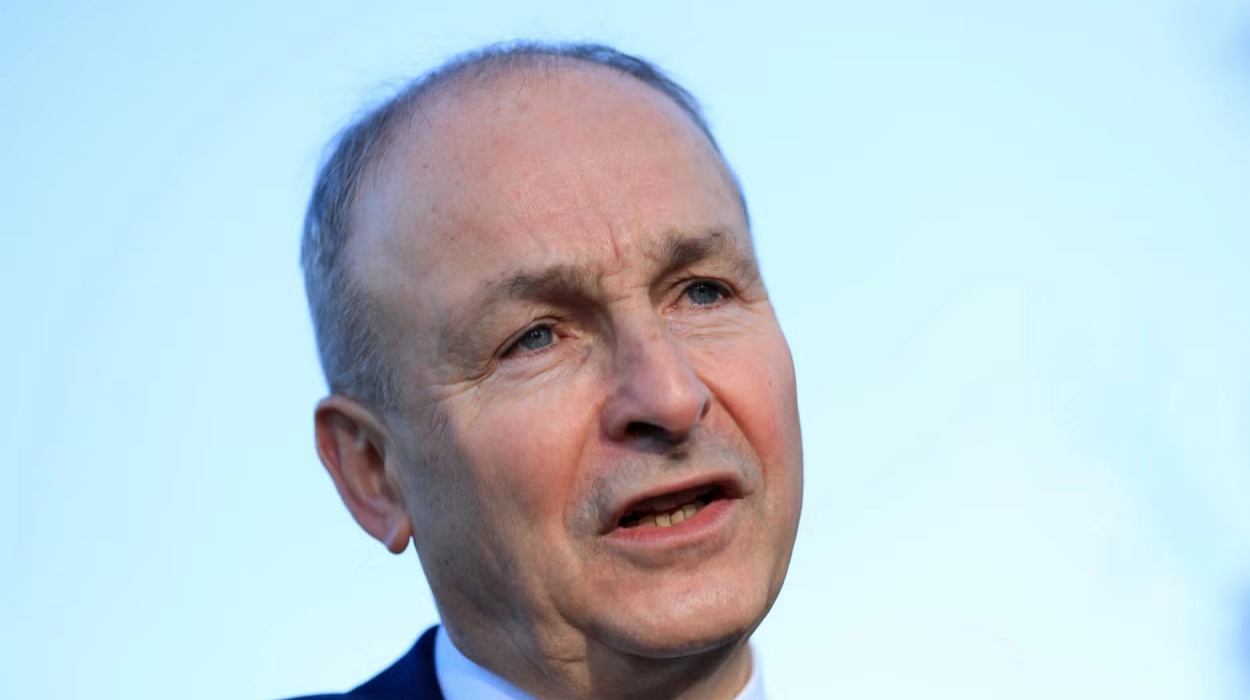
Beijing (Parliament Politics Magazine) – Micheál Martin becomes the first Irish leader in 14 years to visit China, holding talks with Xi and other officials to boost EU-China cooperation.
As reported by The Independent, Ireland’s Prime Minister Micheál Martin will travel to China this Sunday to meet President Xi Jinping, marking the first visit by an Irish leader in 14 years, according to the Chinese Foreign Ministry.
How does Ireland’s PM’s visit to China signal stronger China-EU ties?
Despite disagreements with the EU over tariffs and human rights, China continues to strengthen relations with selected EU member states. During separate visits to Beijing in late 2025, French President Emmanuel Macron and Spain’s King Felipe VI each met with President Xi Jinping.
The Chinese ministry said Martin’s five-day visit will include meetings with Premier Li Qiang and Zhao Leji, head of the National People’s Congress, with travel also planned to Shanghai.
It said China signaled its willingness to strengthen relations with Ireland and promote China-EU cooperation.
Beijing imposed provisional duties of up to 42.7% on EU dairy imports, including milk and cheese, in December. In retaliation for EU tariffs on its electric vehicles, China has launched investigations into European brandy and pork imports.
China will host South Korean President Lee Jae-myung for a four-day visit, during which he will hold his second meeting with Xi Jinping in just two months.
The visit comes amid rising Sino-Japanese tensions, after Japanese Prime Minister Sanae Takaichi said Japan’s military could act if China targeted Taiwan, which Beijing claims as its territory.
Beijing has carried out extensive military drills around the island, issuing a warning to what it called separatist and “external interference” forces.
Before his visit, Lee said in an interview with China’s state broadcaster CCTV that South Korea consistently respects the “One China” policy regarding Taiwan.
What did the US Department of State say about China’s military drills near Taiwan?
The US Department of State said Beijing’s aggressive rhetoric and military drills, which drew strong condemnation from Taipei, have created unnecessary tension.
“China’s military activities and rhetoric toward Taiwan and others in the region increase tensions unnecessarily. We urge Beijing to exercise restraint, cease its military pressure against Taiwan, and instead engage in meaningful dialogue,”
said State Department spokesman Tommy Pigott.
He added,
“The United States supports peace and stability across the Taiwan Strait and opposes unilateral changes to the status quo, including by force or coercion.”
Recently, the US approved an $11 billion arms package for Taiwan, though President Trump said this week that he does not believe China plans to launch an invasion.
He continued,
“I have a great relationship with [Chinese] President Xi [Jinping]. And he hasn’t told me anything about it. I certainly have seen it. They’ve been doing naval exercises for 20 years in that area. Now people take it a little bit differently.”
Why does China claim sovereignty over Taiwan?
Beijing claims there is only one China and that Taiwan has been part of it since ancient times. It cites historical events, including Qing dynasty rule and the 1943 Cairo Declaration, which stated that Taiwan should be returned to China.
The Chinese government views Taiwan’s current separation as a legacy of the civil war and considers the PRC the sole legitimate government representing all of China.
China considers the 1971 UN Resolution 2758, which recognized the PRC as the only lawful representative of China at the United Nations, as affirming its sovereignty over the entire country, including Taiwan.