

UK (Parliament Politics Magazine) – The Office for Budget Responsibility says Brexit trade deals will benefit the UK economy more than Prime Minister Sir Keir Starmer’s EU reset.
As reported by The Telegraph, OBR projections show Brexit trade agreements with global partners will boost Britain’s economy more than Prime Minister Sir Keir Starmer’s EU reset plans.
What did the OBR say about Sir Keir Starmer’s EU reset?
The OBR’s new projections indicate that Labour leader Sir Keir Starmer’s closer ties with Brussels will yield only minimal economic gains, following his recent Brexit remarks.
The fiscal watchdog warned that the agri-food and carbon tax agreements in the Prime Minister’s EU reset will contribute only 0.24% to long-term GDP.
The combined impact of post-Brexit trade alliances with countries including Australia, Japan, and India is projected at 0.38% of GDP.
How did Tory MPs and Eurosceptics react to Labour’s EU reset plans?
Mark Francois, the chairman of the European Research Group of Tory MPs, said,
“Anyone in Labour who thinks the solution to their dire poll ratings is to move towards rejoining the EU or its institutions has lost their marbles.”
He stated,
“As ministers themselves have admitted, we could not have achieved bilateral trade deals with the likes of the US, India and Australia, nor joined the key Trans Pacific Partnership, if we were still in the customs union, which strictly forbids any such independent deals.”
Mr Francois added,
“It’s absolutely true that Starmer remains a Remainer at heart – but he may not remain in No 10 much longer if his MPs carry on like this.”
Eurosceptics warn that aligning UK and EU carbon border taxes may force future UK governments to follow net zero commitments.
The Democracy Movement’s Stuart Coster described Sir Keir Starmer’s EU reset as “a costly flop,” criticizing its economic impact.
He said,
“There are no benefits to gain from a closer relationship with the EU when lower trade barriers for a few exporters are tied to alignment with costly EU regulations that burden businesses across the entire UK economy, whether firms are selling into Europe or not.”
Mr Coster added,
“It would be far more impressive to see the Prime Minister raise his horizons and develop closer links with the high-growth countries of this century, not the last.”
A Labour insider hit back,
“It’s the Tories who failed to make the UK a great trading nation post-Brexit and Nigel Farage who says he’d rip up our deals.”
How did the Government respond to OBR projections on the EU reset and trade deals?
A Government spokesman said,
“The OBR’s figures confirm that the UK’s trade strategy is succeeding on all fronts – the UK is successfully delivering growth through both the EU reset and new global trade deals.”
They added,
“The notion that the UK must choose between the EU and the rest of the world is fundamentally illogical. This Government’s cool-headed approach to trade saw historic agreements secured with the US, India, and the EU, which will grow the economy, back British jobs, and put more money in people’s pockets.”
How will Sir Keir Starmer’s EU reset affect UK trade and economy?
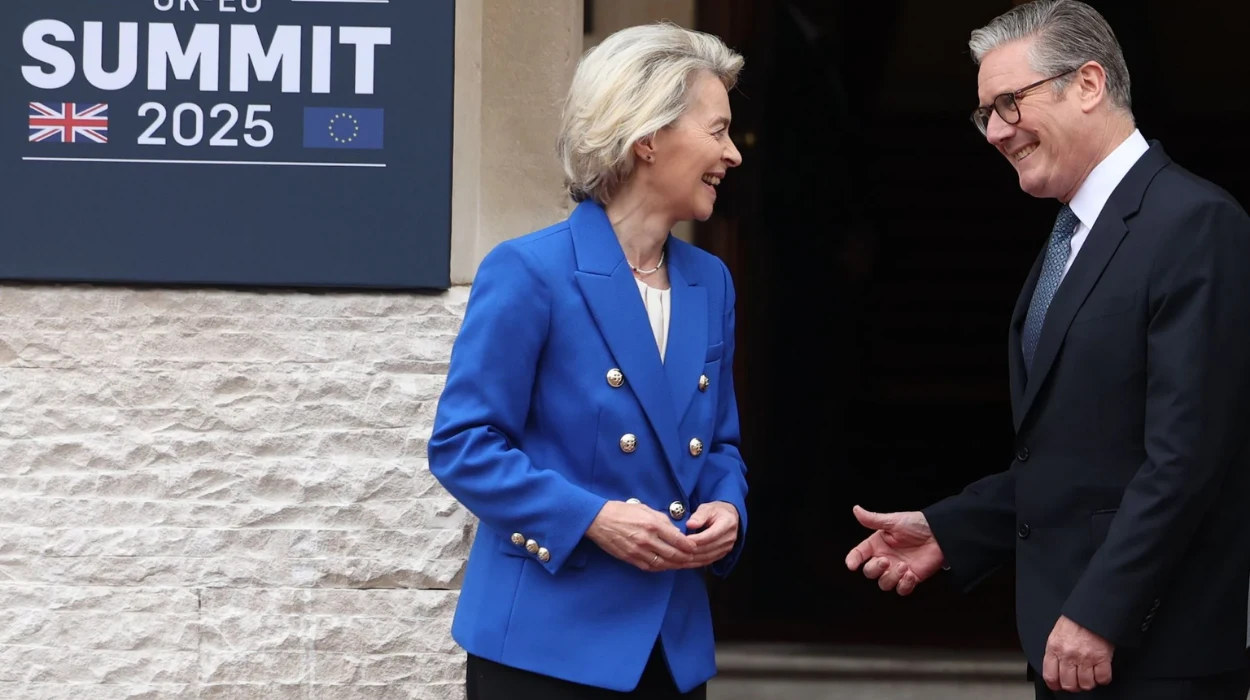
Sir Keir Starmer and EU Commission President Ursula von der Leyen signed an agreement to mark a new chapter in UK-EU relations.
The deal included two key measures: removing nearly all post-Brexit food import checks and aligning UK-EU carbon taxes to ease business red tape.
The Prime Minister called the agreement beneficial for the British economy, describing it as “good for jobs, bills, and borders.”
To finalize the deal, the Labour leader agreed to hand over 12 years of British fishing rights to EU boats.
Under the pact on border checks, Britain is expected to follow parts of the EU food regulations, which could complicate trade negotiations with other countries, especially the US.
What is Brexit?
Brexit refers to the United Kingdom’s exit from the European Union, following the 2016 referendum in which a majority voted to leave. It resulted in the UK leaving the EU’s single market and customs union, ending freedom of movement, and establishing a new trade and cooperation agreement to govern its relationship with the bloc.
Reasons cited for leaving the EU included concerns over immigration, economic control, and the desire for the UK to have greater sovereignty over its laws and borders.