
Eight years ago Pret A Manger signed up to something called the Better Chicken Commitment. The commitment said that by the end of 2026 the company would stop using fast-growing chicken breeds, and switch to birds that grow slower and more naturally. That deadline has now arrived and not one of Pret’s chickens has changed. And instead of getting started, the company has quietly pushed taking any action out to 2031, with a claim of full delivery to 2032, six years past the date it set for itself, and 14 years from its original commitment.
The breed of chicken a company buys is the single biggest decision it makes about how that animal lives. The standard broiler has been bred over decades to reach slaughter weight in around 35 days. It grows so fast that its legs and heart struggle to keep up. Many of these birds go lame. Many sit so long in their own litter that they burn the skin on their hocks. This is what Pret promised to change.
I run Anima – an organisation now encouraging Pret to keep its word. But the promise is Pret’s, not mine. The company chose to make it, in public, with a date attached, saving itself eight years of grace and praise.
2026 was meant to be the year a long list of food companies did this together. Instead the opposite happened. In February, Nando’s, KFC and others all walked away from the same commitment. Pret, to its credit, did not formally leave. It simply stopped short of doing the main thing the commitment asked.
Pret’s answer is that it remains one of the few chains still signed up, and that it has given its chickens more space. Whilst that’s positive, it misses the point. A commitment has little value if it’s not followed through on. That’s an empty promise. The ironic thing is that right now, Pret is selling the exact same fast-growing chickens used by KFC, Nando’s and those other companies that backed out – and whether we should trust that Pret will act this time is the key question.
The honest reason for backing out is cost. Slower-growing birds eat more and take longer to raise, so they cost more to produce. We understand this. But Pret knew the economics in 2018, so did Waitrose which made a full transition to slower growing breeds last year. The commitment was not signed in ignorance of the price (or if it was, what does that say about the value of the commitment?) It was signed because customers were told, and are still told, that this is a business built on natural, honest food and ‘doing the right thing.’ This premium is not a surprise. It is a bill.
So this week we stopped expecting Pret to do the right thing on its own. The past two years of dialogue convinced us that Pret was quiet-quitting. We gave them months of warning that eventually, without concrete action, the matter will have to become public. And here we are.
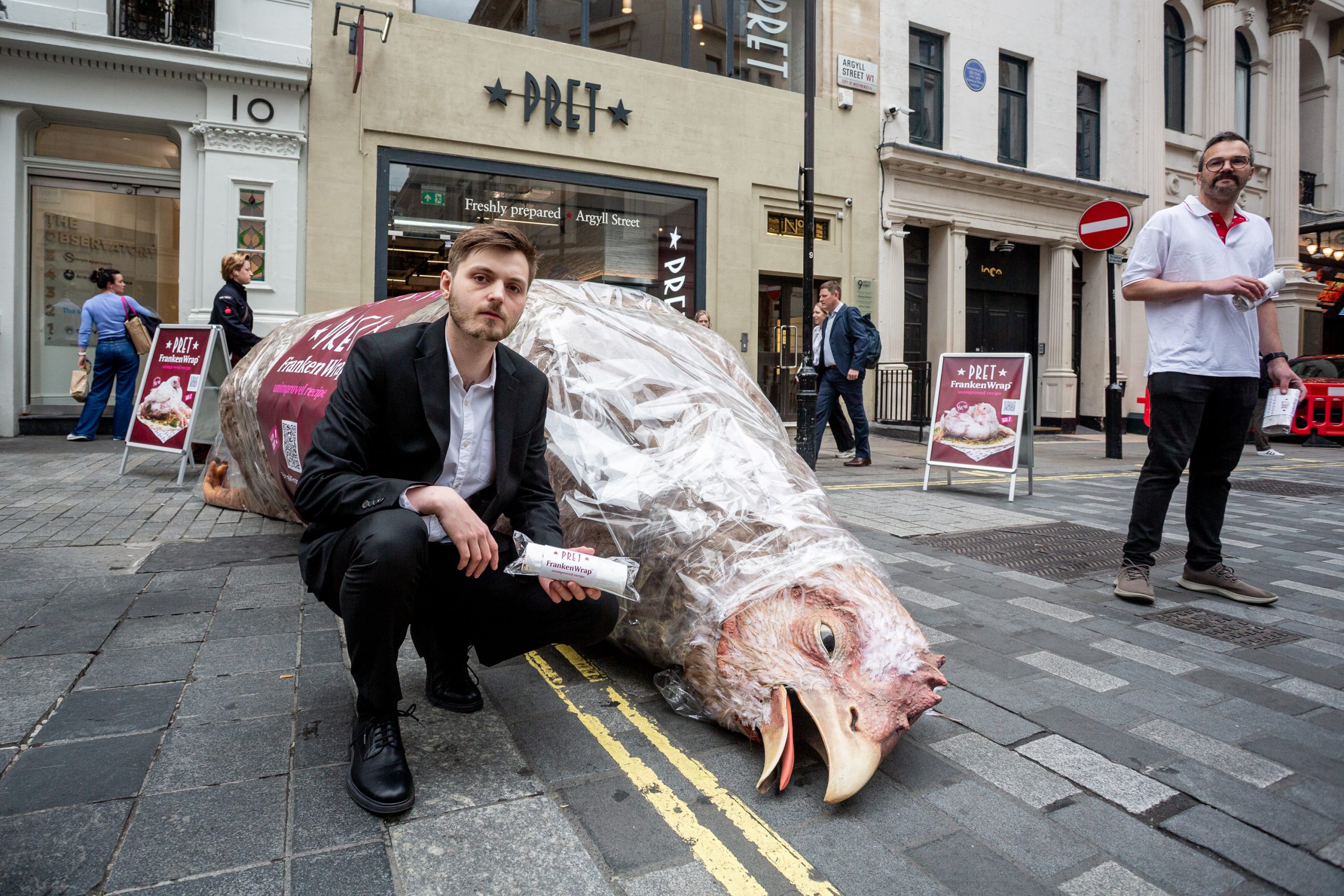
What we’ve launched is unprecedented in a way. It’s a one million pound campaign, the most heavily funded animal welfare campaign ever aimed at a British food company. This week a four-metre animatronic Frankenwrap, billed as the world’s biggest Pret wrap, with a whole fast-growing chicken stuffed inside, appeared outside Pret at Oxford Circus. It has been touring the city alongside posters across the Underground, full-page newspaper ads, and it has been hard for Londoners to miss.
We made it shocking, and a little absurd, on purpose. No customer buying a flat white and a sandwich decided to put fast-growing chickens on Pret’s shelves. Pret’s leadership did. The point of the Frankenwrap is not to shame the person in the queue. It is to tell Londoners, plainly and on Pret’s behalf, what Pret will not tell them itself, and then to give them a way to do something about it by signing a pledge to take a break from Pret.
Pret knows that it can end this campaign whenever it likes. It can produce a credible plan to phase out fast-growing chickens, with steps in the near-term, not in the far future. Until then, we’ll keep on the pressure.
Pret made a promise in 2018 – The bill is now due

5 mins read
Latest from Opinion

Boris Johnson says falling birth rates are not a disaster. It is an attractive argument. Calm,
How coercion, secrecy and abortion can be used to conceal exploitation The crimes of Jeffrey Epstein

I have always considered myself one of the good ones. In the quiet, ongoing battle against

On the 24th October 2023 we lost our 17 year old son Mac, he took his

On Tuesday last week the Supreme Court of the British Indian Ocean Territory blocked the attempt