

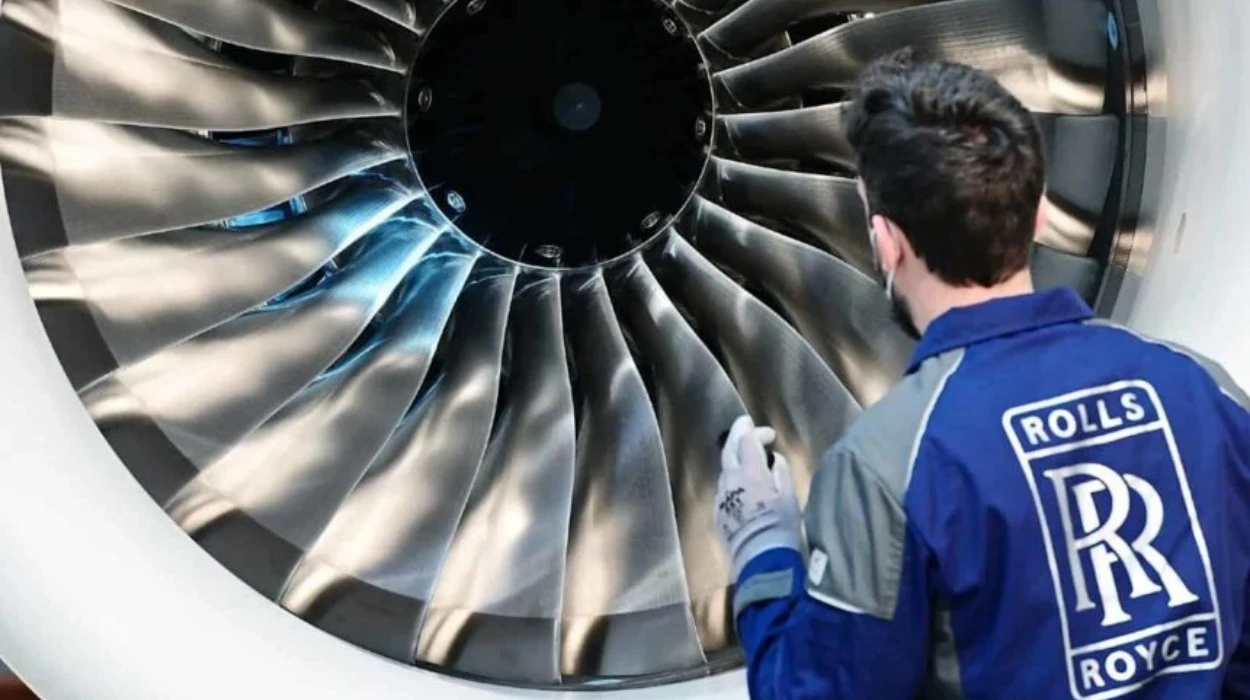
London (Parliament Politics Magazine) January 08, 2026 – Rolls-Royce Holdings plc shares rose 95.45% throughout 2025, closing the year near record highs around 912 pence and pushing market capitalisation above £48 billion. The FTSE 100 engineer’s performance outstripped defence peers and reflected robust civil aerospace recovery alongside steady defence orders.
Investors shifted focus to 2026 cash flow delivery after a landmark turnaround year under CEO Tufan Erginbilgiç.
The company reaffirmed full-year 2025 guidance of £3.1 billion to £3.2 billion in underlying operating profit and £3.0 billion to £3.1 billion in free cash flow before one-offs. Civil aerospace flying hours reached 110% of pre-pandemic levels, driving aftermarket services revenue. Defence and power systems divisions contributed stable growth amid global spending commitments.
Civil aerospace recovery fuels record orders
Rolls-Royce’s civil aerospace unit, its largest by revenue, benefited from airlines expanding widebody fleets with Trent-powered aircraft. The division secured engine orders worth billions, with forward backlog exceeding £80 billion by year-end. Supply chain improvements enabled higher delivery rates for A350 and Boeing 787 engines.
Market commentator David Buik highlighted sector-wide gains in a year-end review. David Buik said in X post,
“DEFENCE SECTOR 2025 – BAE SYSTEMS +48.59%, ROLLS ROYCE +95.45%, QINETIQ +5.14%, BABCOCK +146.63%, RTX Corp +58.09%, LOCKHEED MARTIN +0.29%, THALES +67.01%, LEONARDO +88.64%, RHEINMETALL +158.44%, NORTHROP GRUMMAN +21.84%, GENERAL DYNAMICS +28.98%, BOEING +26.33%”
IG analyst Axel Rudolph noted the stock’s peak alongside FTSE 100 strength. Axel Rudolph said in X post,
“Rolls-Royce shares hit record high as aerospace recovery continues Rolls-Royce stock climbs to fresh peaks alongside the FTSE 100, supported by strong civil aerospace demand and defence spending commitments.”
Defence contracts bolster steady revenue growth
Defence propulsion secured multi-year deals under AUKUS and UK submarine programmes, with orders totalling billions. Power systems saw demand from data centres and marine sectors, posting double-digit growth. These segments provided balance against aerospace cyclicality, supporting overall margin expansion to around 28%.
The balance sheet strengthened with net cash over £4 billion, funding £1.5 billion in buybacks and the first dividend since 2019 at 3.3 pence per share. Pension deficit elimination through contributions and disposals removed a long-standing overhang.
CEO Erginbilgiç drives turnaround execution
After joining in 2023, Erginbilgiç implemented the “Destination 28” plan targeting £10 billion profit by 2028 via cost cuts exceeding £1 billion annually. Non-core assets like ITP Aero stakes were divested, sharpening focus on high-return areas including small modular reactors. Investor Piyush Dutta praised this strategic reset amid volatility.
Piyu said in the X post,
“There are corporate turnarounds. And then there is what Rolls-Royce has executed over the last few years. Its a fascinating story.From crisis, heavy losses and investor scepticism, Rolls-Royce has repositioned itself as one of the standout performers on the FTSE 100.
In just a few days of 2026, the shares are up ~9%, materially outperforming the broader index. This is the market recognising a structural shift in how the business is run.This is an unusual story of leadership and strategy tightly fused with relentless execution.
When Tufan Erginbilgiç joined as CEO in 2023, he was unusually direct with his diagnosis. He described the organisation a “burning platform.” For a company of Rolls-Royce’s stature, this was a jolt.This directness from a new CEO removed any illusion that incremental improvement would be enough going forward.
More importantly, it challenged long-held beliefs like the legacy contracts, entrenched structures and even some elements of the culture that had historically been a source of pride.Leaders often under-diagnose problems to avoid discomfort and preserve stability.
In this case, the choice was the opposite. The danger was deliberately called out so that it could unlock bolder decision-making.The strategic reset that followed was grounded in economics. Margins, cash generation and ROCE discipline became decision filters. The Rolls-Royce story is about making consistent hard choices.
This started with intent on moving from “winning every deal” to consciously walking away from value-destructive contracts and making profitability as non-negotiable. Equally important were the choices of focus: doubling down on businesses with long term demand and attractive returns on core aerospace, defence, power systems and future-forward platforms, like the SMR(Small Modular Reactors) and advanced product engineering.
None of this came with any certainty. With Covid in the background, there was geopolitics volatility and macro uncertainty. This was leadership through ambiguity.If there is one lesson to take from the Rolls-Royce turnaround, it is this- courageous leadership requires brutal honesty. Progress follows when clear and focused strategy rooted in commercial pragmatism is combined with decisive execution. Ultimately the market rewards bold leadership.”
Five-year transformation lifts valuation
From pandemic lows, shares delivered over 10-fold returns by end-2025, with employees as major shareholders through incentives. Tech observer SV_Techie drew parallels to steady industrial performers.
SV_Techie said in X post,
“While we focus on semis gaining massive growth, look at boring biz like rolls Royce – 10x in 5 years. They are the backbone of aviation engines.”
Consensus forecasts projected 2026 revenue at £21.5 billion and EPS near 29 pence, with dividends rising to 9.3 pence. Credit upgrades to BBB+ by S&P reflected balance sheet progress, including bond repayments.
Analyst views on 2026 momentum
Post-year-end consolidation saw shares stabilize around 1,100-1,200 pence after peaking above 1,200 pence. Analysts like JPMorgan set targets over 1,000 pence, citing widebody exposure. Support held at 1,100 pence, maintaining the uptrend structure.
Andrew Ashworth commented on leadership’s value creation. Andrew Ashworth said in X post,
“Rolls Royce’s CEO has increased the value of the company over 10 fold by overseeing structural changes and renegotiating contracts. Shares have increased 1 thousand+% since his appointment. Employees are major shareholders. Is this “theft” or wealth “creation”?”
Guidance upgrades in July 2025 followed half-year strength, with margins and flying hours exceeding expectations. R&D investments in UltraFan and hydrogen technologies supported long-term aviation shifts.
Order backlog secures multi-year visibility
Rolls-Royce Holdings plc reported robust order backlog growth, securing multi-year revenue visibility amid favorable industry tailwinds. The total backlog reached £78 billion, representing exceptional forward cover with 85% of expected 2026 revenues already contracted, a testament to sustained customer confidence in the company’s civil aerospace, defence, and power systems portfolios.
Key new deals bolstered this position, including engine supply agreements for Qatar Airways’ expanding widebody fleet and COMAC’s C919 narrowbody program in China, which together added substantial large-engine orders and highlighted Rolls-Royce’s strategic foothold in high-growth Middle Eastern and Asian markets.
These contracts not only offset prior supply disruptions but also positioned the group for accelerated production ramps, with management signaling confidence in meeting ambitious delivery targets through 2028. Labour stability played a pivotal role in operational recovery, particularly following resolution of protracted UK strikes that had hampered output at critical sites like Derby and Bristol.
With industrial relations normalized, the company ramped up hiring across engineering, manufacturing, and supply chain functions, adding over 1,500 skilled roles in the quarter to support engine final assembly lines and test facilities.
This workforce expansion, coupled with £500 million in targeted capital investments, enabled a 12% year-on-year increase in large-engine deliveries, primarily for Trent XWB and UltraFan variants powering Airbus A350 and future A350-1000 aircraft. Supply chain partnerships further de-risked growth, locking in long-term contracts for strategic materials like titanium forgings and composite blades, mitigating inflation pressures and ensuring raw material availability for a projected 20% production uplift in 2026.
Historical rally outpaces FTSE peers
Rolls-Royce’s stock delivered a remarkable historical rally in 2025, significantly outpacing its FTSE peers and cementing its position as one of the index’s top performers alongside BAE Systems. The FTSE 100 itself posted an impressive 8% gain for the year, reflecting broader market resilience amid global economic uncertainties, but Rolls-Royce’s surge stood out as a testament to the company’s dramatic turnaround from the depths of the pandemic.
In 2020, the aerospace and defense giant had suffered staggering losses totaling around £5 billion, grappling with grounded civil aviation fleets, supply chain disruptions, and a sharp contraction in demand for its engines and services.
Yet, by 2025, strategic creditor restructurings including debt-for-equity swaps and extended maturities negotiated with banks and bondholders provided crucial breathing room, allowing management to stabilize finances and refocus on core operations. This recovery was not merely financial; it was underpinned by operational excellence, as Rolls-Royce ramped up production of its UltraFan demonstrator and pearl engines, which promise 25% fuel efficiency gains over current models.
Sustainability became a cornerstone of the narrative, with the firm committing to net-zero emissions by 2050 through innovations like hydrogen-capable pearl engines and small modular reactors for naval propulsion, aligning with investor demands for green transitions in heavy industry.
