
UK (Parliament Politics Magazine) – UK officials report a Russian submarine followed the Yantar near critical pipelines, raising concerns over increased underwater operations.
As reported by Bryony Gooch of The Independent, British authorities say Russia deployed a submarine and an intelligence ship to map sensitive undersea infrastructure off the UK coast.
How did Russian submarines and the Yantar track Britain’s undersea pipelines?
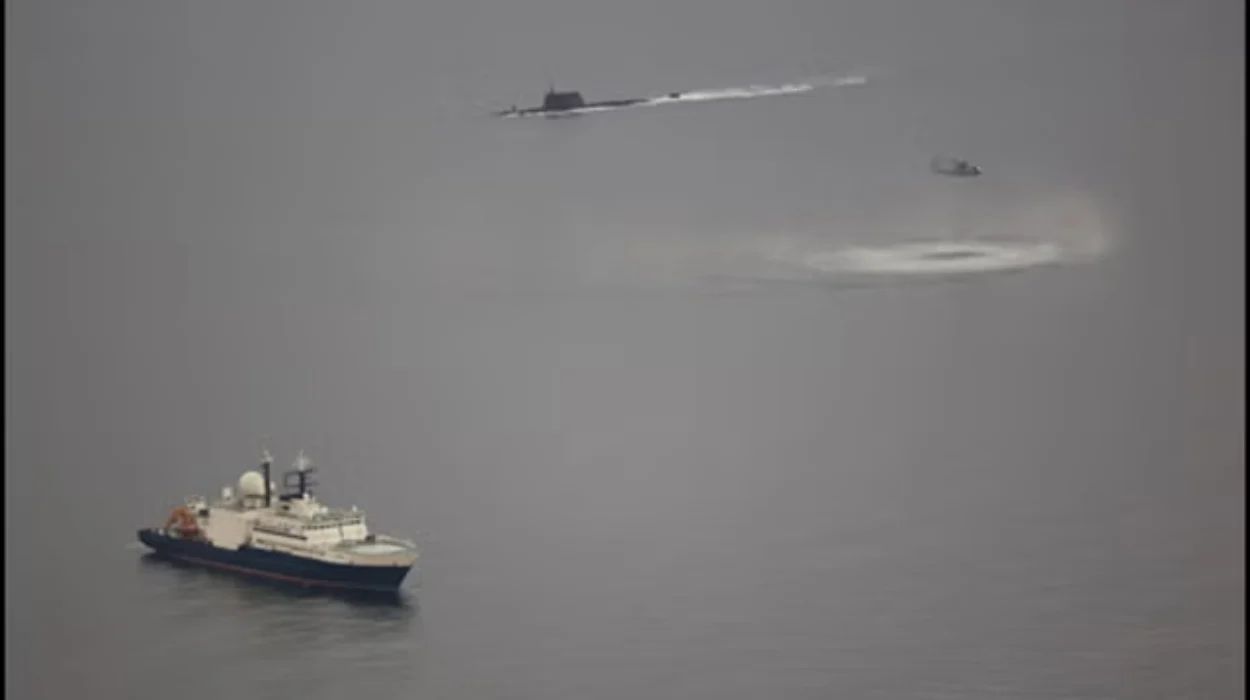
The Ministry of Defence has published a photo showing a submarine following the Yantar, a Russian research vessel reportedly mapping the gas pipeline between Britain and Ireland. It remains unclear whether the escort was a purpose-built Russian attack submarine.
The image reveals a Merlin Mk2 helicopter monitoring the Yantar in the Irish Sea from November last year, with a British submarine also appearing on the surface.
According to The Sunday Times, this appears to be one of several operations in which Russian submarines have accompanied the Yantar near British waters.
Earlier this month, First Sea Lord General Sir Gwyn Jenkins warned that Russian incursions into UK waters have increased by 30 per cent over the past two years.
He said the activity is the most visible sign of Russian operations near UK waters, but warned,
“It’s what’s going on under the waves that most concerns me.”
Sir Gwyn stated last week that Russia is expanding its elite deep-sea submarine division, while Britain sanctioned the military agency this June for its role in Russia’s underwater intelligence operations.
According to the government, its Atlantic Bastion programme, integrating AI-enabled sensors, warships, aircraft, and autonomous vessels, will protect vital undersea networks and help the UK and NATO counter Russia’s submarine threat.
An MoD Spokesperson said,
“As the Defence Secretary has said, our message to President Putin is clear: We see you, we know what you are doing, and we will not shy away from robust action to protect this country. We are acutely aware of the threat posed by Russia, which includes attempts to map undersea cables, networks, and pipelines belonging to both the UK and our allies, and we are tackling these threats head on.”
They stated,
“That is why the Prime Minister set out the biggest sustained increase in defence spending since the Cold War, including a commitment to increase spending to 2.5 per cent of GDP from April 2027, and an ambition to spend 3 per cent of GDP in the next parliament, as economic and fiscal conditions allow. In addition, we have introduced 900 new sanctions against individuals, entities and ships under the Russia regime, and accelerated the development and deployment of advanced anti-submarine technology.”
What did John Healey say about Russia’s spy ship Yantar near UK waters?
Last month, Defence Secretary John Healey warned that the Yantar had been spotted near the northern edge of UK waters over the past few weeks.
He stated that this was the second deployment of the ship off UK waters, describing it as “designed for gathering intelligence and mapping undersea cables.”
Mr Healey said the ship had “directed lasers” at pilots of surveillance aircraft, calling the Russian action “deeply dangerous.”
The defence secretary added,
“We deployed a Royal Navy frigate and RAF planes to monitor and track this vessel’s every move, during which the Yantar directed lasers at our pilots.”
He warned Moscow and Russian President Vladimir Putin,
“We see you, we know what you’re doing, and if the Yantar moves south this week, we are ready.”
The Defence Secretary’s remarks follow an MPs’ report warning that Britain has no clear plan to defend against a military attack, despite government promises to enhance readiness with new arms factories.
Mr Healey stated that 13 locations across Britain have been identified for new military explosives and munitions factories, with construction on the first site expected to begin next year.
The UK has promised to raise defence spending to 2.5% of GDP by 2027 and aims to reach 3.5% in the long term to strengthen its defence against possible threats.