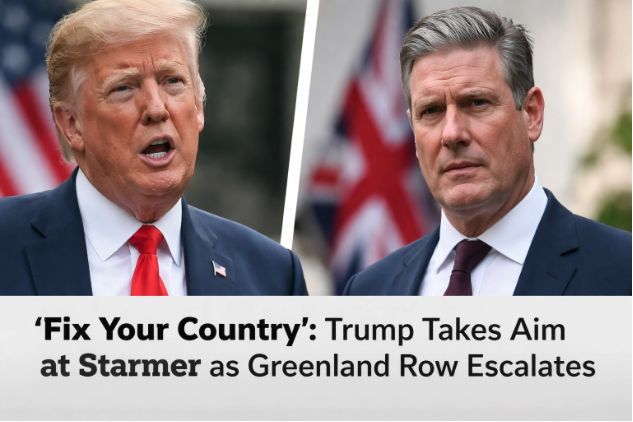
The transatlantic alliance hasn’t looked this fragile in decades. Just days into his second term, Donald Trump has set his sights firmly on European leaders: and Keir Starmer appears to be squarely in the crosshairs.
In a remarkable exchange that’s sent shockwaves through diplomatic circles, the newly inaugurated US president told the British Prime Minister to “fix your country” while doubling down on his territorial ambitions for Greenland and threatening fresh tariffs against the UK and EU.
So what exactly is going on, and why does it matter? Let’s break it down.
Donald Trump has never been one to mince words, but his latest salvo against Keir Starmer represents a significant escalation in rhetoric between two nations that have long prided themselves on their “special relationship.”
The president’s “fix your country” comment came as part of a broader attack on British foreign policy decisions, with Trump specifically targeting what he called the “stupidity” of the Chagos Islands deal.
For those who need a refresher, the UK government recently agreed to hand sovereignty of the Chagos Islands to Mauritius, while retaining a lease on the strategically vital Diego Garcia military base. The deal has proven controversial, with critics arguing it undermines British interests in the Indian Ocean and sells out the Chagos islanders.
Trump’s criticism adds an international dimension to that debate. The US has significant military assets on Diego Garcia, and the incoming administration clearly has concerns about the long-term implications of the handover.
If you thought Trump’s interest in purchasing Greenland during his first term was a passing fancy, think again. The president has returned to the White House with renewed determination to bring the Danish territory under American control.
This time, however, the approach has taken on a distinctly more aggressive tone.
Trump has:
• Posted an AI-generated image depicting Greenland draped in the American flag
• Refused to rule out military intervention to secure the territory
• Threatened 10% tariffs against both the UK and EU if Denmark refuses to sell
• Declared that “the world is not secure unless we have complete and total control of Greenland”
The strategic rationale isn’t entirely without merit. Greenland sits atop vast mineral reserves, including rare earth elements crucial for modern technology. Its Arctic location also offers significant military advantages as climate change opens new shipping routes and tensions with Russia and China intensify in the region.
But the methods being proposed represent a dramatic departure from post-war international norms. NATO allies simply don’t threaten military action against each other: or at least, they didn’t until now.
European leaders have responded to Trump’s territorial ambitions with a mixture of defiance, mockery, and strategic planning.
At the World Economic Forum in Davos, Belgian Prime Minister Bart De Wever delivered perhaps the most memorable rebuke, comparing Trump to the Very Hungry Caterpillar: the children’s book character famous for its insatiable appetite.
The comparison drew laughs from the assembled global elite, but the underlying message was deadly serious. European leaders are watching with alarm as an American president openly discusses absorbing the territories of allied nations.
French President Emmanuel Macron struck a more combative tone, emphasising that Europe would not show “respect to bullies.” His comments reflect a broader shift in European thinking about the transatlantic relationship: one that prioritises strategic autonomy over traditional deference to Washington.
European Commission President Ursula von der Leyen has moved beyond rhetoric to propose concrete action. Her five-point plan for Arctic security represents the EU’s most comprehensive response yet to Trump’s Greenland ambitions.
The plan reportedly includes:
1. Enhanced military cooperation with Denmark
2. Increased investment in Arctic infrastructure
3. Strengthened intelligence sharing among EU member states
4. New diplomatic initiatives with other Arctic nations
5. Economic incentives to reinforce Greenland’s ties with Europe
Whether these measures will be sufficient to deter American pressure remains to be seen. But they signal that Europe is preparing for a world where it can no longer take American friendship for granted.
Back in Westminster, Keir Starmer finds himself in an unenviable position. The Prime Minister held an emergency Downing Street press briefing following Trump’s comments, calling for “calm discussion between allies” and insisting that a trade war is in “no one’s interests.”
Crucially, Starmer ruled out retaliatory action against the US: a stance that has drawn criticism from some quarters but reflects the practical realities of Britain’s post-Brexit position.
The UK needs a trade deal with America. The British economy cannot afford a prolonged tariff war with its largest single-country trading partner. And the defence relationship between the two nations remains fundamental to British security policy.
But there are limits to how much provocation any British leader can absorb without response. Trump’s personal attacks on Starmer, combined with his criticism of British foreign policy decisions, test those limits in ways we haven’t seen since the Suez Crisis.
Trump’s threat of 10% tariffs against the UK and EU isn’t just diplomatic posturing: it would have real economic consequences.
British exports to the United States totalled approximately £60 billion in 2025. A blanket 10% tariff would effectively act as a tax on those goods, making them less competitive against American-made alternatives.
Sectors likely to be hardest hit include:
• Automotive manufacturing
• Aerospace
• Pharmaceuticals
• Scotch whisky and other food and drink exports
• Financial services (though services trade is more complex)
• The EU faces similar exposure, with total exports to the US running into hundreds of billions of euros annually.
• The EU faces similar exposure, with total exports to the US running into hundreds of billions of euros annually.
The coming weeks will be crucial in determining whether this diplomatic spat escalates further or finds some path to resolution.
Several key questions remain unanswered:
Will Denmark negotiate? Danish leaders have consistently maintained that Greenland is not for sale. But sustained American economic pressure might eventually force some kind of accommodation: perhaps enhanced military cooperation or resource-sharing agreements short of full sovereignty transfer.
How far will Trump push? The president’s unpredictability is both his greatest political asset and his biggest diplomatic liability. Markets and allies alike struggle to distinguish genuine policy intentions from negotiating bluster, but the threat of taking Greenland by force has been made and repeated.
Can Europe present a united front? The EU has often struggled with foreign policy coordination. Trump’s pressure may either forge greater unity or expose familiar divisions between member states with different relationships with Washington. France, Germany and Denmark are likely to pursue the toughest lines; Italy has been more cautious, while the jury is out on what Hungary will do.
What role will the UK play? Post-Brexit Britain has sought to position itself as a bridge between America and Europe. That role becomes considerably more difficult when forced to choose sides in an escalating confrontation. While the direct attacks on Sir Keir Starmer over the Chagos deal has significantly undermined the PM’s role as chief ‘Trump whisperer’.
Beyond the immediate drama, Trump’s behaviour signals something more fundamental about the changing nature of international relations.
The rules-based international order that has governed Western diplomacy since 1945 rests on certain assumptions: that territorial boundaries are sacrosanct, that allies don’t threaten each other with military force, and that disputes are resolved through negotiation rather than coercion, but as Antonio Guterres, Secretary General of the United Nations, told the BBC this week: “There are those that believe the power of law should be replaced by the law of power”.
Trump’s Greenland gambit challenges all three assumptions. Whether that represents a temporary aberration or a permanent shift in American foreign policy will shape global politics for years to come.
For now, European leaders are watching, planning, and hoping that the Very Hungry Caterpillar eventually gets full.